
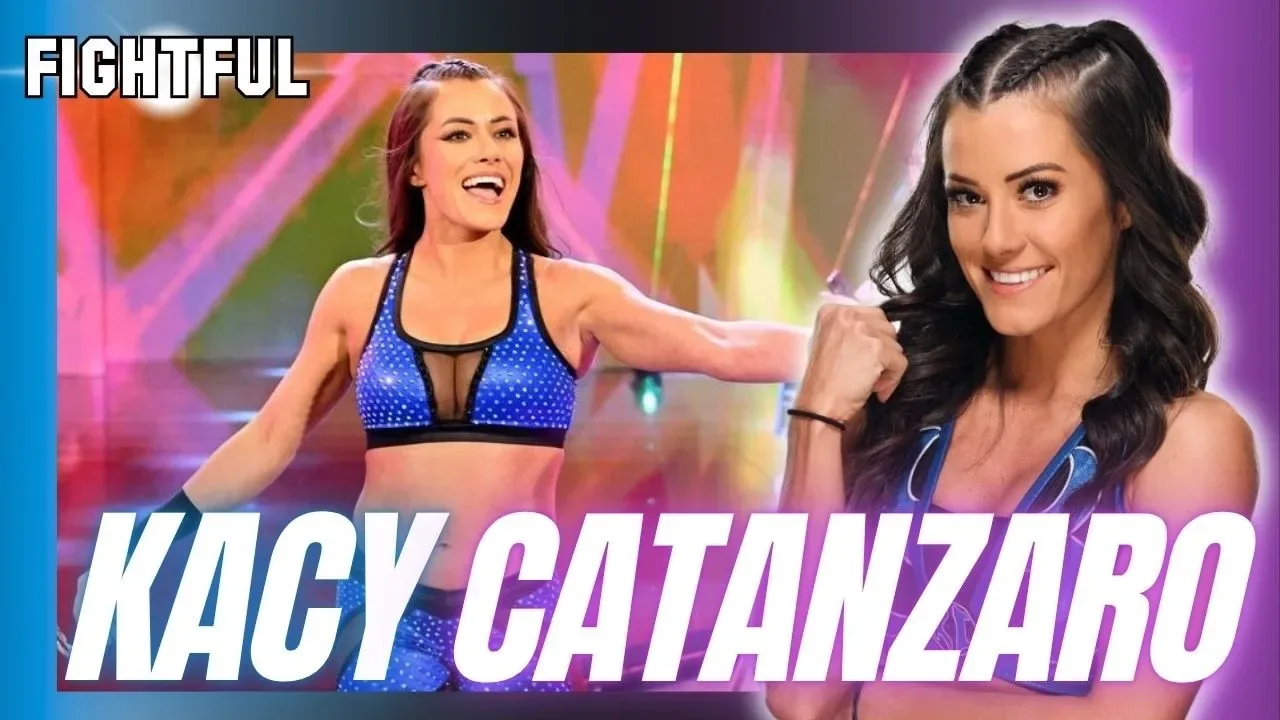
Kacy Catanzaro’s 2019 Royal Rumble appearance lasted just 10 minutes, but one moment from that performance has continued to resonate with WWE fans years later. Entering the Women’s Royal Rumble at No. 19, Catanzaro delivered an elimination escape that immediately separated her from the rest of the field: after being sent toward the floor, she caught herself in a handstand and maneuvered back toward safety rather than allowing both feet to touch down.
For Catanzaro, the spot remains among the proudest moments of her WWE career. It arrived at a critical point in her development, when she was still very new to the company and was being introduced to a much larger audience on one of WWE’s biggest annual events.
“Definitely my 2019 Royal Rumble save,” Catanzaro said when asked about a major moment from her career. “I would say that’s one of my bigger ones just because I was so new and it was such a big moment and years later when I would meet people they’d be like, ‘I loved your Rumble save.’”
Catanzaro said the response has endured well beyond the night itself. While the Royal Rumble format is built around surprise entrants, rapid eliminations and the unpredictable race to the finish, an inventive save can give a wrestler a lasting identity within the match. Catanzaro’s athletic background and willingness to use it in a wrestling-specific way made the sequence feel distinct, and she believes that is why it has remained in viewers’ memories.
For more background on this topic, read Shayna Baszler Reflects on Pure Fusion Collective’s Short WWE Run and TNA Reunion.
“It was just something that kind of stuck in people’s minds and for how new I was, it was just such a big moment that I’m super proud of that,” she said.
A challenge created by the main-roster environment
The moment was not simply a case of Catanzaro arriving with a fully formed plan and executing it exactly as envisioned. She explained that WWE had wanted her to deliver something suited to her particular style when she was selected for the Rumble. However, the physical setup at a main-roster event created a problem for the type of spot she had previously been using in NXT.
Catanzaro had experience climbing and incorporating the ring post into her offense and movement in NXT. At the Royal Rumble, though, the posts were a significantly different obstacle. Rather than the comparatively narrow metal posts she had worked around at the developmental brand, the main-roster setup featured much wider, triangle-shaped screens. That changed the calculation completely.
“So I know that when I was being put in the Rumble they had said, ‘We want you to do something cool, something that is your style,’ because that’s what I was doing,” Catanzaro recalled. “I remember the posts on the main roster are so much bigger than the post in NXT. They’re triangle screens basically. Whereas in NXT, it’s just like a metal post.”
What had seemed practical in NXT was no longer an option under the conditions of the Rumble match. Catanzaro said she initially considered climbing the structure, but quickly realized the surface was too wide and too slippery to make that approach workable. The challenge then became finding an alternate way to give WWE the athletic visual it was seeking while also making sure the moment could be performed safely and convincingly.
“In NXT, I was climbing the post and doing fun stuff with that,” she said. “They’d mentioned that. I was like, ‘I can’t climb this. It’s so wide and slippery.’ I was like, ‘I can’t climb this. What can I do?’ Because they brought me here to do this cool thing and I can’t do it.”
That uncertainty led Catanzaro to build the handstand save around the dimensions of the equipment rather than trying to force her original idea onto a setup that did not accommodate it. Instead of scaling the post with her feet, she was able to use the width of the structure to wrap her legs around it. The adjustment produced a sequence that looked strikingly different from a traditional save and leaned into the balance, body control and spatial awareness that had long been central to Catanzaro’s athletic presentation.
Finding her own version of a Royal Rumble escape
Royal Rumble saves have become a notable part of WWE’s annual battle royal tradition. They offer wrestlers an opportunity to display creativity while playing with one of the simplest rules in the match: a competitor is eliminated after being thrown over the top rope and having both feet touch the floor. Because the rule is so clear, the audience immediately understands the danger whenever someone is left hanging in an unusual position near ringside.
Catanzaro cited Kofi Kingston and Trinity as major inspirations as she tried to determine what kind of escape could fit her own strengths. Both had established reputations for memorable, imaginative near-eliminations. But Catanzaro’s goal was not to repeat an existing idea. She wanted to create a save that reflected what she could uniquely bring to the match.
“Obviously, Kofi and Trinity were huge inspirations to me,” Catanzaro said. “So was like, ‘How can I do my own kind of save with giving them something they wanted to see?’”
The answer was the handstand. With the wider post available to brace against, Catanzaro found a way to make the position work. She described the final outcome as a process in which the pieces came together once the right approach had been identified.
“So we had made the handstand happen and because it was so wide, I was able to wrap my legs around it instead of climbing up it with my feet and it just pieced together,” she said.
The sequence is a useful example of how a highlight in professional wrestling can emerge from problem-solving rather than a rigidly fixed blueprint. The initial concept had to change because the environment did not match what Catanzaro was accustomed to using. Rather than abandoning the effort to create a standout entrance into the match, she and the people involved adapted the idea to the available structure. The final image was memorable precisely because it did not look like a standard recovery from an apparent elimination.
For a performer making only her first Royal Rumble appearance, the spot also established an immediate connection between Catanzaro’s athletic abilities and WWE’s storytelling framework. She was not merely performing an impressive maneuver in isolation; she was using that skill set to survive within the rules of a major match. That distinction helped make the moment accessible to viewers in the arena and at home, whether they were already familiar with her work or seeing her on that stage for the first time.
Confidence built through collaboration
Catanzaro also reflected on a broader part of her in-ring experience: the recurring doubt that can come with being presented with an ambitious idea. She said she often questioned whether she could execute a proposed move or sequence, particularly when the concept involved high-risk positioning or a demanding level of coordination. Still, she stressed that she was surrounded by people who believed in her abilities.
“I want to say all the time that I felt that way,” Catanzaro said when asked whether she had been given ideas she was not immediately sure she could pull off. “But luckily, I was surrounded by people who really believed in me.”
Among the collaborators she named was Lacey, whom Catanzaro described as highly creative. Catanzaro recalled that Lacey would suggest visually ambitious ideas, including situations where Catanzaro would be positioned on her shoulders before diving head first. Those pitches could understandably prompt hesitation, but Catanzaro said Lacey’s confidence helped turn uncertainty into a process of trying the idea and seeing what was possible.
“Honestly a lot of the times I wasn’t sure if I could do something, it was Lacey pitching it to us like, ‘Hey, we should do this,’ and I was like, ‘Can I do it?’ Because she’s very creative,” Catanzaro said. “It was always something really cool, but I was the one on top of her shoulders diving head first and I was like, ‘Can I do that?’”
Catanzaro said the encouragement was consistent. “She was so supportive that she was like, ‘No, I know we can do this,’” Catanzaro recalled. “We would try it out and be able to do it.”
She also pointed to TJ as another important creative influence, praising his mind for wrestling and the ideas he brought to the group. In Catanzaro’s telling, the dynamic was not about eliminating nerves altogether. Instead, it was about having trusted collaborators who could help test the boundaries of what she believed she could do.
“TJ was always really, really helpful and he has such a great mind,” Catanzaro said. “He would give us stuff and I’d be like, ‘Can I do that?’ But that was part of why I loved it, it’s just really challenging myself and figuring out what are your limits and finding them.”
That mindset provides important context for the 2019 Royal Rumble save. The handstand was a polished, viral-ready visual by the time it reached the audience, but Catanzaro’s recollection makes clear that it began with doubt, changed plans and a need to adapt to an unfamiliar setting. It ultimately became one of the defining images of her early WWE run because it captured both sides of her presentation: elite athleticism and the determination to find a solution when the expected route was unavailable.
Years later, fans continue to bring up the save when they meet Catanzaro. For her, that continued recognition is the clearest indication that the risk and the adjustment were worthwhile. What started as an attempt to do “something cool” in her style became a Royal Rumble memory that has outlived the 10 minutes she spent in the match.

Darryl Polo
Darryl Polo is a passionate wrestling fan covering WWE, AEW, TNA and beyond. He loves great rivalries, breakout stars and the moments that keep fans talking long after the bell. How we work.