
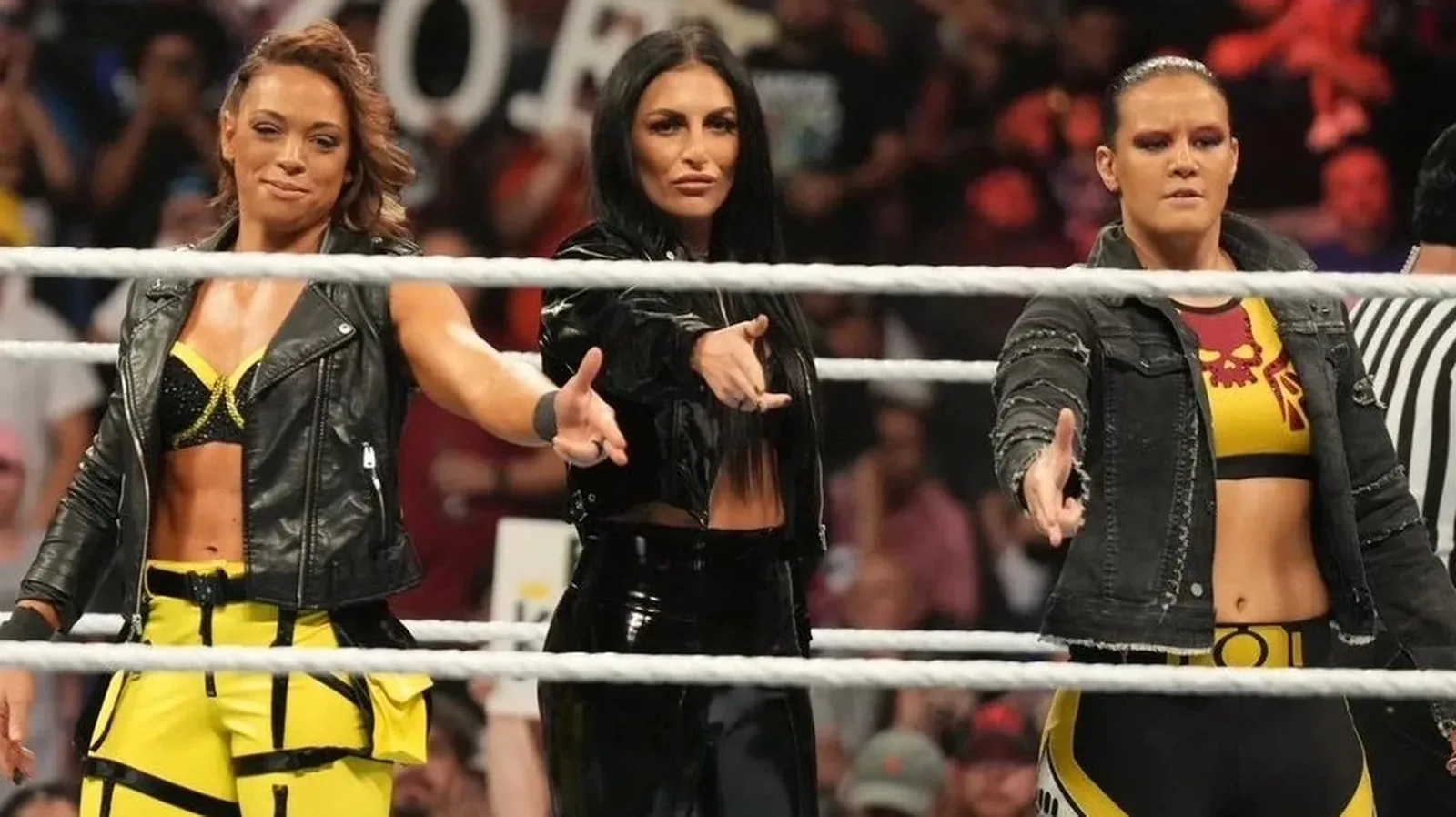
Shayna Baszler believes the Pure Fusion Collective had the ingredients to become a major force in WWE, but says the faction never received enough time or runway to turn its potential into a sustained on-screen success.
The group brought together Baszler, Zoey Stark, now competing as Zoey Serrano, and Sonya Deville, who now uses the name Daria Rae. Each woman entered WWE with a reputation for legitimate combat sports experience, and the alliance was built around that credibility. On paper, the presentation was clear: three hard-nosed competitors with MMA backgrounds, a shared willingness to fight, and the ability to disrupt the women’s divisions across WWE programming.
In practice, however, the Pure Fusion Collective existed for less than a year. The trio came together during the summer of 2024 and had effectively come apart by late spring 2025, amid major changes for all three performers. Deville’s WWE contract expired without a renewal option, while Baszler was released from her own deal. Stark remained with the company for a time before she, too, was released nearly a year later as part of WWE’s annual post-WrestleMania roster cuts.
All three have since landed in TNA in different capacities. Baszler and Serrano have reunited inside the ring and are now the Knockouts World Tag Team Champions following their victory at Bound for Glory. Rae, meanwhile, has become a key authority figure as TNA’s on-screen Director of Operations.
For more background on this topic, read Cathy Kelley Signals Interest in Hosting Love Island UK After Maya Jama Exit.
Baszler Says the Group Had Big Expectations
Speaking with Denise Salcedo, Baszler looked back at the faction’s beginnings and explained that the members had reason to believe WWE was preparing a substantial direction for them.
“I don’t feel like we ever really got our wheels on the ground with that,” Baszler said.
That assessment is especially notable given the thought that initially went into the group’s concept. Baszler revealed that Paul “Triple H” Levesque had approached her about potentially expanding the act with another wrestler who fit the group’s physical identity.
“Hunter had pulled me aside” and asked whether she knew another “brawler shooter” who could be added to the group, Baszler said.
For Baszler, that conversation suggested the Pure Fusion Collective could have been more than a temporary partnership. It created the impression that WWE was considering a wider, longer-term plan built around fighters who could credibly bring a different edge to the women’s roster. With Baszler’s decorated submission grappling and MMA history, Stark’s athletic and aggressive style, and Deville’s combat-sports background and established presence, the three had a natural foundation.
They also had reason to see an opening. Baszler recalled that the performers viewed the shifting landscape around other WWE factions as a possible opportunity for the Pure Fusion Collective to occupy a prominent role.
“Judgment Day’s kind of breaking up right now. Maybe, we can move into this spot,” Baszler recalled thinking at the time.
The idea was not simply to exist as another alliance on the roster. Baszler, Stark, and Deville seemingly envisioned a unit capable of becoming a central act, potentially operating across WWE’s various brands. Their skills made that ambition understandable. Unlike a group built solely around a shared friendship or a loosely defined attitude, Pure Fusion Collective had a tangible in-ring identity available from the outset: technical striking, submissions, physical intimidation, and numerical pressure.
Timing Proved to Be the Major Obstacle
Baszler did not point to one individual event or decision as the reason the group failed to develop. Instead, she framed the situation as a timing issue, compounded by the amount of storytelling already underway in WWE at the time.
“I think at that point in time, there were just so many stories going on,” Baszler said.
That crowded environment can be particularly difficult for a new faction. A group must establish why its members have aligned, what distinguishes it from other acts, what it wants to accomplish, and which opponents it considers its primary targets. That requires consistent television time and a sequence of meaningful matches, confrontations, and rivalries. Without those elements, even a well-conceived act can struggle to become essential viewing.
Baszler stressed that this is especially true when a promotion is introducing a fresh character dynamic or an entirely new stable.
“Especially when it’s a new character or faction or something, you have to put time into telling that story,” Baszler said.
The Pure Fusion Collective’s presentation had an obvious starting point, but the group did not get the extended period needed to turn that premise into a defining WWE storyline. The alliance was initiated on-screen by Deville, whose role gave the unit a focal point beyond the ring. Baszler supplied the intimidation and technical fighting pedigree, while Stark brought energy, athleticism, and a complementary style. Yet the group’s run ended before that blend could fully evolve.
Baszler summed up the situation as “a mixture of bad timing.” It is a measured explanation, but it also reflects the reality that creative concepts can be affected by a company’s broader priorities. A faction may have plans in place, internal enthusiasm, and performers who understand the assignment, but those factors do not guarantee sustained focus when multiple title programs and major stories are competing for space.
A WWE Ending That Changed the Group’s Path
The faction’s short lifespan was ultimately shaped by business developments as much as creative circumstances. Rae’s WWE tenure ended when her contract expired and was not renewed. Baszler’s release followed around the same period, bringing her own active WWE run to a close even though she later continued to contribute in other ways.
Baszler has produced, coached, and made several on-screen appearances for WWE NXT since her release. That continued connection illustrates the value of her experience, both as an accomplished performer and as someone capable of helping develop the next generation. Still, her departure from the main roster meant Pure Fusion Collective could not continue in its original form.
Serrano’s eventual release further closed the chapter on the WWE version of the alliance. By the time she left in the post-WrestleMania cuts nearly a year later, the three original members were no longer together under the WWE banner. What had been introduced as a potentially expanding faction had instead become a brief, unfinished chapter in each woman’s career.
There is often a tendency to judge a group solely by championships or the length of its run. In this case, the more interesting part of Baszler’s reflection is the acknowledgment that the performers saw greater possibilities before the group ever truly found its footing. The Pure Fusion Collective was designed around an identity that did not need to be manufactured. All three women carried real combat-sports credentials and could have presented a unified threat without changing who they were.
That made the lack of a prolonged story more noticeable. The faction’s potential did not hinge on an elaborate mystery, an unlikely partnership, or a complicated reinvention. Its strongest version was straightforward: a collective of dangerous fighters determined to impose themselves on an entire division.
The TNA Chapter Has Already Produced Gold
While the WWE version of the Pure Fusion Collective ended before it could reach those ambitions, Baszler and Serrano have found a new opportunity in TNA. Their reunion has already resulted in a major accomplishment, as the pair captured the Knockouts World Tag Team Championship at Bound for Glory.
The championship victory gives Baszler and Serrano a chance to explore the chemistry that was only partially realized in WWE. They enter TNA with a shared history, a recognizable physical style, and the immediate credibility that comes with holding championship gold. The circumstances are different from their former faction, but the core strengths remain intact.
Rae’s role as Director of Operations adds another layer to the situation. Although she is not aligned with Baszler and Serrano in the same way the three were previously associated on-screen, all three women are now part of the same TNA landscape. One is positioned in management, while the other two stand atop the Knockouts tag team division.
That does not automatically mean a full Pure Fusion Collective revival is planned, and nothing has been confirmed regarding such a direction. But their shared presence in TNA naturally invites attention. Baszler and Serrano have already demonstrated that their partnership can succeed in a championship setting, while Rae’s authority role gives her a distinctly different platform than the one she had alongside them in WWE.
For Baszler, the original group remains a case of unrealized potential rather than an idea she dismisses. Her comments make clear that she believed in the concept, the members, and the larger possibilities that appeared to be under discussion. In TNA, she and Serrano now have the opportunity to create a more complete legacy together—one that has already begun with the Knockouts World Tag Team Titles.
In pictures

Darryl Polo
Darryl Polo is a passionate wrestling fan covering WWE, AEW, TNA and beyond. He loves great rivalries, breakout stars and the moments that keep fans talking long after the bell. How we work.