
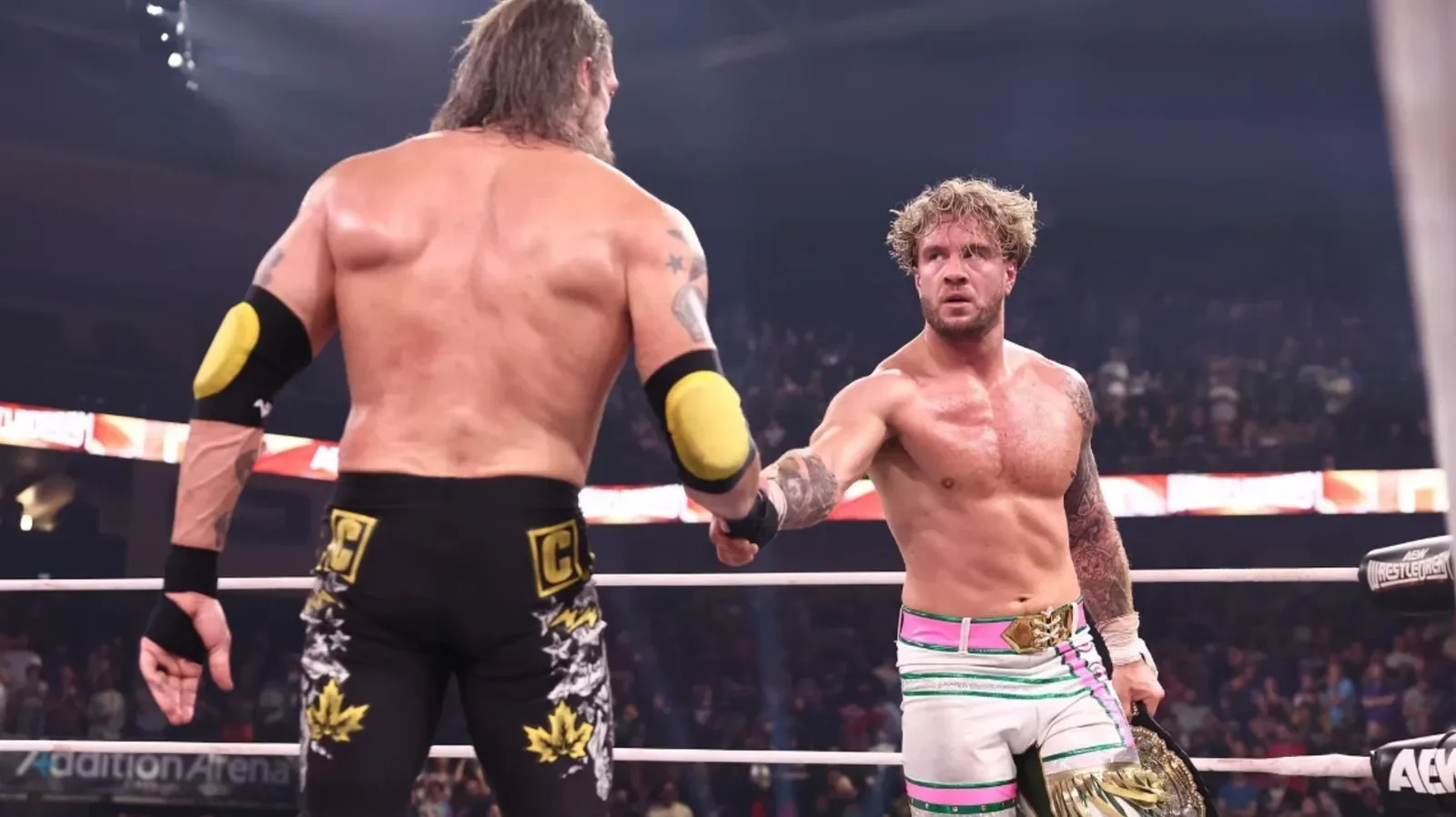
Jeff Jarrett has never hidden his enthusiasm for professional wrestling concepts that ask fans to pay attention in a different way. Following AEW WrestleDream, the veteran performer and executive spoke highly of the company’s decision to put that philosophy into practice on a major stage with the debut of the Clockwork Carnage match.
The match headlined WrestleDream and saw Will Ospreay retain the AEW World Championship. It was a substantial spot for an untested stipulation, especially one built around a format audiences had not previously seen in AEW. Jarrett felt the gamble paid off, arguing that the structure, the talent involved, and the gradual progression of the match made it a standout attraction on the card.
While discussing the event, Jarrett said he had confidence in Clockwork Carnage before it began, even while recognizing that some viewers could have been unsure about a match type without an established history.
“I just sat there and looked at the players in the Clockwork Carnage, and I said, I think there’s probably people that are not really sure because you’ve never seen it how it’s going to play out. But when I kind of walked through it and thought it through, I’m like, this is going to steal the show. I thought that was fantastic.”
For more background on this topic, read Stu Grayson Breaks Down the Explosive Canadian Style Behind Josh Alexander Match.
A Main-Event Test for a New AEW Stipulation
New match concepts can be difficult to introduce. Wrestling crowds are deeply familiar with the rhythms of traditional singles, tag team, ladder, cage, and multi-person contests. Even when a promotion presents a fresh idea, fans generally need to understand the stakes quickly enough to invest in the action while the performers must communicate the rules and pacing in real time.
That challenge becomes greater when the concept is positioned as a pay-per-view main event. A match at the top of the card is expected to provide drama, escalation, decisive stakes, and a satisfying closing image. It is not simply an opportunity to showcase a stipulation; it also carries the responsibility of concluding the event in a way that feels worthy of the championship and the audience’s investment.
For Jarrett, Clockwork Carnage succeeded because it did more than offer novelty. He emphasized the match’s progression and its ability to engage the audience through its elimination element. His comments suggest he saw the format as one that created its own stakes over time rather than relying solely on the prestige of the AEW World Championship or the presence of Ospreay.
Ospreay’s successful title defense ensured the inaugural Clockwork Carnage match also had an immediate place in the history of his AEW World Championship reign. The champion retained in a contest designed to test competitors under conditions distinct from a conventional defense, giving AEW a potentially reusable framework for future title programs or other high-profile rivalries.
Jarrett’s Longstanding Preference for Innovation
Jarrett’s response is consistent with a career that has included considerable involvement in creating, presenting, and promoting specialized match formats. He specifically compared his reaction to Clockwork Carnage with his experience around the King of the Mountain match, a stipulation that became a notable part of TNA Wrestling.
The King of the Mountain format was built around a two-stage idea: competitors first had to qualify, then had to climb. That layered design separated it from more familiar matches and required viewers to follow a different set of conditions. Jarrett acknowledged that the concept drew criticism over the years, but he maintained that he values match structures that give audiences something beyond the expected.
“I love innovative. I love trying new things. I love having the audience get engaged at a different level,” Jarrett said.
That is the lens through which Jarrett viewed Clockwork Carnage. Rather than treating its unfamiliarity as a drawback, he saw it as a reason to lean into the presentation. In his view, the elimination aspect and the way the match unfolded helped the stipulation surpass expectations.
“When you see that you can be eliminated and how it’s drawn out, I just thought Clockwork Carnage exceeded everybody’s expectations. I was really high on it going in. I think it can become a staple in so many ways. I just think the progression, I loved it.”
Jarrett’s point about progression is particularly important for any stipulation intended to last beyond a single event. A successful specialty match cannot just provide a memorable debut; it must leave a promotion with clear reasons to revisit it. If fans understand why the rules matter and if the layout naturally builds toward higher stakes, a new concept can develop an identity of its own over repeated appearances.
The King of the Mountain Comparison
Jarrett did not present Clockwork Carnage as a copy of King of the Mountain. Instead, he cited the two-stage nature of the latter as the kind of structural thinking that comes to mind when evaluating a match designed to unfold in distinct phases.
“I can’t help but say that when I think of a match with two stages, King of the Mountain comes to mind,” Jarrett said. “Got to qualify and then you got to climb. And there was, you know, a lot of, uh, haters on that for years and years and years.”
The comparison underlines an important aspect of wrestling innovation: first reactions are not always the final judgment. A stipulation can be met with skepticism when its rules are first announced, especially if it does not neatly resemble an established match type. How it is executed, how the participants work within it, and whether the audience connects with its central drama ultimately determine whether it earns a recurring place on the calendar.
Jarrett clearly believes Clockwork Carnage has that potential. His assessment went beyond calling the WrestleDream debut a one-time success. He said he could see the match becoming “a staple in so many ways,” an endorsement that reflects his belief that AEW has found a format flexible enough to return in meaningful situations.
Not Every Viewer Shared Jarrett’s Assessment
The positive review was not unanimous within the discussion. Conrad Thompson took a different position, saying he was not a fan of Clockwork Carnage and questioning whether it should have closed a pay-per-view. Thompson’s view was that the match would have been better suited to a television special rather than a major event’s main event.
That disagreement speaks to the balancing act AEW faced with the concept. Putting a new match at the end of WrestleDream gave it immediate importance and presented it as an attraction worthy of the company’s biggest platform. At the same time, that placement invites stronger scrutiny than an experimental match earlier on the card or on weekly television would receive.
Jarrett, however, was firm that the main-event presentation worked. His confidence in the participants was central to his praise; he looked at the “players” in the match and believed the ingredients were there for it to steal the show. In that sense, he viewed the bout not as an experiment that needed a lower-pressure setting, but as a concept capable of thriving when given high stakes and major talent.
AEW’s willingness to try a new format at WrestleDream is the broader takeaway from Jarrett’s remarks. Wrestling promotions often rely on familiar stipulations because audiences instantly recognize their rules and historical significance. Yet a new idea, when delivered with clear stakes and the right performers, can create a fresh talking point and expand the range of stories a promotion can tell.
What Clockwork Carnage Could Mean Going Forward
It remains to be seen when, or if, AEW will bring Clockwork Carnage back. Jarrett’s comments make clear that he hopes it will not be a one-off. The WrestleDream match provided the first test, with Ospreay retaining the AEW World Championship in the process, and Jarrett believes its design gives it room to become a recurring feature.
For now, the match has accomplished something that new stipulations need in order to matter: it has generated a debate. Jarrett sees a successful innovation that exceeded expectations and could become a staple. Thompson sees a concept that did not belong in a pay-per-view main event. That contrast will only add interest if AEW elects to revisit the format.
Jarrett’s own career offers context for why he is so receptive to the idea. He knows that unconventional match rules can take time to find acceptance, and he also knows that criticism does not automatically mean a concept lacks value. His verdict on WrestleDream was straightforward: AEW tried something different, committed to it at the highest level of the card, and delivered a result he considered fantastic.
In pictures

Darryl Polo
Darryl Polo is a passionate wrestling fan covering WWE, AEW, TNA and beyond. He loves great rivalries, breakout stars and the moments that keep fans talking long after the bell. How we work.