
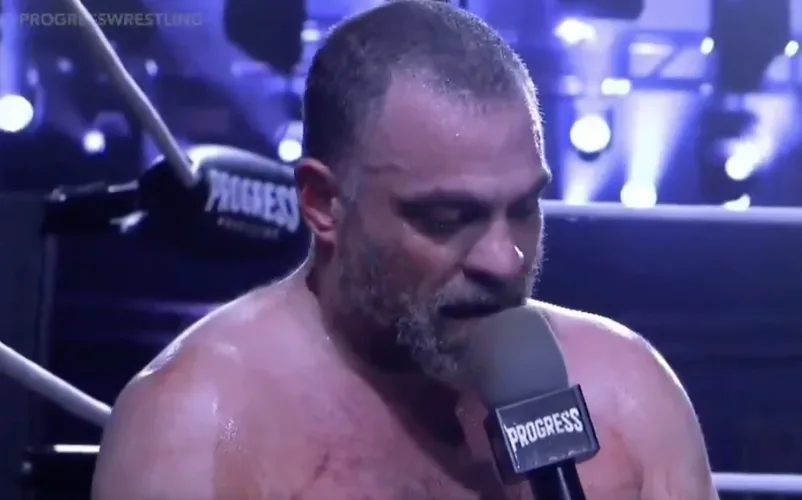
Eddie Kingston delivered one of the most personal speeches of his career following his match with Luke Jacobs at PROGRESS Chapter 199, speaking openly to the crowd about grief, mental health and the support he has received from wrestling fans in the wake of recent losses.
Kingston’s remarks came during an especially painful period for the wrestling community following the deaths of Andy Williams, known to fans as The Butcher, and Benjamin “PAC” Satterley. Both men were widely respected by those who knew and worked with them, with tributes emphasizing their generosity and the impact they had on people throughout the industry.
After his bout with Jacobs, Kingston did not frame the moment around the match itself. Instead, he used the opportunity to acknowledge the emotional toll that losing friends has taken on him. The AEW wrestler explained that he withdrew from the world after Williams and Satterley passed away and considered whether he could continue in professional wrestling at all.
View the referenced post on X
“You lose real people. Life is a fucked up place,” Kingston said. “But I wake up every morning and do this because of the fans.”
For more background on this topic, read Jeff Jarrett Praises AEW’s Clockwork Carnage Gamble at WrestleDream.
That distinction was at the center of Kingston’s message. Wrestling is frequently presented as a world of characters, rivalries and performances, but Kingston spoke in unmistakably human terms. His comments were about people rather than personas, and about the difficult reality of mourning people who mattered deeply to him.
Kingston has long been known for a direct style that leaves little room between the performer and the person speaking. At PROGRESS Chapter 199, that honesty made the address especially affecting. He told the crowd that messages from supporters had moved him to tears, and he thanked those who had shared their own struggles with him.
“You fans put me into fucking tears with some of your messages,” Kingston said.
The emotional weight of the moment became even clearer when Kingston described how he responded in the immediate aftermath of the losses. He said that he did not leave his home for five days following the deaths of Williams and Satterley. During that time, he said, he wanted to walk away from the wrestling business.
“After Andy and Ben passed away, I didn’t leave my house for five days,” Kingston said. “I wanted to leave this business.”
For a performer whose bond with fans has been built in part through candor about hardship, Kingston’s willingness to say that publicly carried considerable significance. He did not present himself as having all the answers, nor did he attempt to make grief sound neat or easily resolved. Instead, he spoke about the uncertainty and pain of a moment that had made him question something that has defined so much of his life.
Kingston also made clear that the address was not meant to center himself. He acknowledged the support he has been given while stressing that the larger issue was the people who had been lost and the enduring effect their deaths have had on their friends, colleagues and supporters.
“This is not about me anymore. This is not about what I want,” Kingston said.
The words reflected a larger sense of responsibility that Kingston described feeling toward the fans who have reached out. He said he does not fully understand why so many people connect with him, but he expressed deep appreciation for those connections. In particular, he addressed supporters who have shared stories involving mental health and difficult circumstances in their own lives.
Kingston said that when fans tell him he has helped them, he sees the relationship differently. Rather than accepting that he is solely the person providing inspiration, he credited those supporters with helping him through his own darkest moments.
“Every fan who hit me up to tell me your story about mental health and your fucked up life, and you tell me I helped you, bullshit, you helped me,” Kingston said.
That exchange between wrestler and audience has been an important part of Kingston’s public identity. His career has not been defined by maintaining distance from the people watching him. Instead, his connection with fans has often been rooted in speaking frankly about adversity and refusing to pretend that life outside the ring is always easy. At PROGRESS Chapter 199, that connection appeared to give the speech its purpose.
Rather than offering a conventional post-match celebration, Kingston turned the moment into an acknowledgement of collective hurt and collective support. His words recognized that wrestling fans are not simply spectators when performers are going through personal losses. The messages he referenced, especially from people confronting mental-health challenges or painful situations of their own, helped remind him why he continues to wrestle.
Williams and Satterley’s deaths have led to an outpouring of remembrance across wrestling. Their names carry meaning far beyond their on-screen roles. Williams was recognized as The Butcher, while Satterley was known worldwide as PAC. Kingston’s use of their given names, Andy and Ben, underscored the personal nature of what he was trying to convey: these were friends, not merely fellow wrestlers whose names appeared on posters or television broadcasts.
Kingston was also part of AEW’s tribute programming for Williams. That involvement placed him within a broader group of wrestlers and friends who have publicly honored The Butcher’s life and legacy. His PROGRESS comments showed that the grief surrounding Williams and Satterley was still immediate, and that it has continued to affect those who shared locker rooms, rings and personal relationships with them.
There was no attempt in Kingston’s speech to turn loss into a tidy lesson. He spoke in the blunt language for which he is known, acknowledging that life can be cruel and that there are moments when continuing feels difficult. But the address also contained gratitude. He thanked fans for seeing him, writing to him and trusting him with their own stories.
That gratitude did not erase the pain he described. It gave him a reason to keep moving through it.
For Kingston, waking up each morning and continuing to wrestle is tied to that sense of shared connection. The profession can be built around competition and conflict, but his message at PROGRESS Chapter 199 focused on something more enduring: people helping one another through circumstances that cannot be fixed by a win or loss.
The setting also mattered. PROGRESS has long provided a stage where wrestlers can speak directly with a passionate live audience, and Kingston used that environment to say something that clearly went beyond the usual boundaries of a wrestling promo. His address was raw, mournful and grateful at the same time.
Kingston’s match against Luke Jacobs brought him to the ring at Chapter 199, but the lasting image from the event may be what followed. Standing before the crowd, he spoke about wanting to leave wrestling after the deaths of his friends. He then explained why he has not done so: the fans who reached out, the people who shared their struggles and the community that reminded him he was not facing his grief alone.
In doing so, Kingston offered a deeply personal tribute to Andy Williams and Benjamin “PAC” Satterley while also recognizing everyone dealing with pain of their own. His words were not a promise that grief becomes easy. They were a thank-you to the people who helped him keep going when it did not.

Darryl Polo
Darryl Polo is a passionate wrestling fan covering WWE, AEW, TNA and beyond. He loves great rivalries, breakout stars and the moments that keep fans talking long after the bell. How we work.