
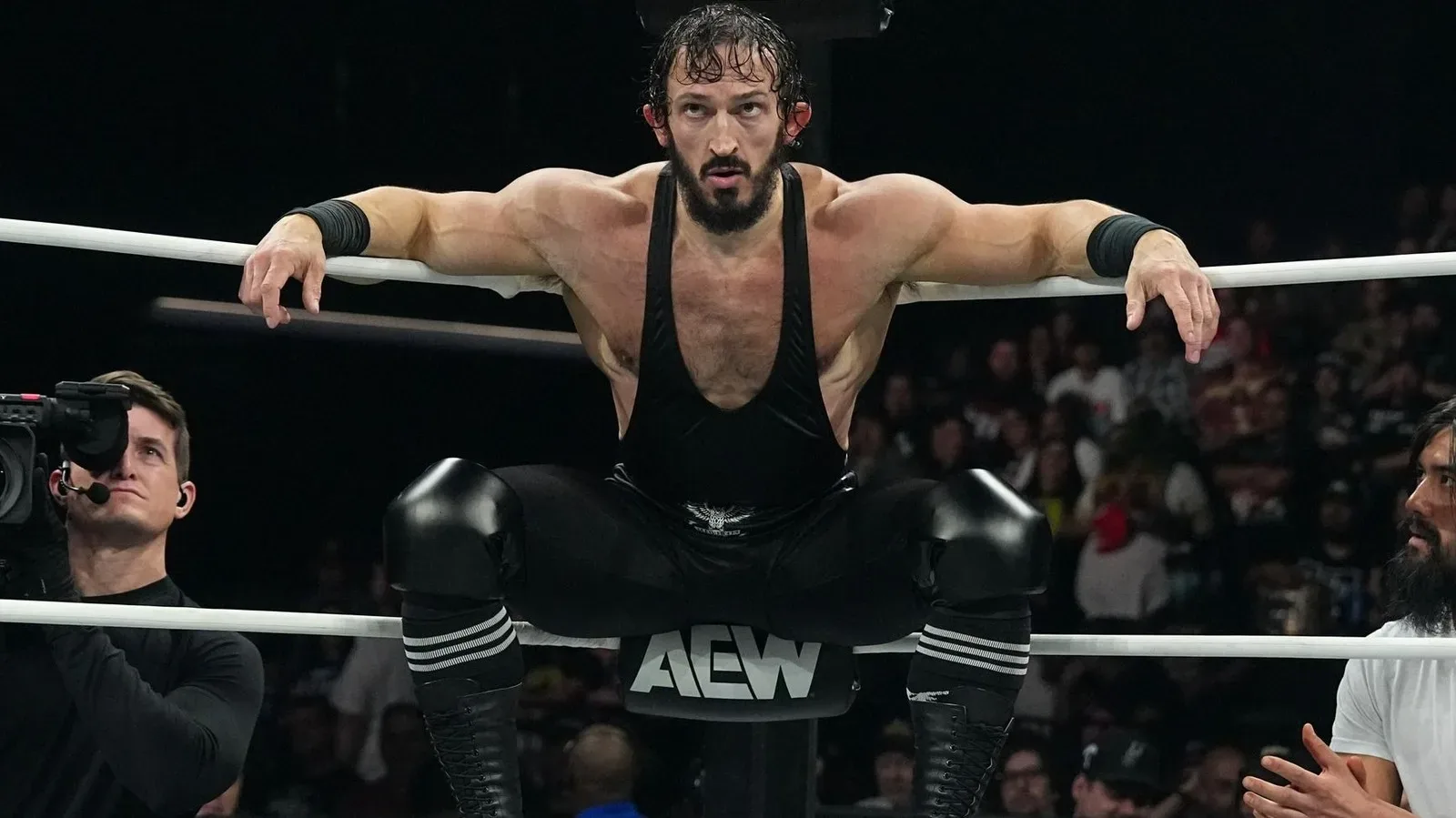
JBL has reflected on the remarkable WWE potential he saw in Pac, known to WWE audiences as Neville, while recalling an early character concept Vince McMahon reportedly considered for the high-flying star.
Speaking on Something to Wrestle following Pac’s passing, the WWE Hall of Famer praised the wrestler’s ability, personality, and immediate impact within the company. JBL also discussed McMahon’s fondness for the classic superhero cartoon character Mighty Mouse and said Neville was viewed as someone uniquely suited to carry a similar presentation.
The idea, as JBL remembered it, was not simply to make Neville a cartoon character. It was rooted in the perception that his spectacular athleticism and undersized-but-powerful frame could make him feel like a real-life superhero: a performer who could do things in the ring few others could replicate.
“Yeah, I really enjoyed Neville. I always called him Neville, so I never was used to calling him Ben,” JBL said. “When Neville came in, man, he was unbelievable. I mean, just unreal. You know, Vince loved Mighty Mouse, and he wanted Neville to be Mighty Mouse, but he already had one in Rey Mysterio.”
For more background on this topic, read Steve Maclin Overcame Broken Fibula To Face Adam Copeland At MLP Northern Rising.
A Superhero Presentation That Never Fully Materialized
JBL’s recollection offers an interesting look at how WWE decision-makers initially viewed Neville. The performer arrived with a reputation as one of the most dynamic wrestlers of his generation, and his style was tailor-made to stand out in a WWE ring. His speed, aerial ability, explosive movement, and polished execution made him an obvious candidate for a presentation built around extraordinary physical feats.
In JBL’s view, the Mighty Mouse comparison was a natural one. The character is famously small in stature but capable of outsized heroics, a description that could easily apply to a wrestler whose size was often dwarfed by WWE’s biggest heavyweights but who could captivate audiences through his athletic output.
However, JBL believed WWE already had its own version of that archetype in Rey Mysterio. Mysterio had long been one of the company’s most beloved high-flyers and had established a deeply recognizable identity built around overcoming much larger opponents. With Mysterio already occupying that space, the company did not fully move forward with a Mighty Mouse-style direction for Neville.
JBL said the concept continued to come up in internal discussions because Neville appeared so well suited for it.
“And I remember several times in the meetings, you know, wanting to position Neville more as Mighty Mouse, which obviously he’s perfect for that. You know, it was something that he could have done that, that superhero, the superhero that could do things. He was perfect for that.”
The comments underline the difference between a creative idea and a final WWE presentation. A concept can be discussed repeatedly in creative meetings, particularly when a performer has an immediately identifiable strength, without ever becoming a sustained on-screen direction. In Neville’s case, the central appeal was clear: he could make impossible-looking offense seem routine.
That ability had value beyond the ring itself. A superhero framing can give a high-flyer a simple, accessible story for viewers: the athlete who flies higher, moves faster, and succeeds despite the size disadvantage. JBL’s description suggests WWE recognized those qualities in Neville from the outset.
Neville’s Early WWE Attention
JBL also recalled that Neville generated major attention during his early WWE run, including on social media. He said creative meetings included discussions about the volume of impressions Neville was receiving and described those numbers as substantially higher than those of other performers at the time.
“I was sitting there one day [in the creative meeting], and they talked about how much [social media] impressions he was getting. He was getting double the impressions of everybody else when he came in. Neville was a world-class talent and a good guy. Neville was always so pleasant to talk to.”
Those recollections are significant because they point to a level of early audience interest beyond the response inside arenas. Social-media engagement has become an increasingly important measure of how performers connect with fans, and JBL’s account indicates Neville was making a strong impression across platforms shortly after arriving.
For a wrestler whose appeal was built in large part on what he could physically accomplish, online attention made sense. A spectacular move can travel quickly in short clips and highlights, while a unique sequence can introduce a performer to fans who may not have watched an entire program. Neville’s ring style gave him that kind of visibility.
JBL’s praise also focused on Pac as a person. He described Neville as pleasant to speak with and as a world-class talent, adding to the many tributes that have emphasized both the wrestler’s accomplishments and the respect he earned from peers.
The Rey Mysterio Factor
The comparison to Mysterio is especially revealing because it illustrates the challenge WWE faces when attempting to define new performers. A wrestler can be exceptionally gifted and still encounter a crowded creative landscape if a top star has already made a similar role iconic.
Mysterio’s legacy as a smaller wrestler who could defeat larger rivals was already firmly established. He was more than a high-flyer; he represented a particular kind of WWE hero, one whose speed, resilience, and aerial offense allowed him to overcome seemingly impossible odds. Any superhero-driven identity for Neville would inevitably invite comparison.
JBL’s point was not that Neville lacked the ability to succeed in such a role. Quite the opposite: he repeatedly said Neville was perfect for it. The obstacle, in his telling, was that WWE already had a performer audiences associated with that kind of larger-than-life underdog superhero image.
That is also why the Mighty Mouse proposal stands out as an intriguing what-if. The concept would have leaned heavily into Neville’s natural gifts rather than asking fans to overlook them. It could have emphasized the contrast between his physical size and the scale of what he was able to do in the ring.
At the same time, WWE’s eventual handling of Neville took a different course from the one JBL described. The Mighty Mouse concept remained a creative possibility rather than becoming the defining identity attached to him on WWE programming.
Pac’s WWE Departure in 2017
Pac walked out of WWE in 2017 before a WWE Raw show. Reports at the time indicated that the decision displeased McMahon. His departure ended a WWE chapter that, as JBL’s comments make clear, had included considerable admiration for his talent and discussions over how best to position him.
The story is a reminder that creative visions in wrestling can remain unresolved. There can be strong internal support for a performer, impressive audience metrics, and a clear understanding of the athlete’s strengths, yet the final character direction may still be shaped by timing, roster dynamics, and the presence of other established stars.
For JBL, there was no question about Neville’s ability. His remarks were emphatic: he considered Pac an exceptional wrestler, someone capable of delivering a superhero-like presentation through the authenticity of his performances rather than through elaborate explanation.
In remembering Pac, JBL returned repeatedly to the same core themes: immense talent, striking athleticism, strong fan interest, and an easygoing presence away from the ring. The unrealized Mighty Mouse idea may now be an unusual footnote in WWE creative history, but it also reflects how highly the performer was regarded inside the company.
As tributes continue following Pac’s passing, JBL’s memories provide another perspective on the wrestler’s career: not only as a standout in the ring, but as a talent WWE believed could be presented as something extraordinary from the moment he arrived.
In pictures

Darryl Polo
Darryl Polo is a passionate wrestling fan covering WWE, AEW, TNA and beyond. He loves great rivalries, breakout stars and the moments that keep fans talking long after the bell. How we work.