
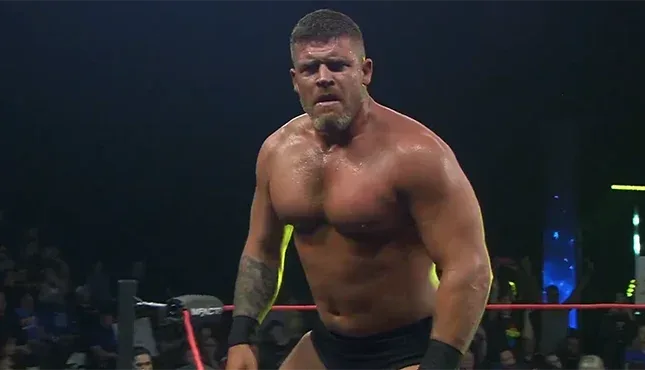
Steve Maclin’s main-event meeting with Adam Copeland at MLP Northern Rising on October 3 was already a major personal milestone. For Maclin, the opportunity to wrestle Copeland represented a dream match rooted in his childhood fandom. The stakes behind that bout were even greater, however, after Maclin revealed that he had worked back from a broken fibula suffered only 10 weeks earlier.
Maclin had been injured during his match with Isaiah Broner at NCG Drive To Glory. The incident occurred when Maclin delivered a choke backbreaker onto his own knee. Something went wrong on the landing, and the match was stopped as paramedics checked on him.
At first, Maclin believed he had merely rolled his ankle. He later thought the injury was a fractured ankle. The eventual diagnosis was a broken fibula, creating a serious obstacle between Maclin and a match that clearly meant a great deal to him.
View the referenced post on Instagram
A difficult road to a dream opponent
Ten weeks is an extremely tight turnaround for any performer attempting to return from a broken fibula, particularly for a wrestler preparing for a featured singles match. Professional wrestling places continuous pressure on the lower body through running, striking, jumping, landing, lifting and absorbing impact. Getting back into the ring is one challenge; getting ready to perform at main-event level against a major opponent is another.
For more background on this topic, read John Cena Reportedly Lined Up for ‘The Family Disappears’ Comedy With David Harbour.
Maclin nevertheless used the period between the injury and MLP Northern Rising to rehabilitate and prepare for Copeland. The speed of that return adds another layer to the October 3 encounter, which was not simply a high-profile attraction on the card. It was a match Maclin had to fight to make happen after an injury that initially looked uncertain in the immediate aftermath.
The personal importance of the match had been clear long before the bell. Maclin grew up using Copeland’s WWE action figure to portray himself. That detail speaks to the unusual full-circle nature of their eventual meeting. Copeland was not just another accomplished name on Maclin’s opponent list; he was someone Maclin had associated with his own wrestling aspirations from a young age.
For many wrestlers, the path from being a fan to sharing a ring with a childhood favorite is meaningful on its own. Maclin’s path was complicated by the fact that he had to recover from a broken fibula in a limited window before the chance arrived. The MLP main event therefore carried both the competitive significance of facing Copeland and the emotional significance of reaching the ring at all.
Copeland earned the victory at Northern Rising
Adam Copeland defeated Maclin in the main event of MLP Northern Rising. The match did not unfold as a strictly one-on-one affair from beginning to end, as Rhino and Maclin’s wife, Deonna Purrazzo, were involved through run-ins.
The presence of Rhino and Purrazzo added further activity to a bout already built around the first-time singles clash between Maclin and Copeland. Copeland ultimately came away with the win, but Maclin’s effort in reaching the event after the injury remains an essential part of the story surrounding the match.
Maclin has established himself as a tough, physical competitor whose style regularly asks a great deal of his body. That reputation can make it easy to view resilience as expected rather than exceptional. In this case, though, the timeline provides important perspective. A broken fibula suffered 10 weeks before a main event would put most major commitments into doubt. Maclin was able to rehabilitate in time to compete opposite one of the most recognizable wrestlers of his generation.
That does not lessen the significance of Copeland’s victory. Copeland entered the match as an elite veteran with experience in major-event settings across a long career. The result gave him a notable win in the MLP environment, while Maclin was able to take part in an encounter he had wanted for years despite the difficult circumstances leading into it.
The injury changed the context of the match
Injuries are an unavoidable part of professional wrestling, but the circumstances surrounding them can vary dramatically. Maclin’s injury came during an in-ring move rather than in a training setting or away from competition. The bout with Broner had to be halted, paramedics became involved, and the initial uncertainty over the nature of the problem developed into confirmation of a broken fibula.
That sequence is important because it illustrates how quickly an in-ring moment can change an athlete’s immediate plans. Maclin initially assessed the situation as a rolled ankle, then believed he had fractured his ankle, before learning the injury involved his fibula. What followed was not a lengthy absence from public view, but a focused 10-week effort to become ready for one of the most personally meaningful matches of his career.
There is also a difference between returning to make an appearance and returning to wrestle an opponent such as Copeland in the main event. A match of that profile invites attention, carries expectation and requires confidence in the body’s ability to handle the demands of a live performance. Maclin’s decision to pursue the return underscores how much the opportunity mattered to him.
It also gives the Northern Rising main event a more human dimension beyond the final result. Fans saw Copeland and Maclin in a marquee match with outside involvement from Rhino and Purrazzo. Behind the scenes of the match’s buildup, Maclin had been working to recover from an injury that could easily have prevented the contest from happening on its planned date.
A full-circle moment despite the loss
Wrestling careers are often measured by championships, win-loss records and appearances on major cards. Those markers matter, but certain matches carry a different kind of weight. Facing a wrestler who influenced someone’s earliest connection to the sport can become a defining moment regardless of who gets their hand raised.
Maclin’s recollection of using Copeland’s figure to represent himself as a child makes the October 3 main event especially distinctive. It connects a childhood imagination of becoming a wrestler with the reality of standing across the ring from Copeland in 2026. The fact that Maclin reached that point after a broken fibula only 10 weeks earlier makes the story more remarkable.
Copeland’s win remains the official outcome of MLP Northern Rising’s main event, and the involvement of Rhino and Purrazzo ensures the match will be remembered for more than its opening bell-to-bell exchanges. But Maclin’s recovery is central context for evaluating the night. He went from an injury stoppage against Isaiah Broner, through uncertainty over the severity of the damage, to a demanding return for a long-awaited meeting with Copeland.
Maclin did not leave Northern Rising with the victory, but he did make it to a match that had the feeling of a career landmark. For a wrestler whose dream of entering the business once included playing with Copeland’s action figure, that achievement carried meaning that extended beyond the final decision.
The 10-week recovery period highlights both the physical demands wrestlers face and the determination required to seize rare opportunities when they arrive. Maclin’s match with Copeland was a dream encounter complicated by a serious injury, a compressed rehabilitation schedule and the pressure of a main-event setting. On October 3, he was able to make that moment real.

Darryl Polo
Darryl Polo is a passionate wrestling fan covering WWE, AEW, TNA and beyond. He loves great rivalries, breakout stars and the moments that keep fans talking long after the bell. How we work.