
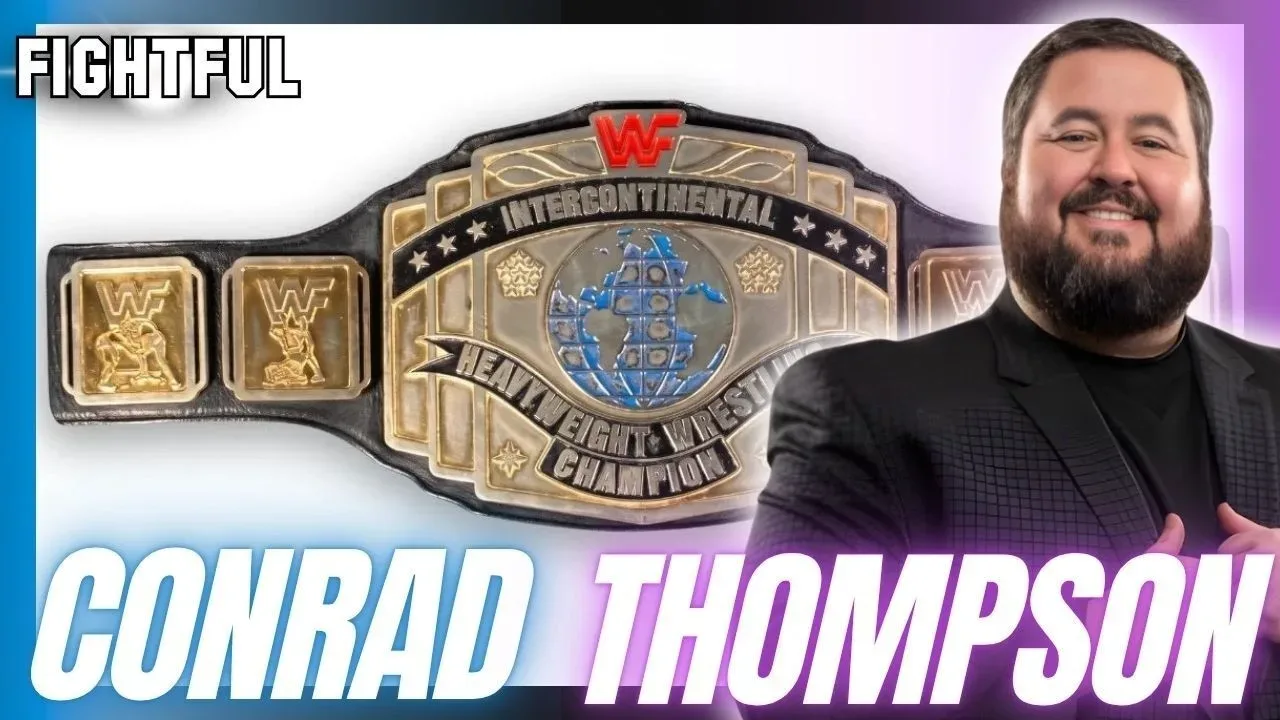
Conrad Thompson has built one of professional wrestling’s most recognizable podcast lineups, but there are still two names at the top of his wish list: Paul Heyman and Michael Hayes.
During a recent interview, Thompson identified both longtime WWE figures as his biggest remaining dream guests. Heyman and Hayes have each held influential roles across multiple eras of the business, and Thompson believes either man could offer an unusual level of firsthand perspective if they ever chose to sit down for an extended, open-ended podcast conversation.
“Obviously Paul Heyman would be a big white whale for me, as would Michael Hayes,” Thompson said.
Thompson’s interest in Heyman is easy to understand. Heyman’s career has included his years as a broadcaster and manager, his work running Extreme Championship Wrestling, and his lengthy run in WWE as an on-screen character and behind-the-scenes creative presence. His current association with Roman Reigns and the Bloodline saga has only reinforced his standing as one of wrestling’s most prominent modern personalities. A detailed discussion covering his years in WCW, ECW and WWE would span several of the industry’s defining creative and business shifts.
For more background on this topic, read WWE Survivor Series WarGames Match Expected To Feature Five Wrestlers Per Team.
However, Thompson placed particular emphasis on Hayes, a WWE veteran whose impact reaches far beyond his better-known run as one-third of The Fabulous Freebirds. Thompson feels Hayes’ story is one that could significantly alter the way some fans assess his place in wrestling history.
Why Michael Hayes Appeals to Thompson
Hayes became a major star through The Fabulous Freebirds, alongside Buddy Roberts and Terry Gordy, and the group left an enduring mark on wrestling through its charisma, music and groundbreaking rivalry with the Von Erich family in World Class Championship Wrestling. The Freebirds’ legacy remains especially connected to Texas wrestling history, while the team’s influence also extends to the widely used “Freebird Rule,” which allows any two members of a three-person unit to defend a tag team championship.
But Thompson’s interest is not limited to that territory-era fame. He pointed to the breadth of Hayes’ experiences, including his time in WCW and his long tenure working behind the scenes for WWE.
“Michael Hayes would not only give you the territory stuff, but he could give you the WCW stuff, look at this really long uninterrupted run behind the scenes in WWE,” Thompson said.
That range is what makes Hayes a particularly compelling potential guest. Many wrestling podcasts are built around a distinct chapter in a performer’s life: a defining championship reign, a famous feud, a promotion’s rise or collapse, or a controversial turning point. Hayes could potentially speak from a considerably wider vantage point. His career includes the territorial system, the national expansion period, WCW, and decades within WWE’s creative infrastructure.
Hayes has remained relatively private compared with many peers from his era, especially when it comes to discussing his professional work in detail. Thompson acknowledged that Hayes is not especially active online and suggested that this may be intentional. In Thompson’s view, that distance from constant public discussion could make an eventual long-form appearance even more valuable.
“He’s not very online and, obviously, that’s by design,” Thompson said. “So if you could actually hear him in his natural state, just talking wrestling, there’s a reason he’s been so successful and been with WWE for so long.”
A Career Beyond the Public Narrative
Thompson’s comments were also a defense of Hayes’ broader reputation. In public wrestling discussions, Hayes is often remembered first for the Freebirds, their unforgettable presentation and their historic rivalries. That legacy is substantial on its own. Yet Thompson argued that popular conversation does not always fully recognize Hayes’ longevity and value as a backstage contributor.
“I think that the narrative out there maybe doesn’t give him full credit for that,” Thompson said. “So I would love to reshape the way people think about Michael Hayes one day.”
The desire to “reshape” that perception is central to Thompson’s interest. A long-form wrestling podcast can provide room for a guest to explain their decisions, influences and philosophy in a way that short interviews or isolated anecdotes generally cannot. In Hayes’ case, such a conversation could cover the evolution from active performer to a person working behind the curtain during a long stretch of WWE history.
Thompson believes that Hayes’ ability to entertain would make the potential interview more than a historical exercise. Hayes’ on-screen persona was built around confidence, verbal flair and a distinctive sense of showmanship. Those traits helped make The Fabulous Freebirds memorable, and Thompson expects that the same instincts could translate naturally to a podcast format.
“That’s unprecedented and the idea that he was behind the scenes in a major way, in on a lot of really critical moments in history, he’s in the room where it’s being discussed for the first time,” Thompson said. “I think he could be tremendous and clearly he’s a natural entertainer. He knows how to spice it up. So I think the genre will welcome him whenever he’s ready.”
Thompson’s Established Podcast Roster
Thompson is already associated with a substantial collection of wrestling podcast personalities. His network has featured shows with Jeff Jarrett, Tony Schiavone, Eric Bischoff, Jim Ross and JBL, among others. That roster covers a broad cross-section of the industry, from wrestling executives and announcers to performers with deep territory, WCW and WWE backgrounds.
The format has often allowed those figures to revisit events at length, offering recollections that can include both the on-screen product and the circumstances surrounding it. The appeal of a potential Hayes series or appearance would be the possibility of adding another veteran voice with experience across several major generations of wrestling.
Heyman would bring a similarly vast collection of stories, though from a different professional path. He is one of wrestling’s most prominent speakers and has long demonstrated a strong ability to explain the logic behind characters, rivalries and broader presentation. His career has placed him at the center of influential moments as an advocate, promoter, executive and creative force.
For Thompson, the appeal of pursuing both men is not simply their fame. It is the depth of access each could provide to eras and decisions that have helped shape modern wrestling. Hayes represents a rare bridge between territory wrestling’s cultural impact and WWE’s long-term creative operation. Heyman represents a figure who has moved between major companies and repeatedly remained relevant through changing industry conditions.
No Podcast Announcements Yet
Thompson’s comments were aspirational rather than an indication that either podcast project has been finalized. There was no announcement of an agreement with Heyman or Hayes, no recording date, and no confirmation that either figure is currently preparing to launch or join a show.
Still, the remarks make clear that both remain major targets for Thompson. Given the number of acclaimed wrestling voices already represented on his network, the addition of either man would be notable. A Hayes conversation could offer a fresh look at a career that stretches from The Fabulous Freebirds to decades of WWE work. A Heyman conversation could provide another deep examination of one of the industry’s most influential and enduring minds.
Until either possibility develops further, Thompson’s comments stand as a clear statement of the two wrestling figures he most wants to hear from next. In his view, both have lived through too much wrestling history—and contributed to too much of it—to remain outside the long-form podcast space forever.

Darryl Polo
Darryl Polo is a passionate wrestling fan covering WWE, AEW, TNA and beyond. He loves great rivalries, breakout stars and the moments that keep fans talking long after the bell. How we work.