
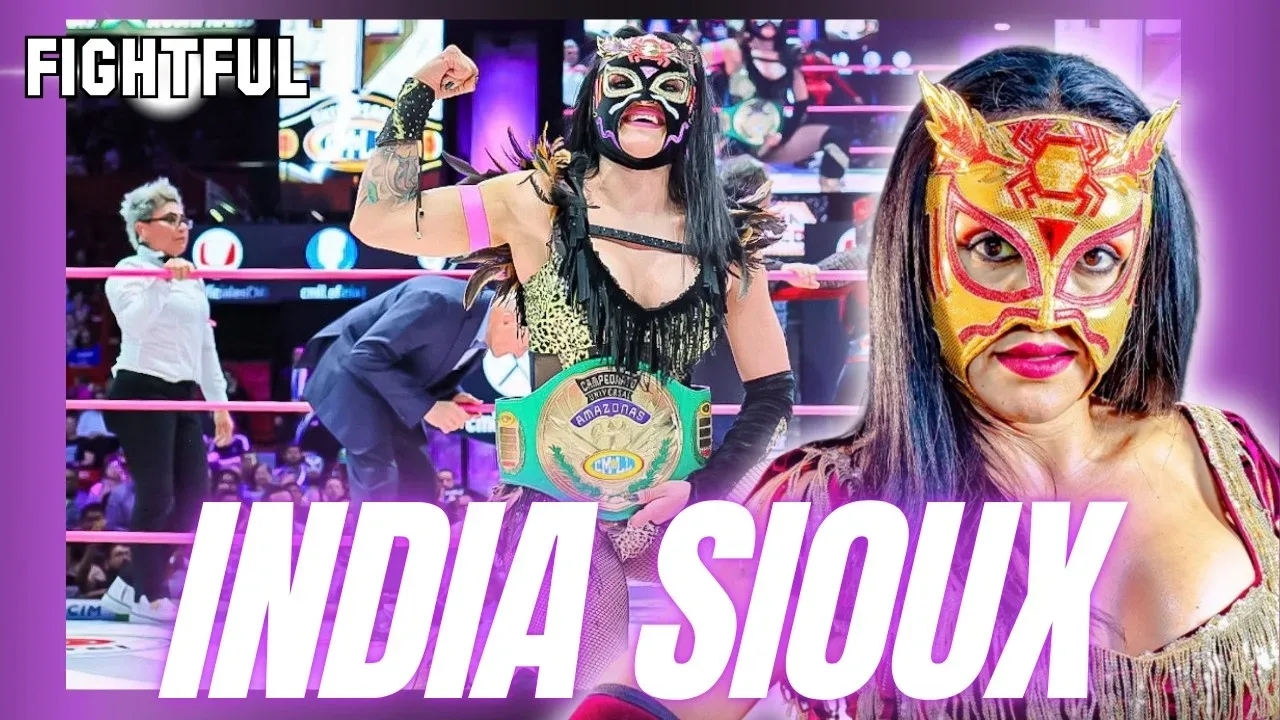
India Sioux has opened up about her time working on Mitos del Ring, CMLL’s ambitious project that brought together Mexican professional wrestling, Mesoamerican cosmovisión and pre-Hispanic cultural imagery in a presentation unlike a conventional arena card.
The project, which CMLL launched earlier in June, featured Sioux alongside performers including Metálica, Star Jr., Akuma, Fugaz and Hermanos Calavera. Within that setting, Sioux took on the role of Mayahuel, an experience she said changed her perspective once she was able to step into the ring and fully inhabit the character.
While the concept appealed to a different side of lucha libre, Sioux admitted that her first reaction was not immediate certainty. The unusual blend of mythology, character work and wrestling naturally raised questions about how audiences would receive it and what the project would ultimately become.
“At first, when the idea was presented to me, I thought about it a lot: ‘What would it be like?’” Sioux said. “The idea sounded a little strange, and I wondered whether people would like it.”
For more background on this topic, read India Sioux Reflects on How CMLL Has Changed Since Her First Run.
That hesitation gave way to enthusiasm as Mitos del Ring began taking shape. Sioux said the first time she performed as Mayahuel established the emotional connection she would have with the role and with the larger production.
“As it developed, honestly, from the very first day I stepped into the ring as Mayahuel, I was fascinated,” Sioux said. “It’s a really beautiful project; it stirs up a lot of emotions.”
A Different Framework for Lucha Libre
Mitos del Ring placed CMLL talent inside a framework informed by Mesoamerican mythology and pre-Hispanic culture. That foundation gave the wrestlers an opportunity to approach their work through characters and themes beyond the identities audiences regularly see on traditional CMLL programming.
For Sioux, that was one of the central strengths of the production. The wrestling remained at the heart of the experience, but the environment around it allowed performers to explore a new kind of presentation. Rather than simply changing gear or adopting a one-night theme, the cast was asked to bring distinct figures to life within a larger world.
Sioux described the project as an emotionally resonant undertaking that lived up to the high standards surrounding it. She pointed to the overall execution, including the atmosphere created through the events held at Arena México and the way the commentary contributed to the presentation.
“Expectations were high, and I think they met them,” Sioux said. “Most of her appearances were meet-and-greets, where they opened Arena México. Everything was incredible, right down to the commentary.”
The reference to meet-and-greets underscores that Mitos del Ring was built as more than a straightforward sequence of matches. Opening Arena México for fan-facing experiences helped create a setting in which the project’s characters and visual identity could be encountered outside the usual competitive structure of a wrestling event.
For a company so closely connected to tradition, Arena México is an especially meaningful place to test a new creative idea. CMLL’s home has long been associated with established stars, title bouts, tournament matches and the rhythms of weekly lucha libre. A mythology-driven project operating in that building could therefore draw power from that history while presenting fans with something intentionally unfamiliar.
Mayahuel Offered Sioux a New Challenge
Sioux’s role as Mayahuel became her entry point into that unfamiliar territory. She said she “absolutely loved” the character, making clear that the role became more than a temporary assignment once the project was underway.
Her comments also speak to a major creative benefit of productions such as Mitos del Ring. Wrestlers often build deep familiarity with their in-ring personas over years of matches, tours and fan interaction. Taking on another character can demand a separate kind of preparation, one that involves movement, emotional expression, visual presentation and the ability to communicate an identity that audiences may not have previously associated with the performer.
“You see wrestling in a different light, but in the end, it’s still wrestling,” Sioux said. “It allowed us, as wrestlers, to try something different, like stepping into the shoes of another character, which was incredible.”
That distinction is important. Sioux did not frame the project as something removed from lucha libre, even with its mythology-based approach. Instead, she viewed it as wrestling seen through a different lens. The core skills of connecting with the crowd and performing in the ring remained essential, but the project gave those skills a different setting and purpose.
It also provided a notable showcase for the range within CMLL’s roster. With wrestlers such as Metálica, Star Jr., Akuma, Fugaz and Hermanos Calavera included in the project, Mitos del Ring assembled talent from different corners of the promotion around a shared concept. That kind of ensemble approach can create opportunities for performers to display dimensions that may not always be foregrounded in ordinary match announcements.
Olympia Took Over the Role
Sioux was unable to remain with the role for the entirety of the project because of other commitments. She stepped away from portraying Mayahuel midway through its run, and Olympia joined the cast in her place.
Rather than treating the transition as a setback, Sioux praised Olympia’s work in the role. She said Olympia did a great job and highlighted the value of being challenged creatively.
“Due to other commitments, I had to step down from the role halfway through the project, and Olympia joined the cast and did a great job as well,” Sioux said. “They really pushed her out of her comfort zone, so I think that’s incredible.”
The change demonstrated one of the potential advantages of a project built around a broader cast and conceptual world. Although Sioux had formed a strong attachment to Mayahuel, the character could continue through another performer. Olympia then had the chance to take on a role that Sioux clearly felt asked something new of the wrestler.
Sioux’s comments about Olympia being pushed beyond her comfort zone also align with her own experience. The project’s unconventional initial pitch became a source of creative energy once she was inside it. In that sense, Mitos del Ring offered performers an opportunity to take risks in a controlled, collaborative environment while still working within the discipline of professional wrestling.
Hope for a Larger Future
Looking beyond her own tenure as Mayahuel, Sioux expressed optimism that CMLL could continue developing Mitos del Ring. She believes the concept carries more potential and hopes it will receive further opportunities, including the possibility of being presented internationally.
“I believe this project has a lot more potential, and I hope they’ll see it that way in the future and give it a chance to even take it to other parts of the world,” Sioux said.
That ambition fits the project’s central appeal. Wrestling is built around immediately understandable elements: athletic competition, conflict, colorful identities and audience interaction. At the same time, Mitos del Ring roots its identity in specifically Mexican cultural influences. A future presentation outside Mexico could introduce new audiences to that blend without requiring the project to abandon the cultural ideas that make it distinct.
Whether CMLL expands the initiative remains to be seen, but Sioux’s assessment is clearly positive. She entered the project wondering how its unusual premise would work and whether fans would embrace it. By the time she had performed as Mayahuel, she had found a role she loved, witnessed a setting she described as incredible, and come away convinced there is room for the concept to grow.
Elsewhere, Sioux also discussed winning the CMLL-Japan Title, another significant milestone in her career. Her reflections on Mitos del Ring, however, highlight a separate kind of accomplishment: the chance to participate in a production that asked wrestlers to honor the fundamentals of lucha libre while discovering how far those fundamentals can stretch through new characters, mythology and theatrical imagination.

Darryl Polo
Darryl Polo is a passionate wrestling fan covering WWE, AEW, TNA and beyond. He loves great rivalries, breakout stars and the moments that keep fans talking long after the bell. How we work.