
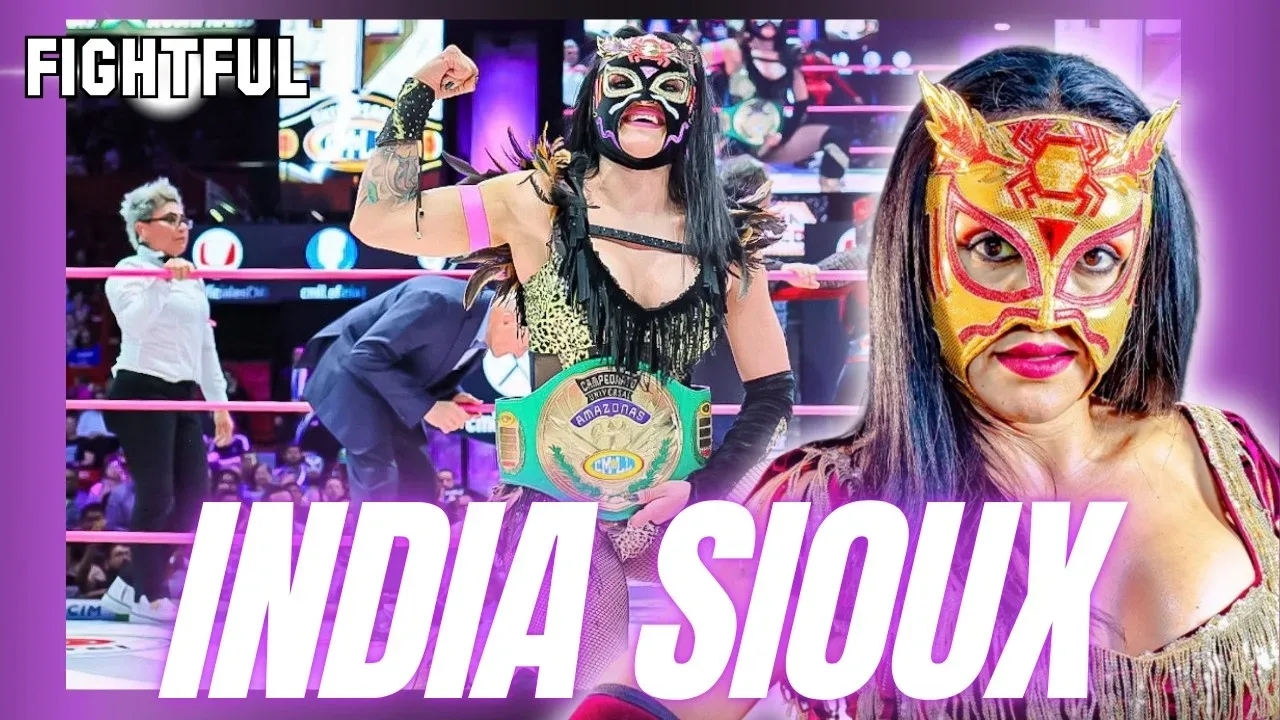
India Sioux has experienced Consejo Mundial de Lucha Libre from two dramatically different vantage points. Her first stint with the historic Mexican promotion began in 2004 and lasted until 2008. Sixteen years after stepping away, she returned in 2024, bringing with her the perspective of a wrestler who has seen both the earlier era of the company’s women’s division and its contemporary evolution.
Now holding the CMLL-Japan Women’s Title, Sioux has reflected on the contrast between the CMLL environment she entered as a newer wrestler two decades ago and the promotion she found upon returning. Her comments paint a picture of a changing lucha libre landscape: one that still values its foundational mat-based approach, but one increasingly shaped by aerial offense, visual spectacle, and the expectations of newer generations of fans.
For Sioux, the difference starts with the physical intensity of the wrestlers who populated CMLL during her original run. She described that period as rougher and more demanding, particularly for someone still gaining experience in the ring.
“Wrestling has changed a lot,” Sioux said. “I think it used to be a little rougher, more intense. The wrestlers—both men and women—were bigger and tougher. I think they were more dedicated to classic wrestling.”
For more background on this topic, read India Sioux Reflects on the Meaning of Her CMLL National Women’s Championship Reign.
That assessment does not dismiss the present-day product. Instead, Sioux sees modern CMLL as an example of a promotion adapting to the changing tastes of its audience while retaining an important connection to the traditional style that has long defined lucha libre. In her view, the shift toward faster-paced and more aerial action is part of a broader generational change across wrestling.
“It’s changed so much; now wrestling has become much more aerial,” Sioux said. “People are clamoring for more of this kind of flashy action. We haven’t completely lost the ground-level wrestling—the classic style—but I think that’s also part of growing and adapting to new generations.”
A difficult path for a rookie in 2004
Sioux entered CMLL at a time when breaking through as a rookie was particularly difficult. The challenge was not simply earning a place on cards; it was the level of opposition facing developing wrestlers. She recalled being put in the ring with experienced and physically imposing talent, a process that forced her to learn quickly.
“Interestingly, I joined CMLL in 2004 and returned in 2024,” she said. “But I think it used to be much harder to break in as a rookie. As a new wrestler, I lacked experience, and it was very difficult because I had to face some very strong wrestlers.”
Two names stood out to Sioux when considering the opponents who tested her early in her career: La Comandante and Amapola. Both were remembered as formidable figures whose strength and toughness made them especially challenging rivals. Sioux said La Comandante was one of the wrestlers who truly made her “test my luck,” while also naming Amapola among the toughest opponents she ever had to face.
Those references underline the significance of Sioux’s return. She is not approaching CMLL as someone merely revisiting a familiar workplace. She is returning to a promotion that helped shape her through demanding early matches against opponents who represented the hard-nosed style of that period.
The current CMLL roster and presentation may place a greater spotlight on spectacular movement and aerial sequences, but Sioux’s own career has given her a direct appreciation for both sides of the equation. Her first run was formed in an environment where the classic fundamentals and physical struggle could be unforgiving. Her present run arrives at a time when women’s lucha libre has a larger platform and more visible opportunities.
From early opportunity to a larger women’s platform
A major part of Sioux’s reflection centered on the growth of women’s wrestling within the CMLL landscape. She views the period around her original arrival as an important starting point for the opportunities women now receive. In particular, she spoke about being present during an early effort to bring women back to the World Wrestling Council.
“In fact, I joined in at the very beginning, right when we were first given the opportunity to bring women back to the World Wrestling Council, and I think we did pretty well,” Sioux said.
For Sioux, that early period was not the finished product. It was the beginning of something that later developed into more prominent roles for women on major cards. She described the work done during that stage as a seed that eventually grew into a much larger presence.
“I’ve always said this, but I believe that was the little seed planted back then that led us to where we are today, headlining events, especially this month, when we have three World Wrestling Council matches on the card,” Sioux said. “It was that little seed, and I’m also very happy to have been part of that first stage of the effort, because we planted it well, and from there it grew into what we are now.”
The importance of that statement lies in the long view Sioux brings to the conversation. She has been involved in CMLL across two distinct eras separated by 16 years. That makes her return more than a comeback story; it also gives her a rare ability to measure the advancement of women’s wrestling from firsthand experience.
Sioux credited the women who continued working and building after her initial departure for making the most of the opportunities available to them. She said it has been especially meaningful to come back and see how much progress has been made.
“It’s gone from small beginnings to something much bigger, and that’s been incredible, too,” she said. “Coming back and seeing that the girls have done so well and paved the way, and they made the most of it so that CMLL could continue to give us this opportunity.”
The meaning of India Sioux’s return
Sioux’s 2024 return to CMLL came after a lengthy absence, but her championship status has immediately made her a notable part of the company’s women’s scene. As the CMLL-Japan Women’s Champion, she represents both a current titleholder and a wrestler with deep personal history in the promotion.
Her tenure from 2004 through 2008 placed her in a far different wrestling climate. At that point, she was a developing talent attempting to establish herself against seasoned competitors such as La Comandante and Amapola. The current version of Sioux returns with years of experience and the ability to contextualize the changes that took place in her absence.
That experience also adds weight to her praise for the current generation. Sioux did not frame the more acrobatic direction of modern wrestling as a rejection of what came before. She recognized it as an adaptation, while emphasizing that the ground-based, classic lucha style has not disappeared. The balance between those approaches remains central to CMLL’s identity, even as the company and its wrestlers evolve.
Her comments also illustrate why veteran voices remain valuable in a promotion built on history. CMLL’s legacy is tied to its ability to preserve established traditions while continually introducing new stars and responding to shifts in audience demand. Sioux has witnessed that process across two decades, first as a rookie working to survive a demanding environment and now as a champion returning to a division with expanded visibility.
Looking back while competing in the present
Although Sioux has spoken warmly about the milestone of winning the CMLL National Women’s Title, her latest reflections are primarily about the journey surrounding her CMLL career. The promotion she left in 2008 and the one she rejoined in 2024 are connected by tradition, but they are not identical. The wrestlers, audience expectations, and in-ring style have all shifted.
Still, Sioux’s account makes clear that she sees continuity alongside change. The lessons learned against powerful veterans have stayed with her. So has her belief that the early efforts to create opportunities for women mattered, even if those efforts began on a smaller scale than the platform available today.
As CMLL continues to feature women in increasingly meaningful positions, Sioux stands as a bridge between those stages of growth. Her career reflects the difficulty of entering the system in an earlier era, the resilience needed to face elite competition, and the satisfaction of returning to find that the women’s side of the promotion has continued to expand.
For the reigning CMLL-Japan Women’s Champion, the changes are unmistakable. Wrestling may be flashier, more aerial, and more tuned to contemporary audiences than it was in 2004. Yet the classic foundations remain, and Sioux’s own story shows how much can grow from the opportunities created by those who helped lay the groundwork years ago.

Darryl Polo
Darryl Polo is a passionate wrestling fan covering WWE, AEW, TNA and beyond. He loves great rivalries, breakout stars and the moments that keep fans talking long after the bell. How we work.