
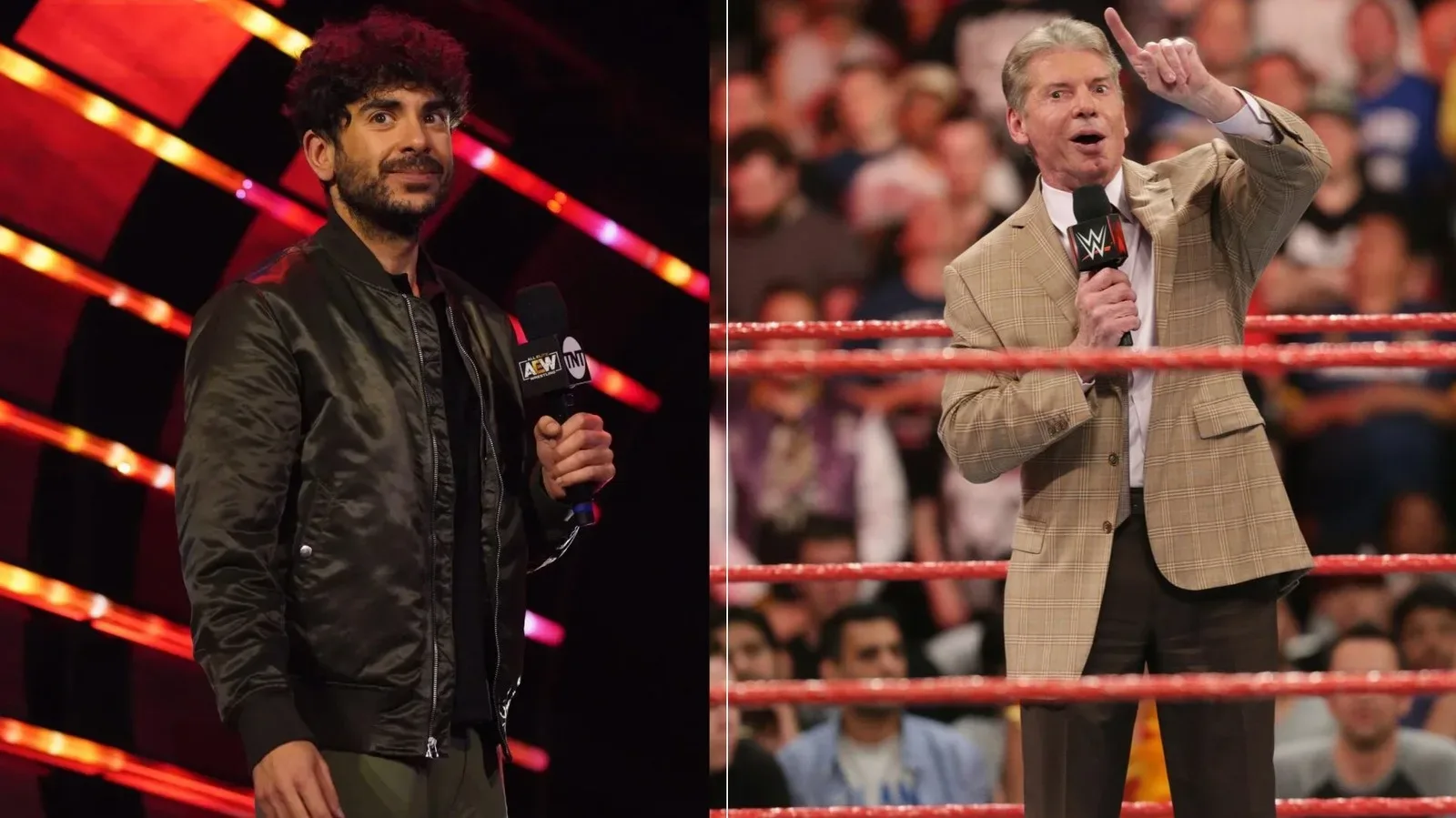
Eric Bischoff believes AEW President Tony Khan and former WWE Chairman and CEO Vince McMahon share one essential quality: an unusually deep personal commitment to professional wrestling.
Speaking on 83 Weeks with Eric Bischoff, the former WCW Senior Vice President discussed the kind of passion he associates with McMahon’s decades leading WWE and compared that mindset to Khan’s publicly visible enthusiasm for AEW. Bischoff’s point was not that the two executives are identical. In fact, he made clear there are substantial distinctions between them. But he sees a common intensity in the way both men have approached the wrestling business.
“Yes, I think Vince was proud of his passion for the product and expected everybody around him to be as passionate as him,” Bischoff said. “My impression was Vince would not understand if you're working in WWE, in particular, and you don't have a passion for the product.”
Bischoff continued by suggesting that, in McMahon’s WWE, merely treating a job as a job would not have been enough to satisfy the company’s longtime leader.
For more background on this topic, read Matt Hardy Calls AEW’s PAC Tribute ‘Very Classy’ and ‘Well Done’.
“I think he would have a hard time understanding or even being willing to tolerate you being a part of WWE... Tony probably is of similar nature. We know he is, based on... anecdotal information that we've all heard from people that we know and respect. He loves what he's doing.”
The comparison speaks to a familiar conversation within modern wrestling: how much a promotion’s identity is shaped by the personality and priorities of the person running it. AEW and WWE operate at different points in their histories, under different corporate structures and with different leadership approaches. Yet both companies have been closely linked with the visions of the executives most associated with guiding them.
Bischoff’s perspective on wrestling leadership
Bischoff is uniquely positioned to discuss the pressures and personality types involved in running a national wrestling organization. As a central executive figure during WCW’s rise in the 1990s, he experienced the direct competition between WCW and WWE at the height of the Monday Night War. His career has also made him a frequent observer and critic of the changing wrestling landscape, including the emergence and growth of AEW.
His remarks focused less on creative decisions or business strategies than on the emotional investment required from a person at the top. McMahon spent roughly five decades in professional wrestling and built WWE into the dominant global brand in the industry. His connection to the product was not simply corporate or financial; it was widely regarded as personal and total. McMahon’s leadership style, for better or worse, was often defined by the expectation that those around him meet his own level of urgency.
Bischoff’s description of that environment emphasizes the degree to which passion was viewed as a baseline requirement. In that framing, a lack of enthusiasm for professional wrestling could be perceived not as a harmless difference in personality, but as an inability to understand the culture McMahon wanted within WWE.
Khan’s relationship with AEW has often been presented in similarly personal terms, though the circumstances are very different. Khan founded AEW in 2019 and has remained closely associated with its creative direction, talent presentation and broader expansion. He has consistently spoken as a longtime wrestling fan whose opportunity to launch a major promotion grew out of that interest.
For Bischoff, the available accounts from people around Khan support the idea that AEW’s president brings a comparable love of the medium to his work. That does not establish that Khan manages AEW the same way McMahon managed WWE, nor did Bischoff argue that it does. Rather, it identifies a shared willingness to devote considerable energy to a business that demands constant attention.
Important differences remain
While the headline comparison is naturally striking given McMahon’s place in wrestling history, Bischoff did not flatten the two figures into a single category. He acknowledged that Khan and McMahon have stark differences, even if he did not detail those differences during the remarks in question.
That qualification matters. McMahon’s influence over WWE was built over generations, beginning with the transformation of what became WWE from a regional territory into a national and then international powerhouse. His tenure included vast expansion in television, live events, merchandising, licensing and media rights. It also included an era in which WWE’s corporate structure and public identity were inseparable from McMahon himself.
Khan entered wrestling from a different starting point. AEW was created as a new national alternative in an already consolidated media environment, and it developed alongside the continuing growth of streaming, changing viewing habits and a broader international wrestling marketplace. The company’s formation gave performers and audiences another major platform in North America, while its relationship with Warner Bros. Discovery established it as a significant player in televised wrestling.
The leaders also face different challenges. McMahon’s WWE spent decades building the infrastructure, library and worldwide recognition that made it wrestling’s market leader. Khan’s AEW continues to define what long-term success and expansion will look like for a promotion that is still relatively young compared with WWE’s history. Shared passion may be part of the foundation in both cases, but it does not erase differences in experience, scale, corporate circumstances or management philosophy.
McMahon’s departure from WWE
McMahon stepped away from WWE in 2024 after sexual assault and trafficking allegations were made by former WWE employee Janel Grant. The allegations were part of Grant’s civil lawsuit against McMahon. The case moved to private arbitration in June.
McMahon’s exit brought an end to his direct involvement in the company he had led for decades. WWE has since operated under the TKO Group Holdings structure, with Paul “Triple H” Levesque continuing as WWE’s Chief Content Officer and a key creative leader. The company’s direction has therefore evolved beyond the era in which McMahon was its defining executive presence.
Bischoff’s comments do not attempt to revisit or assess the allegations against McMahon. Instead, they address the intensity McMahon brought to wrestling during his time as WWE’s leader and how that intensity informed the expectations around him. It is a distinction that keeps the discussion centered on the leadership trait Bischoff was asked to consider, while recognizing that McMahon’s departure remains a major part of the modern wrestling industry’s story.
Khan and AEW’s next media chapter
For Khan, the immediate focus remains AEW’s continued development as its media future approaches another important crossroads. AEW’s current media agreement is set to expire sometime after the beginning of 2028, leaving the longer-term placement of its content unresolved beyond that point.
That uncertainty is normal in a business increasingly shaped by media-rights negotiations and changing distribution models, but it will be a significant issue for AEW as the expiration date gets closer. The promotion has established a regular weekly television presence and has built an extensive event schedule, making the future arrangement for its programming a consequential matter for fans, talent and the company’s wider strategy.
Khan has also recently expressed positive feelings about working under Skydance. That relationship is another factor in the larger media landscape AEW will navigate in the coming years. At present, however, what AEW’s content situation will look like after its current deal concludes remains to be seen.
In the meantime, Bischoff’s observation offers a concise explanation for why Khan has remained such a hands-on and prominent figure in AEW. Professional wrestling can demand around-the-clock focus from people directing creative, television, live events, talent relations and business operations. A leader’s passion alone does not answer every question about a promotion’s future, but it can shape the culture of the company and the persistence behind its goals.
McMahon’s legacy as WWE’s longtime leader and Khan’s continuing work with AEW belong to very different chapters of wrestling history. Bischoff nevertheless sees a recognizable trait connecting them: neither appears to regard professional wrestling as a casual interest. In his view, both men have approached the industry with a level of devotion that they expect others around them to understand.
In pictures

Darryl Polo
Darryl Polo is a passionate wrestling fan covering WWE, AEW, TNA and beyond. He loves great rivalries, breakout stars and the moments that keep fans talking long after the bell. How we work.