
Start with the public identity, not a biography
El Santo is the wrestling name commonly associated with Rodolfo Guzmán Huerta. The Guardian describes the figure as someone who helped popularize lucha libre internationally across five decades, while also linking his cultural-icon status to wrestling, films and comic books. That combination makes El Santo a useful case for examining how a wrestling presentation could be recognizable in several media. It does not make every appearance the same kind of text: a match, a comic and a film can use one familiar identity while asking the audience to follow different kinds of stories.
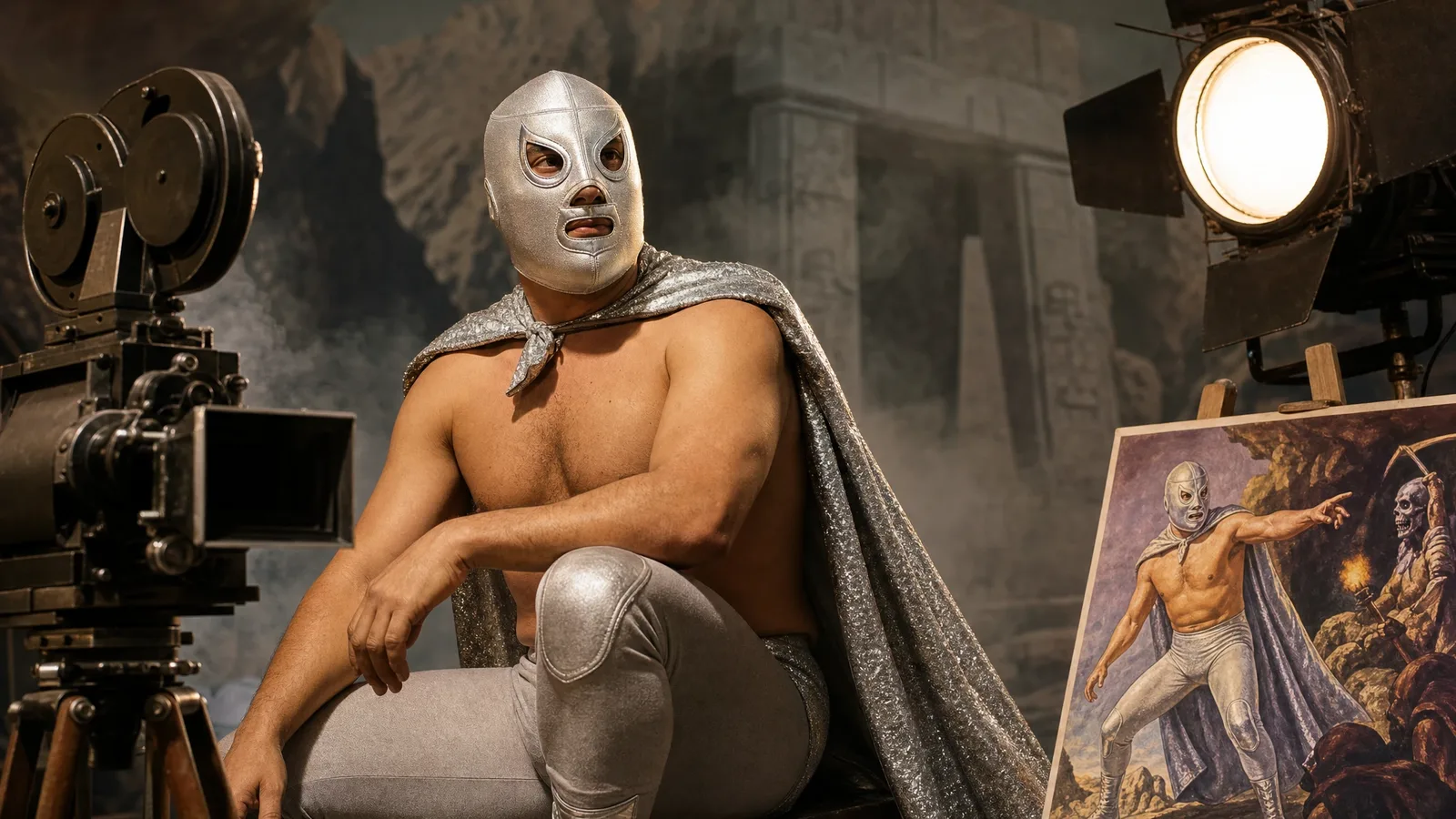
The visual anchor was the silver mask. “El Enmascarado de Plata,” or the silver-masked man, functioned as a descriptive epithet for the presentation. For a viewer, that continuity matters before any plot detail: the mask makes the film hero legible as El Santo even when the setting moves far away from a wrestling venue. At the same time, the historical person, the ring name and the fictional protagonist should not be collapsed into one biography. A screen rescue or battle belongs first to the film’s invented world.
A useful distinction becomes especially clear around identity. The Guardian reports that Guzmán adopted the El Santo name after reading Alexandre Dumas’s The Man in the Iron Mask, with the masked prisoner cited as inspiration. It also reports that he publicly revealed his identity in 1984, two years after retiring from the ring. That real-world disclosure is separate from the continuing fictional identity used by the films. Viewers can therefore ask whether a claim concerns the performer, the public persona or a character’s on-screen mission.
What the mask brings from lucha libre
CMLL’s explanation for its 2013 Arena México mural calls mask and hair stakes a fundamental base of lucha libre. The statement does not provide a plot formula for every film, but it gives context for why the mask is more than a costume detail in a screen image. When a silver-masked hero appears on a poster or in a scene, the image arrives with a recognized wrestling symbol already attached to it. The film can build fantasy or crime-fighting around that symbol without needing to turn the action into a conventional match.
The same institutional interpretation frames lucha libre through paired tensions: rudos and técnicos, victory and defeat, life and death, and day and night. Those pairings offer a careful viewing vocabulary rather than a claim that every Santo picture follows identical moral divisions. A fan can look for how a particular film stages an opponent, danger or resolution, then describe what is actually on screen. It is safer to identify a contrast in a title’s fiction than to assume that it records a wrestler’s private values or the experience of every audience member.
CMLL explicitly gives “cinematic art and science fiction” a place in its mural explanation. Its text represents wrestlers as popular heroes moving beyond a six-by-six-meter ring to confront supernatural beings, villains and extraterrestrials. This is a retrospective cultural interpretation, not a literal rule of wrestling or a credit list for a particular feature. Still, it helps explain the basic shift in medium: the recognizable masked figure can enter a world where the conflict is no longer limited to an opponent across the ring.
The early screen record needs careful dates
Permanencia Voluntaria identifies Santo contra cerebro del mal as El Santo’s screen debut and Santo contra hombres infernales as its follow-up. The archive holds original negatives for both titles, an important distinction between a film’s credited existence and the material objects that can preserve it. Its report also dates a photographed scene from Santo v the Evil Brain to 1961. Together, these details provide a grounded starting point for discussing an early Santo screen cycle without treating a later restoration program as proof of an original release date.
Production and release-era references should not be treated as interchangeable. Archivist Viviana García Besné says the first two Santo films were shot in Cuba shortly before Fidel Castro entered Havana in 1959. That is production context. The archive report’s 1961 date for a photographed scene from Santo v the Evil Brain is a separate release-era reference. Keeping those claims in separate boxes prevents a common mistake in film discussion: converting where or when a production was made into an unsupported assertion about when every version reached viewers.
The archive reports that the first two Santo films were selected for restoration and digitization. That later work adds another layer to a fan’s encounter with the movies: surviving, restoring and making a film accessible are not the same event as making it. Permanencia Voluntaria was formed around a rescued collection connected to Cinematográfica Calderón, a company reported to have produced more than 250 films across seven decades. The surrounding archive therefore places Santo titles within a much larger history of Mexican popular-film preservation.
A wrestling image becomes screen adventure
The Guardian’s popular-cinema account describes El Santo in fictional terms as a silver-masked crime-fighting wrestler. That compact description captures the bridge between ring presentation and movie role. “Wrestler” preserves the recognizable identity; “crime-fighting” identifies a task assigned by screen fiction. The wording should not be read as a biography of Guzmán. Instead, it tells viewers what kind of heroic work the films could give a character whose mask already supplied an immediate visual identity across posters and scenes.
Las Mujeres Vampiro, also rendered Vampire Women, is identified by the Guardian as a 1962 El Santo film. In its reported premise, El Santo is called on to rescue a professor’s daughter after vampires kidnap her. The example is valuable precisely because it is specific: it shows the character entering a supernatural kidnapping narrative rather than simply appearing in a match setting. It should be described as film fiction, however, not as an episode in the performer’s life or proof that every lucha-libre film uses vampires, rescues or the same kind of adventure.
CMLL’s mural explanation offers language for this departure from ordinary settings. It says the movement from the real toward the magical contributed a surreal imaginary to Mexican cinema. In that framework, a masked wrestler’s confrontation with supernatural beings is not presented as a literal extension of ring competition; it is an imaginative screen transformation. When watching a title such as Las Mujeres Vampiro, a helpful question is simple: which parts of the character’s image remain recognizably tied to lucha libre, and which parts are supplied by the film’s fantasy world?
One hero could share the frame
Las Momias de Guanajuato is another El Santo film, described by the Guardian as his most financially successful. It co-stars Blue Demon and Mil Máscaras. The credit arrangement is a concrete reminder that a lucha-film feature could bring several already recognizable wrestling identities into one story. Rather than assuming that one masked figure had to carry every adventure alone, viewers can note how a title’s listed co-stars shape its basic premise. The evidence here establishes a shared feature credit, not the characters’ personal relationships outside the film.
This ensemble example also clarifies the difference between recognition and sameness. El Santo’s silver mask gives his screen presence a particular visual continuity, while the co-starring names show that a feature could assemble more than one known wrestling identity. A fan reading a poster or catalogue entry can begin with modest, verifiable questions: Who is named in the cast? Is the film being described as an El Santo vehicle or as a shared adventure? What can a source actually establish about the characters, as opposed to the public identities that make the names recognizable?
Cinema was part of a wider media path
The Guardian credits El Santo with 52 films and says four were dubbed into English for wider release. Those figures support a limited but meaningful observation: the screen persona was not confined to a single Spanish-language exhibition context. They do not, by themselves, measure reception in any country or establish why viewers responded. The same account notes that El Santo’s brand later appeared in comic books and cartoons as well as films. A poster-to-screen discussion can thus treat cinema as one visible part of a cross-media public identity, rather than its only form.
Permanencia Voluntaria situates wrestling films alongside historical stories, legends, hero narratives, ranchera films, rumbera films and melodramas within Mexican popular cinema. That grouping is useful for resisting an overly isolated reading of lucha-libre movies. The films can be approached as part of a broader field of popular forms, even when a specific title centers a masked wrestler. García Besné argues that films once met with critical disdain should be viewed in their historical context instead of dismissed as disposable entertainment. That is an invitation to look closely at form, preservation and genre rather than make blanket judgments.
Audience claims require modest language
In the archive report, García Besné describes large working-class audiences as drawn to drama, thrills, romance and escapism in this popular cinema. This is a valuable account of an audience orientation, but its scope matters. It should be attributed to García Besné’s description and not expanded into a claim about all Mexican viewers, all eras or every lucha-libre film. For a careful fan, the better question is not “what did everyone want?” but “which pleasures does this account identify, and how might a particular film’s documented premise fit among drama, thrills, romance or escapism?”
The preservation record makes that careful viewing possible in another sense. The Permanencia Voluntaria collection contains roughly 400 films and has been showcased through Spain’s national film archive. Original negatives for several El Santo films, including Santo contra cerebro del mal and Santo contra hombres infernales, are among the materials it holds. Archival survival does not settle every question about a film’s original circulation or audience, but it does show that these works are objects of restoration, collection and curatorial attention as well as popular entertainment.
A practical way to watch the masked hero
A disciplined viewing method begins by separating three layers. First is the documented performer and public wrestling identity: Rodolfo Guzmán Huerta, known as El Santo, whose presentation was tied to the silver mask. Second is the film credit and production record: for example, the archive’s identification of the first screen titles or the Guardian’s 1962 identification of Las Mujeres Vampiro. Third is the fiction inside the feature: vampires, kidnappings, crime-fighting or other imagined dangers. Keeping these layers apart lets a fan enjoy the elaborate premise without converting it into a factual biography.
From there, compare only what the evidence permits. Look at how the silver mask supplies continuity, how a listed co-star changes the scale of a feature, and how a supernatural premise moves the action beyond the ring. Then ask where the information comes from: an archive can establish holdings, preservation and certain production context; a report can identify a stated premise or financial description; CMLL’s mural supplies a retrospective cultural framework. This approach preserves the pleasure of masked-hero cinema while making clear where documented history ends and screen invention begins.
Explore more

Darryl Polo
Darryl Polo is a passionate wrestling fan covering WWE, AEW, TNA and beyond. He loves great rivalries, breakout stars and the moments that keep fans talking long after the bell. How we work.