
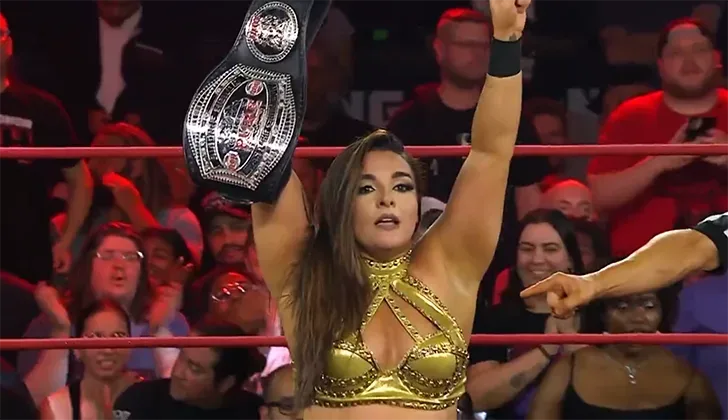
Deonna Purrazzo has spent years learning how to navigate professional wrestling from inside the ring. In June, the ROH Women’s Pure Champion took on a very different challenge when she helped present Battle For The Brave, her first event as a promoter.
The experience gave Purrazzo a firsthand look at the extensive preparation, unexpected setbacks and rapid problem-solving that go into staging a wrestling card. While wrestlers are accustomed to arriving at an arena with the ring assembled, lighting installed and the venue ready for action, Purrazzo found herself responsible for many of the details that normally happen far from the performers’ view.
Battle For The Brave was held at the Rahway Rec Center in New Jersey and was built around supporting a charitable cause. Purrazzo said the goal was not simply to put on matches, but to create an event where talent and fans felt appreciated. That ambition was tested by an assortment of venue and production obstacles, including a late lighting issue and severe heat inside the building.
Despite those challenges, Purrazzo described the event as a valuable learning experience and confirmed that work is underway on holding another show next year.
For more background on this topic, read ROH Complete-Event DVDs: Release Timing, Packaging and Reception.
A New Perspective On What It Takes To Run A Show
Purrazzo’s biggest takeaway from Battle For The Brave was the amount of behind-the-scenes work required to make a wrestling event function. The Rahway Rec Center was a sizable setting, and its capacity created logistical demands that went beyond arranging a card and bringing in talent.
The event team rented its wrestling ring from one party and initially planned to use lighting from another. When the planned lighting arrangement fell through shortly before the event, Purrazzo was forced to confront a problem that performers rarely need to consider on a show day.
“We never ran a wrestling show; we just, as wrestlers, show up and the ring is built, and the light rig is up, and we do our job as the wrestler,” Purrazzo said.
With a building capable of holding roughly 1,200 people, lighting the room was not a minor concern. Purrazzo recalled trying to find a workable solution as the event unfolded, even considering whether floodlights could be brought in and directed into the venue from an entrance point.
The ring provider was able to help, but Purrazzo noted that the available lighting had not been intended for a building of that size. A further assist came from the Tunnel To Towers production team, Savanti, which had a backstage light that could be moved into use for the show.
That process underscored the new responsibilities Purrazzo and her partner Steve faced. Instead of focusing solely on a match, travel schedule or call time, they were tasked with assessing a production emergency and finding a solution in real time. For Purrazzo, that type of practical troubleshooting became the defining lesson of her promoter debut.
Putting Talent First
Purrazzo and Steve also approached Battle For The Brave with a clear priority: treating the booked wrestlers in the manner they would want to be treated as talent. Charity events can bring additional financial and logistical pressures, but Purrazzo said they did not want to ask performers to lower their value simply because the event was for a good cause.
Instead, the focus was on determining what it would take to get each wrestler to the show and making the experience as smooth as possible once they arrived. That included securing hotel rooms for people who got in early, arranging airport transportation and ensuring food was available at the venue.
Squared Circle Cafe contributed to that effort by donating its time and catering services. Purrazzo emphasized that the organizers wanted Battle For The Brave to leave people with a positive impression, both because of its cause and because of the way everyone involved was treated throughout the day.
“We really just wanted to make sure that this is an event that people hope we hold again and want to be a part of next year,” Purrazzo said.
That philosophy speaks to a frequent concern in independent wrestling: talent conditions can shape a show’s reputation as much as the action in the ring. Travel, accommodations, meals and communication are crucial parts of an event day, particularly when a card brings in wrestlers from outside the immediate area. Purrazzo’s comments indicate that those considerations were central to the planning process rather than afterthoughts.
For an active wrestler running her first event, that perspective also reflects an understanding of the gaps that can exist between a promoter’s plans and a performer’s day-to-day needs. Battle For The Brave gave Purrazzo the opportunity to apply her own experience as a traveling talent to the promoter side of the business.
Record Heat Creates Another Major Obstacle
Lighting was not the only late complication at the Rahway Rec Center. Purrazzo said the organizers did not learn that the building lacked air conditioning until the morning of the event. The discovery came on the hottest day recorded in New Jersey that year, turning an already demanding production day into an even more difficult situation for the audience, wrestlers and staff.
As attendance grew to an estimated 700 to 800 people, temperatures inside the building became increasingly oppressive. Purrazzo and Steve responded by ordering approximately 1,000 bottles of water through Uber Eats and distributing them to those in attendance.
The water order was an example of the same immediate problem-solving that had defined the lighting challenge. There was no way to install air conditioning during the event, so the team’s priority became helping attendees remain as comfortable and safe as possible under the circumstances.
“Steve and I were trying to make sure that everyone was taken care of,” Purrazzo said.
Purrazzo expressed particular gratitude to the fans who supported the event despite the conditions. She admitted there had been uncertainty over how the public would respond, but the turnout remained strong and the audience stayed through the conclusion of the card.
The Hardys headlined Battle For The Brave, and Purrazzo noted that the crowd was still present for the main event. For a first-time promotion dealing with extreme heat and last-minute venue complications, that sustained audience support was a meaningful sign of the goodwill surrounding the show and its mission.
Another Battle For The Brave Is Planned
Purrazzo confirmed that she and Steve intend to promote another event next year. One of the early priorities is clear: finding a building with air conditioning.
That adjustment is not just a reaction to an uncomfortable day in June. It reflects the broader value Purrazzo took from her first show. Promoting is often an exercise in planning for problems that performers may never see, then responding when a venue, vendor or weather-related issue still breaks through those plans.
A future Battle For The Brave event would benefit from the experience gained at Rahway Rec Center, including lessons about production vendors, building infrastructure, crowd comfort and contingency preparation. Purrazzo’s stated aim remains to build an event that talent will want to return to and that supporters will feel encouraged to attend again.
There is no announced date, venue or lineup for next year’s show. However, Purrazzo’s confirmation that work has begun on securing a new building establishes that Battle For The Brave was not intended as a one-time undertaking.
Purrazzo Continues Her ROH Run
While reflecting on her work outside the ring, Purrazzo remains active in Ring of Honor as the ROH Women’s Pure Champion. Her most recently noted ROH appearance came on the August 27 edition of ROH on HonorClub, where she defeated Lacey Lane in a Proving Ground Match.
The victory allowed Purrazzo to continue building momentum in ROH competition while she balances the responsibilities that come with launching an event of her own. Her promoter experience has added another layer to her career, showing her the operational demands behind the cards on which she performs.
Battle For The Brave presented Purrazzo with a steep learning curve, from lights to heat to attendee welfare. Yet her reflections make clear that the difficulties did not deter her from trying again. Instead, they supplied a working blueprint for how the next event can be better prepared while retaining the people-first approach that guided the first one.
Darryl Polo
Darryl Polo is a passionate wrestling fan covering WWE, AEW, TNA and beyond. He loves great rivalries, breakout stars and the moments that keep fans talking long after the bell. How we work.