
A championship with two distinct periods
The ROH Pure title’s history is best approached as two separate periods joined by the same championship concept. It was introduced in 2004, then unified with the ROH World Championship in 2006, ending its original standalone run. ROH announced a revival in January 2020, although the planned tournament was delayed during the COVID-19 pandemic. That gap matters for viewers: a Pure match is not simply any technical singles match in ROH history. It is a match built around a specifically announced rules framework and, in the revival, a restored title presented as part of ROH’s technical-wrestling identity.
The original tournament gives the championship an identifiable starting point. A later history account lists AJ Styles as defeating CM Punk in the inaugural final, with John Walters, Chris Sabin, Doug Williams, Matt Stryker, Josh Daniels and Jimmy Rave among the field. The same account says the name shifted from the Pure Wrestling Championship to the ROH Pure Championship after the TNA–ROH talent-sharing agreement ended. Those details help separate the belt’s lineage from any single version of its rules: the name, tournament history and later presentation are related, but they are not interchangeable questions.
That original period concluded through unification rather than an ordinary continuation of the standalone title. The later account places Bryan Danielson’s retirement of the championship in 2006, after its unification with the ROH Championship during his program with Nigel McGuinness. When the championship returned, Jonathan Gresham defeated Tracy Williams in the final of a 16-person tournament to become the first ROH Pure champion in 14 years. The revival article also connected the restored belt to prior holders including AJ Styles, Samoa Joe and Daniel Bryan, explicitly presenting it as a continuation of the earlier lineage.
The central idea: rope breaks are limited
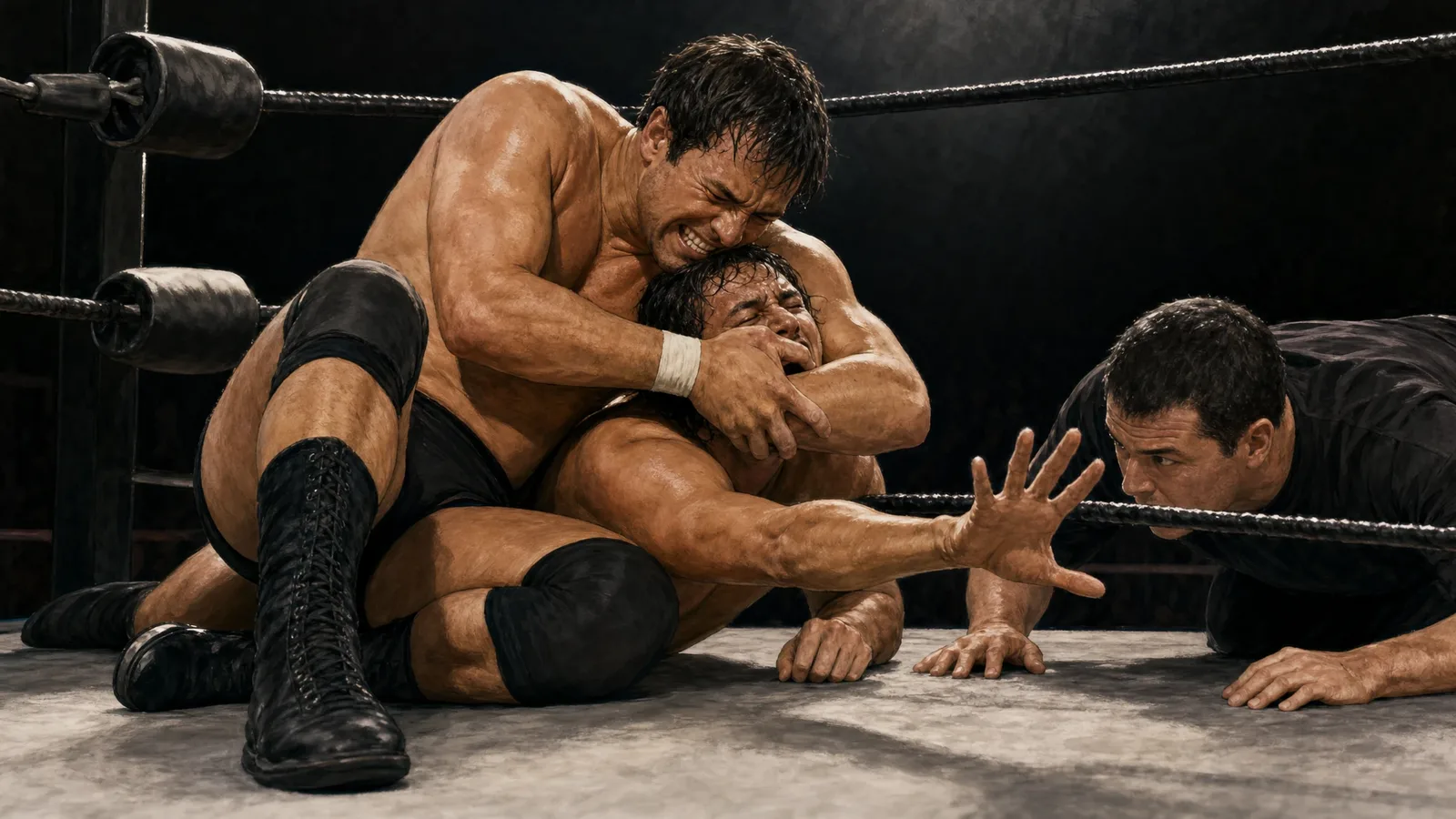
The clearest difference between the announced 2020 Pure format and an ordinary singles match is that a rope break had a fixed supply. Each wrestler received three rope breaks, usable to stop either a submission hold or a pinfall attempt. A wrestler therefore had to consider whether reaching the ropes was worth spending one of only three escapes. The rule makes an action that can otherwise feel routine into visible match information. Rather than treating the ropes as a permanent reset button, viewers can track them as an individual resource that changes the choices available later.
Once all three rope breaks were gone, the condition changed sharply. Pinfalls and submissions on or under the ropes became legal against the wrestler who had exhausted that allowance. This is why a Pure match can make a seemingly small positional exchange matter. A wrestler may be defending a hold in the present, but also deciding whether to preserve a rope break for a later pin or submission near the ropes. The rule does not dictate one correct strategy; it gives the audience a concrete question to follow whenever a wrestler is close enough to force an escape.
For a viewer, the useful habit is to keep the two wrestlers’ totals separate. Ask who has spent a break, what ended the immediate threat, and whether the next attempt occurs near the ropes. A wrestler with breaks remaining can still halt a pinfall or submission there; a wrestler with none cannot rely on that option. The drama is not that the ropes disappear physically. It is that their procedural protection changes for one competitor. That is a more precise way to read the style than assuming that Pure wrestling is defined only by holds or by a slower pace.
Strike rules make the referee’s call visible
The 2020 announcement drew a deliberate line between kinds of striking. Closed-fist punches to the face were prohibited, while open-handed slaps and chops to the face were permitted. Punches to other parts of the body were allowed, but low blows remained excluded. The result is not a blanket ban on contact or aggression. Instead, viewers are invited to notice location and technique: Was the strike to the face? Was it open-handed or closed-fist? Was it directed elsewhere on the body? Those distinctions give the referee a specific rule to apply rather than a vague request for restraint.
The announced penalty structure gave that distinction an escalating consequence. A first closed-fist punch to the face brought a warning; a second meant disqualification. That sequence creates an additional piece of match state to remember after a disputed strike. The audience can watch not only whether a wrestler lands a blow, but whether the official identifies it as prohibited and whether a prior warning is already in place. A warning is therefore not merely a pause in the action. Under the announced rules, it changes what a repeat offense can cost.
This is also one of the places where the rules support disagreement without making disagreement proof that the format has failed. Gresham said detailed rules give wrestlers and audiences material for stories because they can react to technicalities and disputed officiating decisions. The rule announcement and Gresham’s framing present Pure as a format where limits can be enforced, broken, exhausted or debated; they do not present it as a promise that every participant will behave honorably. A viewer can therefore distinguish the stated prohibition from the referee’s judgment about a particular strike.
The count-out rule retains urgency beyond the ring
Pure rules did not remove the importance of the floor. The 2020 rules retained a 20-count when a wrestler was outside the ring, matching the count-out structure used in standard ROH matches at that time. In practical viewing terms, that means a technical contest could still be shaped by the clock after someone leaves the ring. A wrestler can be working around submissions, pins and rope-break totals while also needing to beat a count. The format narrows certain options, but it does not reduce the entire match to mat exchanges.
A later description adds an important championship-specific qualification: in men’s Pure rules, the title could change hands by disqualification or count-out. That stake should not be blurred into a claim about every non-title Pure match, nor should it be assumed without checking the match’s stated conditions. But for a championship match described under that rule, a count or a disqualification can carry more than a temporary setback. It can decide possession of the title. That makes the floor count and strike-warning ledger especially important to the viewer.
Outside involvement was addressed even more severely in the 2020 announcement. It stated that a wrestler who interfered would face automatic roster termination. Whether watching an individual bout or recalling the tournament format, the key point is the rule’s stated severity: outside involvement was positioned as a separate enforcement issue, not just another way to gain an advantage. Alongside the floor count, it places boundaries around what can happen beyond the immediate exchange between the two wrestlers.
Time limits and judges prevent a simple dead end
The revival tournament used escalating time limits by round: 15 minutes in round one, 20 minutes in block semifinals, 30 minutes in block finals and one hour in the tournament final. A time limit therefore was not identical in every tournament match. It was part of the bracket’s structure. When watching or revisiting a tournament bout, the round matters because it establishes how much time the wrestlers had before a judges’ decision could become relevant. The limits are best understood as announced tournament conditions, not a universal duration for all Pure matches.
The 2020 tournament also called for three judges in every match. If the time limit expired, their decision would determine the result instead of the bout automatically remaining a draw. Judges thus gave a time-limit finish a defined destination within the tournament. For viewers, the meaningful question near the limit is not only whether either wrestler can secure a pinfall or submission. It is also how the match may be evaluated if neither does. The rules made that possibility explicit before the result, rather than leaving a draw as the only stated outcome.
Judges are sometimes treated as a decorative addition to technical wrestling, but the announced format assigns them a practical job: deciding time-limit draws. Their role belongs beside the other trackable conditions, including rope-break totals, facial-strike warnings, floor counts and outside involvement. The rules do not say that every bout must become a judges’ decision, and they do not prescribe how viewers must score an unfinished contest. They do establish that a draw at the limit could still produce a winner in this tournament structure.
What “technical” meant in the revival’s own framing
Gresham described the revived division as a way for ROH to foreground a sports-oriented, technical-wrestling identity rather than simply add another championship. His description of technical wrestling was broad: he cited faster lucha libre, Japanese styles associated with Karl Gotch and Antonio Inoki influences, British Lancashire wrestling, and American styles mixed with MMA. That list is useful because it resists a narrow reading of Pure as one universal rhythm or repertoire. The rules identify a framework; the wrestling inside it can still take multiple approaches.
Gresham also described his emphasis on submissions and reversals as an effort to demonstrate technical wrestling as broad match storytelling rather than a single slow-paced style. The rope-break structure helps explain how that claim can work in practice. A submission is not only an attempt to force a finish; near the ropes, it can also force an opponent to spend a limited escape. Likewise, a reversal can change who is threatened before that escape is used. This is an interpretation of the stated rules and Gresham’s framing, not a claim that every Pure match follows one pattern.
The 2020 entrant pool likewise indicates a field broader than one narrowly defined wrestling identity. The named group included established ROH figures Jay Lethal, Rocky Romero, Matt Sydal and David Finlay, alongside Tracy Williams, Josh Woods, Wheeler Yuta, PJ Black and Tony Deppen. Before travel restrictions altered potential international representation, ROH had also identified Yuji Nagata, Doug Williams, Mark Haskins, Slex, Joe Hendry and Ren Narita as confirmed participants who could no longer take part. The tournament’s field and the stated rules together offered several possible ways to work within the same limits.
A practical checklist for following a Pure match
A productive way to watch a Pure match is to treat it as several visible questions running at once. How many rope breaks does each wrestler have left? Is a pin or submission occurring near the ropes? Has a facial strike drawn a warning, and would another prohibited closed-fist punch mean disqualification? Is one wrestler outside during the 20-count? Is there a time limit, and are judges part of the stipulated format? These are not hidden layers added after the fact; the written rules identify them as distinct enforcement questions a viewer can follow.
That checklist also explains why the format is more than a request for clean wrestling. The announced rules began and ended each Pure match with a Code of Honor handshake, but the larger framework contains finite escapes, prohibited strikes, warnings, count-outs, consequences for interference, time limits and judges. Gresham’s explanation similarly emphasized that rules create story material through technicalities and officiating disputes. The handshake is one stated ritual within the format; it does not erase the competitive pressure produced by the rest of the rules.
The most accurate shorthand is that Pure rules make particular choices legible. A wrestler can spend a rope break now or risk a worse position later. A strike can be allowed or prohibited depending on its form and target. The ring boundary can become a count-out problem, and a time limit can lead to judges rather than a final draw in the announced tournament. Those are the mechanics that distinguish the 2020 ruleset. They provide a clear lens for watching the revived championship without assuming that every era, match or enforcement decision was identical.
Reading the history without flattening its differences
The championship’s history supplies context, but the 2020 rules announcement supplies the clearest detailed rule list in the available record. The title began in 2004, ended as a standalone championship through 2006 unification, and returned through a delayed 16-person tournament in 2020. Gresham’s victory over Tracy Williams connected the revival to a title lineage that the feature linked with earlier holders. At the same time, the later account’s note about title changes by disqualification or count-out shows why viewers should pay attention to the stated conditions attached to a particular Pure championship setting.
For fans, the lasting value of the format is its readability. You do not need to assume a wrestler’s motive or impose one definition of technical wrestling to follow it. Start with the announced conditions, track the resources and penalties, and notice when time or position changes the available options. The original tournament, the 2006 unification, and the 2020 revival establish a championship history; the rope breaks, strike restrictions, count, judges and tournament limits explain the match framework most fully documented for the return. Together, they offer a focused way to see why a Pure match is distinct from an ordinary singles contest.
Explore more

Darryl Polo
Darryl Polo is a passionate wrestling fan covering WWE, AEW, TNA and beyond. He loves great rivalries, breakout stars and the moments that keep fans talking long after the bell. How we work.