Start with the rules announced for the match
ROH Pure Rules are best approached as a match-specific format with documented versions rather than a single, unchanging rulebook. That matters before any discussion of strategy. Reports from Final Battle 2020, December 2024 and September 2025 describe recurring features, especially a three-rope-break allowance, but they also record meaningful differences in time limits, judging and closed-fist treatment. A viewer who begins by identifying the announced conditions has a clearer basis for reading the action. The useful question is not simply whether a match is called Pure Rules, but which version the participants and officials have established for that particular bout.
Time limits provide an immediate example of why that check matters. A December 2024 Pure Championship open challenge was described with a 30-minute limit, while the September 2025 Lee Moriarty versus Josh Woods title match was announced with a one-hour limit. Both reports included a judges’ decision as the listed outcome if time expired without a winner, yet the available time was not the same. Rather than carrying a number from one event into another, viewers can listen for the time limit at the outset and keep it in mind as the match develops.
The 2024 standard format: three breaks, a warning and judges
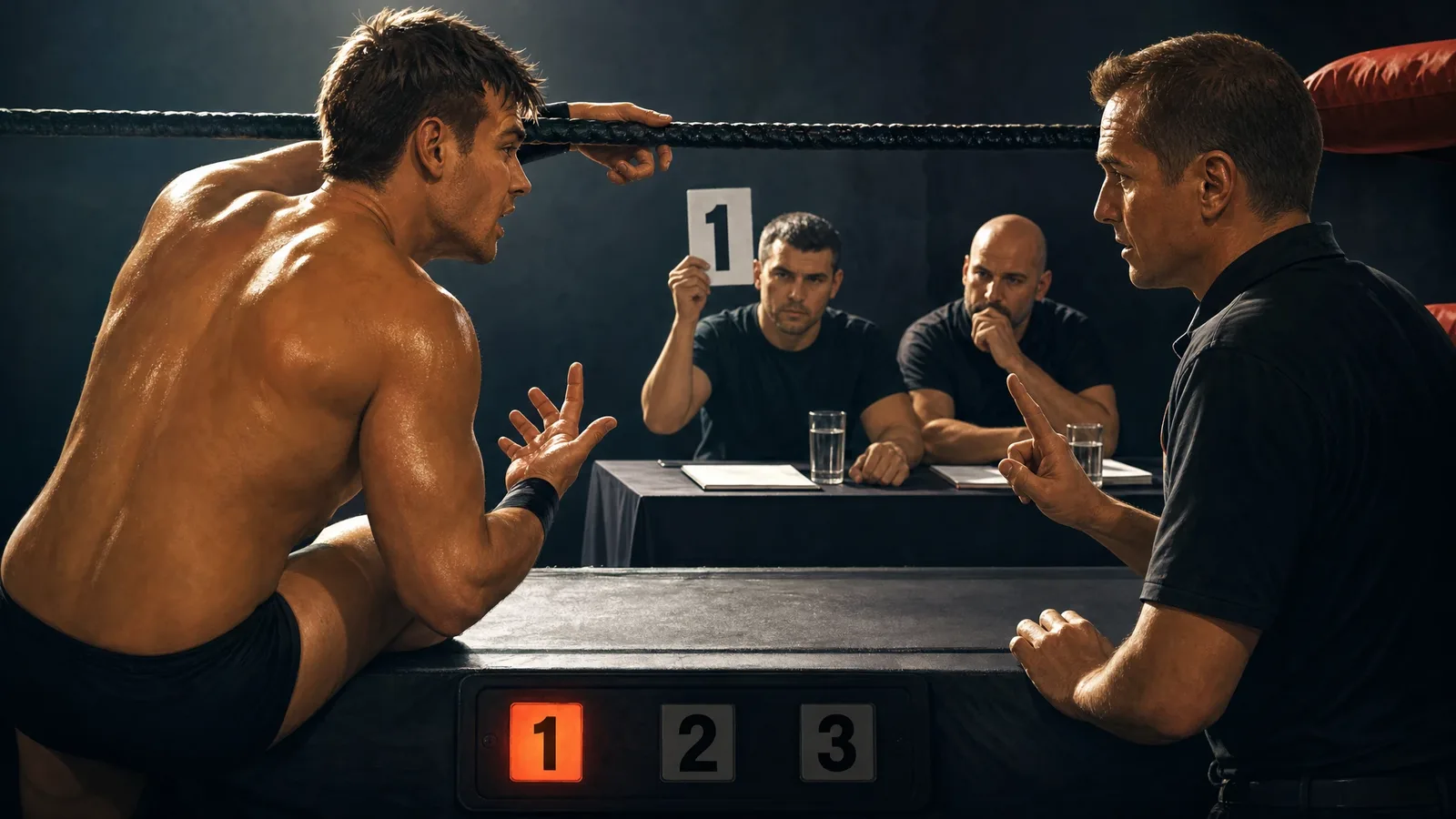
The December 2024 report’s description of the standard Pure Rules format gives a concise starting framework: each competitor received three rope breaks and one closed-fist warning. The report also stated that a competitor could be disqualified once the closed-fist warning allowance had been used. These are separate things to monitor. A rope break is a finite protection against the qualifying pinfall or submission situations described in the rules, while the closed-fist provision asks viewers to notice an official ruling on a strike. The count in either category can shape what remains available later in the bout.
The same 2024 format included conditions beyond the two individual allowances. Outside interference was listed as a disqualification, and the report specified that such a disqualification could change a championship. If the match reached the time limit without a pinfall or submission, judges’ points would decide it. Jerry Lynn, Christopher Daniels and Rocky Romero were named as judges before the December 2024 Pure Championship open challenge, making that possible finish visible to the audience in advance. Those details encourage viewers to watch the full rules presentation, not only the first hold near the ropes.
Why the December 2024 old-rules match needs its own lens
The December 2024 match between Nigel McGuinness and champion Lee Moriarty was expressly framed differently. McGuinness and Moriarty agreed to use old Pure title rules, rather than the contemporary open-challenge format outlined in the same report. The stated old rules omitted judges and specified that victory could come only by pinfall or submission. That distinction is important for viewers: a time-expiry points decision was not part of the announced finish structure for this version. The match should therefore be read through its own stated terms, even though it retained a familiar Pure Rules element in its rope-break count.
Under the old rules used for McGuinness versus Moriarty, each wrestler still had three rope breaks, but closed fists were specified as zero. The report then recorded an especially revealing ruling: a strike deemed a closed fist cost Moriarty a rope break. This is a clear example of an infraction affecting the same limited count that otherwise protects a wrestler from a pin or submission. For a viewer, the lesson is not to assume that the rope-break total changes only when someone reaches the ropes during a hold. An official’s ruling can also alter the count in a documented version of the format.
The match also shows why rope position can be worth tracking before anyone makes an obvious escape. McGuinness forced Moriarty to use an early rope break by drawing him close to the ropes during a hold. Later, Moriarty forced McGuinness to spend all three of his breaks through successive submission sequences. Once McGuinness’s allowance was exhausted, the report noted that the ropes could no longer save him from a hold. After both men had used all three, Moriarty employed the ropes for leverage in a pinning attempt, which the report characterized as legal at that stage. Each ruling becomes easier to follow when the remaining count is known.
What the 2020 report adds to the rope-break picture
A Final Battle 2020 rules summary also described three rope breaks per wrestler, with the allowance applying to both submission holds and pinfalls. It further stated that, after a wrestler had exhausted the breaks, an opponent’s submission and pin attempts under the ropes became legal. This establishes a practical viewing distinction. In an early sequence, the ropes may end a threatening attempt while also reducing the wrestler’s remaining protection. In a later sequence, the same physical location can be governed differently after the count reaches zero. The viewer’s task is to follow the allowance alongside the move or pin attempt, rather than treating the ropes as a permanent reset.
The 2020 summary supplied a more detailed closed-fist progression than the December 2024 standard-format description. It distinguished facial closed-fist punches from open-handed slaps or chops to the face, while allowing punches to other body areas except low blows. A first closed-fist use brought a warning; a second cost a rope break. If that wrestler was already out of rope breaks, the second offense brought disqualification. This reported version makes the referee’s assessment important on two levels: what kind of strike was used, and whether the wrestler still had a rope break available when the penalty was applied.
The same 2020 account included a referee twenty-count for a wrestler who went to the floor. It is a useful reminder not to transfer every provision automatically between Pure matches. The 2020 report establishes that condition for the version it summarized, but a viewer should look for the applicable match announcement before expecting the same count elsewhere. This is the wider habit that keeps the format legible: identify what is expressly in force, then track those conditions during the match. Similar labels can contain different combinations of time, judging, striking and ringside provisions.
Two 2020 match moments show how a count carries forward
Jonathan Gresham versus Flip Gordon at Final Battle 2020 provides a reported example of rope breaks being spent early. During Gresham’s submission work, Gordon used enough breaks that the report described him as having fewer than one remaining within roughly the first several minutes. The important viewing cue is chronological. A rope break can look like an immediate escape, but the count remains part of the match afterward. When a wrestler uses one early, viewers can ask how many remain, what kind of threat drew the break, and whether the opponent later returns to a similar position after the allowance has changed.
Later in that match, Gresham could not use the ropes to end another submission because his own rope-break allowance was gone. The report said he instead got both wrestlers out of the ring. The bout ended by referee stoppage after Gresham’s sustained attack on Gordon’s arm, not by judges’ decision. Together, those reported events show that the ropes did not provide Gresham the same option once his count was exhausted, while the actual finish did not require a time-limit decision. The safest way to read either moment is to separate the stated rule condition from the reported conclusion of the match.
Judges and time limits are announced possibilities, not assumed endings
A judges’ provision tells viewers what may happen if the stated time limit expires without a pinfall or submission; it does not mean every Pure Rules match is destined to reach that stage. The December 2024 standard format listed a judges’ points decision under those circumstances, and the September 2025 Moriarty-Woods report did as well. By contrast, the December 2024 old-rules match between McGuinness and Moriarty omitted judges and allowed victory only by pinfall or submission. When judging is announced, note the judges and the time limit. When it is omitted, do not import it from a different version.
The 30-minute limit reported for the December 2024 open challenge and the one-hour limit reported for Moriarty versus Woods in September 2025 demonstrate the same principle. A viewer can treat the clock as part of the announced structure, but should not assume a universal Pure Rules duration. This avoids a common reading error: interpreting a later phase of a match as though the same amount of time always applies. The report on Moriarty versus Woods specifically connected its one-hour limit to a judges’ decision only if no winner emerged by the limit, so both parts of that condition belong together.
The 2025 title match offers a complete count to follow
The September 2025 Pure title report again described three rope breaks per competitor, one closed-fist warning, automatic disqualification for outside interference and the possibility of a title change on disqualification. It also listed judges if the one-hour limit expired without a winner. Those announced conditions offer a compact checklist before following the actual Moriarty-Woods sequences: rope-break totals for both wrestlers, any closed-fist ruling, whether outside interference occurs, and whether the bout approaches its stated time limit. The checklist is based on the format reported for that match, rather than a claim that every ROH Pure contest uses identical terms.
Early in Moriarty versus Woods, each wrestler used a rope break after being placed in a threatening hold, leaving the count even at that point. The report then recorded Moriarty being charged a second rope break while already positioned on the ropes during Woods’ submission attempt. That moment is a useful caution against tracking only conspicuous reaches toward the ropes. Referee rulings are part of the information the viewer needs. A simple running count can make the next sequence easier to understand: after the second charge, Moriarty had less rope-break protection than Woods, regardless of how the earlier exchanges appeared.
The final stages reported for Moriarty-Woods make the count especially visible. A Woods pinfall attempt was nullified because Moriarty’s foot was under the ropes, but the same sequence used Moriarty’s final rope break. After Moriarty had none left, grabbing the ropes did not end Woods’ ankle lock. Moriarty escaped by changing the situation into a bridging pin and won by pinfall. The report supplies the relevant sequence without requiring a viewer to guess at a universal rule: first identify the final rope-break ruling, then notice that the later rope grab did not stop the hold, and finally distinguish the escape from the pinfall finish.
A practical way to watch without flattening the format
For a documented Pure Rules match, start by noting the announced finish routes: pinfall and submission, and, where stated, a judges’ decision at the time limit. Next, write down each wrestler’s rope-break total and update it only when the referee’s ruling establishes a charge. Then listen for the closed-fist condition, including whether the match has a warning structure or an old-rules zero-closed-fists provision. Finally, check any special conditions such as outside-interference consequences or the 2020 floor count only when they have been announced for the version being watched.
The strongest viewing questions are specific ones. How many rope breaks remain? Did the official charge one for a hold, a pinfall situation or a strike ruling? Is the wrestler near the ropes before the hold is fully applied? Has the match established that ropes no longer stop an attempt for someone with no breaks left? Are judges and a time limit actually part of this version? These questions fit the reported 2020, 2024 and 2025 examples while preserving their differences. They turn Pure Rules from a label into a visible set of match conditions that can be followed sequence by sequence.
Explore more

Darryl Polo
Darryl Polo is a passionate wrestling fan covering WWE, AEW, TNA and beyond. He loves great rivalries, breakout stars and the moments that keep fans talking long after the bell. How we work.