
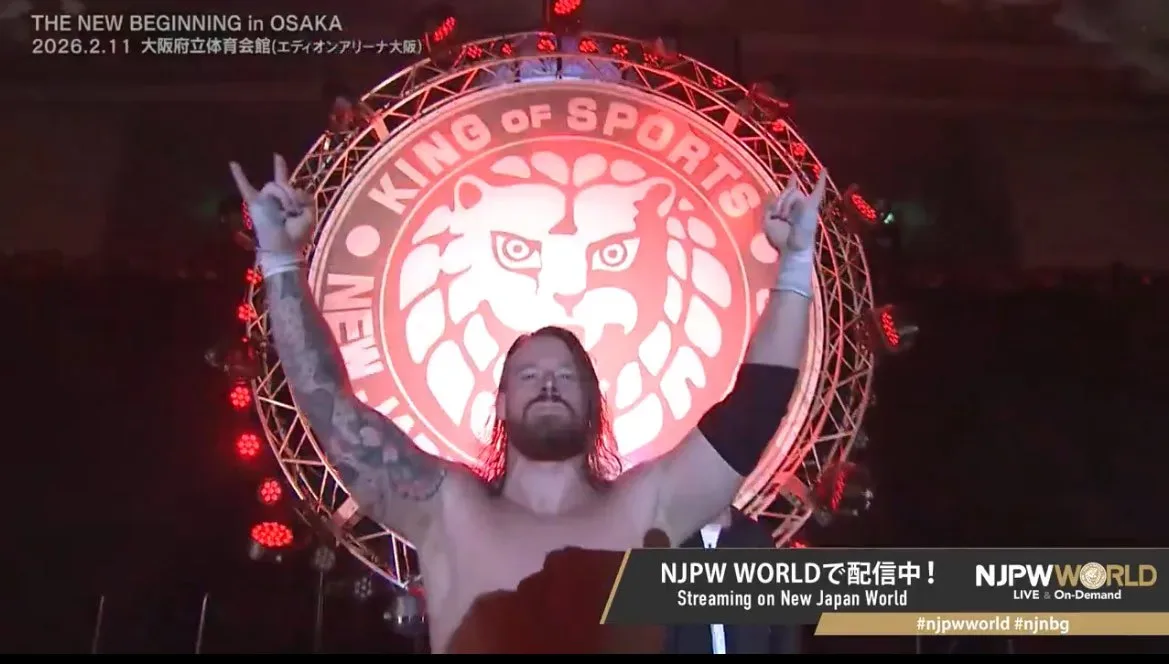
David Finlay has reflected on a significant turning point in his New Japan Pro-Wrestling career, saying the company moved him from a weekly arrangement to a salaried deal after All Elite Wrestling launched.
Speaking during an appearance on Talk Is Jericho, Finlay discussed his long association with NJPW and the contract security he had sought while establishing himself within the promotion. The current leader of The Dogs said he had been trying to secure a longer-term situation before the landscape changed with AEW’s arrival.
“Shout out AEW,” Finlay said with a smile. “AEW started, and I was on a weekly thing [with NJPW] until they came along and then… for some reason, they were afraid I was gonna leave.”
Finlay laughed as he described how close that possibility may have been, adding that the change allowed him to lock in a more stable arrangement with the promotion.
For more background on this topic, read Jon Moxley’s Pandemic Title Run Remembered as a Key Step in AEW-NJPW Partnership.
“Almost. So I was able to get locked in for the remainder of — it was like a yearly thing but, I don’t know, for five or six years, I was on salary.”
Finlay’s NJPW deal came during a changing wrestling business
AEW’s launch created a new major destination for wrestlers and, by extension, added another layer of competition for talent across the industry. Finlay’s comments illustrate how that shift affected contract discussions for performers already working internationally, including those who had built their careers through New Japan’s system.
Before the reported salary arrangement, Finlay said he was paid on a weekly basis. That type of setup can leave a wrestler’s long-term position less certain than a dedicated salary structure, especially in a business in which opportunities, travel and availability can change rapidly. For a performer seeking a clearer professional foundation, the move represented a meaningful development.
Finlay did not present the matter as a hostile split or claim that he was imminently headed elsewhere. Instead, his remarks framed AEW’s emergence as a factor that appeared to make New Japan more willing to formalize a longer commitment. He jokingly suggested that NJPW did not want to risk losing him as the newer promotion began offering another prominent option in the wrestling marketplace.
The distinction is important. Finlay said the arrangement was still structured on a yearly basis, but he described being on salary for roughly five or six years. That gave him a level of consistency after a period in which he had been attempting to get into a more secure contract position.
A long road through New Japan
Finlay’s comments carry added weight because of the amount of time he spent developing under the NJPW umbrella. His career in the promotion was not built overnight. He became familiar to New Japan audiences through sustained work across the roster and gradually took on larger responsibilities as his in-ring style and on-screen identity evolved.
Over time, he moved far beyond being viewed simply as a younger wrestler finding his footing. Finlay became a featured name in the company and eventually stepped into one of the most scrutinized roles in modern New Japan: leading Bullet Club after Jay White’s departure from the group.
That assignment placed Finlay at the center of one of wrestling’s most recognizable factions. Bullet Club has undergone numerous changes in membership, direction and leadership over the years, and each new era comes with strong expectations from fans. Finlay’s tenure demanded that he establish his own approach rather than merely imitate the leaders who came before him.
His recollection of the salary deal offers another look at the professional foundation that existed behind that rise. Contract security does not determine a wrestler’s creative trajectory on its own, but a longer-running financial arrangement can provide the stability needed to grow into greater roles. In Finlay’s case, he spent years under that setup before moving into the prominent leadership position he later held.
The significance of a salaried arrangement
In wrestling, the language around contracts can often be broad, and Finlay was careful not to describe the deal as one uninterrupted multi-year agreement. He specifically characterized it as yearly while also explaining that he was on salary for an extended stretch. The key takeaway from his account is that he moved beyond the weekly system that had been in place when he initially pursued greater stability.
That transition matters in the context of a promotion like NJPW, where the roster has historically included a mix of domestic stars, international talent, touring performers and wrestlers working under varied circumstances. New Japan’s relationship with its talent has changed across different eras, particularly as the global wrestling business has become more interconnected.
Finlay’s experience does not establish a universal model for every wrestler who worked with NJPW. It does, however, provide a personal account of how one talent’s circumstances changed at a moment when the industry was recalibrating around AEW’s arrival. His story is also a reminder that the impact of a new promotion can extend beyond headline signings. It can influence the leverage, planning and contractual conversations surrounding wrestlers who are already integral to another company.
From Bullet Club leader to The Dogs
Finlay is now signed with AEW, having joined the company in early 2026. He currently leads The Dogs alongside Clark Connors and Gabe Kidd. The group has presented a hard-edged identity built around the three wrestlers’ chemistry and their shared intensity.
That present-day role adds another layer to Finlay’s recollection. The wrestler who once joked that NJPW might have feared he would leave amid AEW’s arrival is now part of the AEW roster. His comments do not establish that AEW was involved in any discussions at the time of his NJPW salary agreement, nor did he claim that he had an offer waiting elsewhere. Rather, he described the broader marketplace as the circumstance that prompted New Japan to make a move.
Finlay’s journey also underscores how quickly professional circumstances can change over a career. A wrestler can move from weekly terms to a salary structure, take on leadership duties in one of the sport’s most historically important factions, and later arrive in a different major promotion with a new unit around him. Each chapter carries its own stakes, but the experiences are connected by the performer’s effort to build lasting leverage and a clearly defined place in the industry.
AEW’s arrival remains a major dividing line
For many wrestlers, promoters and fans, AEW’s launch stands as a clear before-and-after point in the modern wrestling landscape. Its presence created more high-level employment opportunities while also increasing the urgency for established organizations to retain performers they considered valuable. Finlay’s story is a concise example of that wider reality.
His use of humor should not obscure the substance of what he described. He had been looking for a longer-term arrangement, had been operating on a weekly basis, and then reached a salaried setup that lasted several years. The timing, as Finlay tells it, was directly connected to the arrival of a new competitor.
There is no need to overstate the claim beyond that. Finlay did not detail the specific terms of his yearly agreements, and he did not identify every factor involved in NJPW’s decision. But he clearly tied the shift in his contractual status to the period when AEW began operating, while offering a lighthearted explanation for why New Japan finally became more willing to secure him.
For Finlay, the memory appears to be one of appreciation as much as negotiation. His “Shout out AEW” line was delivered with a smile, acknowledging that the company’s creation had an indirect positive effect on his own situation before he ever became part of its roster.
As he continues leading The Dogs with Connors and Kidd in AEW, Finlay’s account provides useful context for the path that brought him to this stage. His years in New Japan were central to his development, and the salary arrangement he described gave him a sustained run of security during a formative and increasingly prominent period of that career.

Darryl Polo
Darryl Polo is a passionate wrestling fan covering WWE, AEW, TNA and beyond. He loves great rivalries, breakout stars and the moments that keep fans talking long after the bell. How we work.