
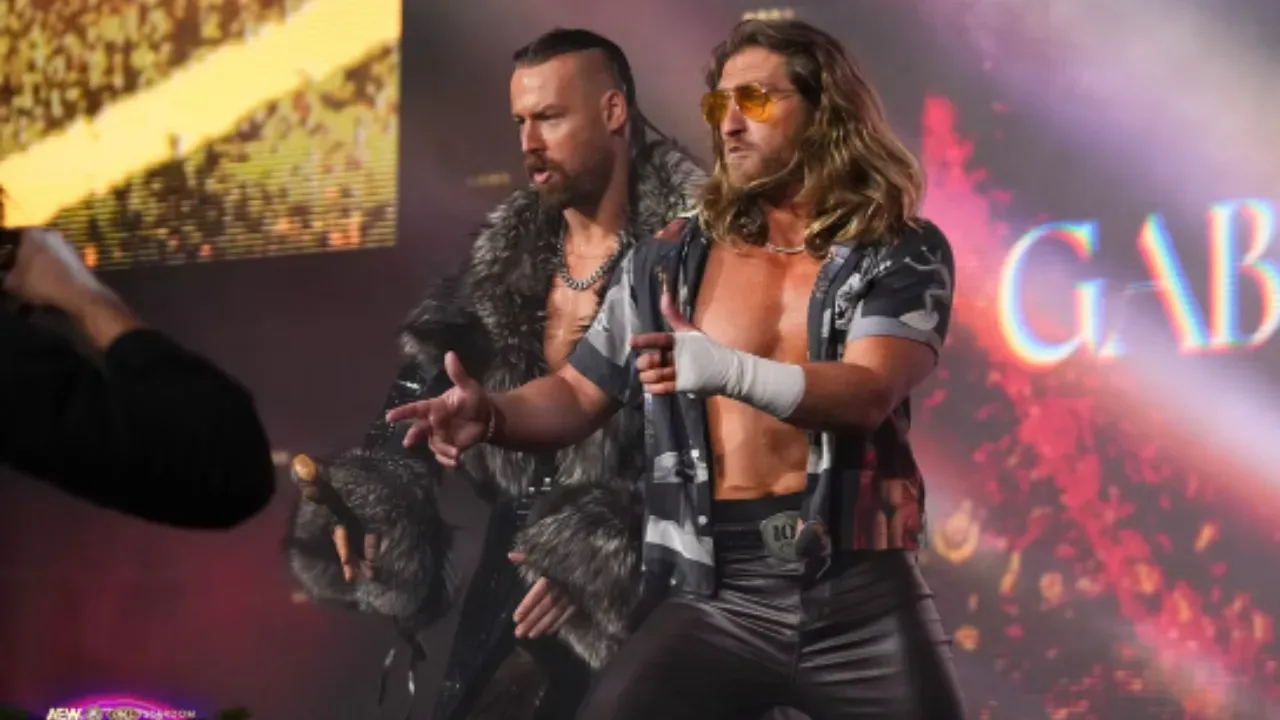
David Finlay’s move into All Elite Wrestling has brought a new set of in-ring demands for a performer whose career was largely shaped in New Japan Pro-Wrestling. The Dogs member has made clear that he is still learning the finer points of working in a television-driven environment, particularly when it comes to camera positioning, strict timing and the need to make rapid adjustments during a match.
Finlay has been with AEW since 2026 following a lengthy run in NJPW that spanned the majority of the past decade. That experience gave him a major-stage background and the ability to work long, physically demanding matches, but he explained that the structure surrounding an AEW bout can be markedly different from what he had grown accustomed to in Japan.
Speaking on Talk Is Jericho, Finlay was asked whether he was still getting used to working around television cameras and the hard camera. His answer was direct: the adjustment remains a work in progress.
“Yeah, yeah,” Finlay said. “I’m still adjusting, I feel like. I had a little bit of experience with working for companies in the States, like just a tiny bit so it wasn’t completely foreign to me but, in New Japan, it’s like, do the match and they’ll catch you.”
For more background on this topic, read David Finlay Says NJPW Moved to a Salary Deal After AEW’s Launch.
That distinction speaks to one of the central differences between a promotion built around a regular television schedule and one where the presentation of a match can operate with more flexibility. Television wrestling requires wrestlers to remain conscious not only of their opponent and the live crowd, but also of camera direction, planned broadcast beats, segment timing and the overall rhythm of a show that has a fixed amount of airtime.
For Finlay, the contrast is especially evident when comparing match length. He described an NJPW environment in which a main-event performer could often be afforded substantial freedom, provided the match delivered and did not exceed any upper limit that had been set.
“If you’re in the main event in New Japan, it’s like, yeah, however long you wanna go, which is cool,” Finlay said. “Or if you get told a time, it’s usually a range. ‘Like, from here to here,’ whatever, and as long as it’s good, you can’t go over. You never get in trouble for it.”
That kind of latitude can allow a match to develop naturally. Wrestlers may have more room to respond to crowd reactions, build through a longer middle stretch or adjust the pace based on how the audience is receiving key moments. Finlay’s comments do not suggest that one format is inherently superior to the other. Instead, they underline how each format asks for a different discipline from the talent involved.
Precision becomes part of the performance
AEW’s television setting places a premium on precision. Matches and segments must work within the framework of a tightly planned broadcast, where one overrun can affect everything that follows. A wrestler may need to shorten a sequence, alter the order of planned spots or move quickly toward the finish if circumstances change.
Finlay identified that responsibility as one of the biggest changes he has encountered. Rather than viewing it as a limitation, he said he enjoys the challenge of having to adapt in real time.
“Whereas here, it’s like, more riding on it. We’re on a tight schedule. You gotta be more precise, which is a skill in itself,” Finlay said. “I like that, of like, alright, we might have to call an audible here or we might have to adjust. I enjoy that. Thinking on my feet… Alright, how good am I really?”
The willingness to embrace those situations is notable. Finlay is not presenting the television format as an obstacle he simply has to endure. He sees it as a test of his ability to process information quickly and still deliver an effective match. In a live wrestling environment, that capacity can be crucial. Timing can change for a number of reasons, and a performer must maintain the story of the bout while making those changes appear seamless to viewers.
Camera awareness is another important piece of that puzzle. Wrestling for a live audience and wrestling for a televised audience overlap in many ways, but they are not identical tasks. A crowd inside the building can follow the physical action from a variety of angles. The audience at home, however, experiences the bout through the production team’s selected shots. Knowing where the hard camera is, understanding when a facial expression can register most clearly and ensuring pivotal moments are visible can significantly affect how a match translates on screen.
Finlay’s comments show that he remains actively engaged with that learning curve. He had some prior experience in the United States before joining AEW, so the television environment was not entirely new to him. Still, limited exposure is different from being part of a promotion where weekly broadcasts make those concerns a consistent part of the job.
A decade of NJPW experience remains a foundation
Finlay arrives in AEW with the benefit of extensive experience in New Japan, where he spent the last decade of his career before this new chapter. That background has given him a foundation in working high-stakes bouts, navigating a major promotion’s expectations and performing in front of demanding audiences.
His current transition is therefore less about starting over and more about expanding his range. The core elements of wrestling—timing with an opponent, crowd engagement, physical storytelling and match structure—remain essential. The difference lies in how those skills are applied within a more rigid television production model.
There is also a creative dimension to the issue Finlay raised. A defined television window can force wrestlers to identify what matters most in a match. Every sequence must contribute to the overall story, establish character, create momentum or advance toward the finish. While longer matches offer room for an extended arc, a tighter schedule demands clarity and economy without sacrificing the emotional or physical impact of the performance.
Finlay’s description of potentially needing to “call an audible” reflects the collaborative nature of that process. It requires communication between opponents and a clear understanding of the intended match. If time is cut or circumstances require a change, both wrestlers have to recognize the new path and execute it without disrupting the audience’s experience.
Recent AEW action at All Out
Finlay was last in action in late September at AEW All Out: Tailgate Brawl. The appearance continued his work within AEW as he becomes more familiar with the company’s presentation and the demands that come with performing on its programming.
His remarks on Talk Is Jericho offer a candid look at a transition that can often be overlooked. Fans see wrestlers change promotions and may focus on new opponents, alliances or opportunities. Behind the scenes of the performance itself, however, a move from one major system to another can require meaningful adjustments in pacing, production awareness and decision-making.
For Finlay, that adjustment is still ongoing. Yet his comments indicate that he is approaching it with curiosity rather than frustration. The tight scheduling, need for exact timing and possibility of last-second changes have become a way for him to measure himself as a performer.
That outlook could serve him well as his AEW run continues. Finlay already has the experience of a decade in NJPW behind him, and he is now adding the specialized demands of televised wrestling to his skill set. Whether a bout calls for a carefully timed sprint, a camera-conscious showcase or an abrupt in-ring adjustment, Finlay appears eager to meet the challenge and find out how far his adaptability can take him.

Darryl Polo
Darryl Polo is a passionate wrestling fan covering WWE, AEW, TNA and beyond. He loves great rivalries, breakout stars and the moments that keep fans talking long after the bell. How we work.