
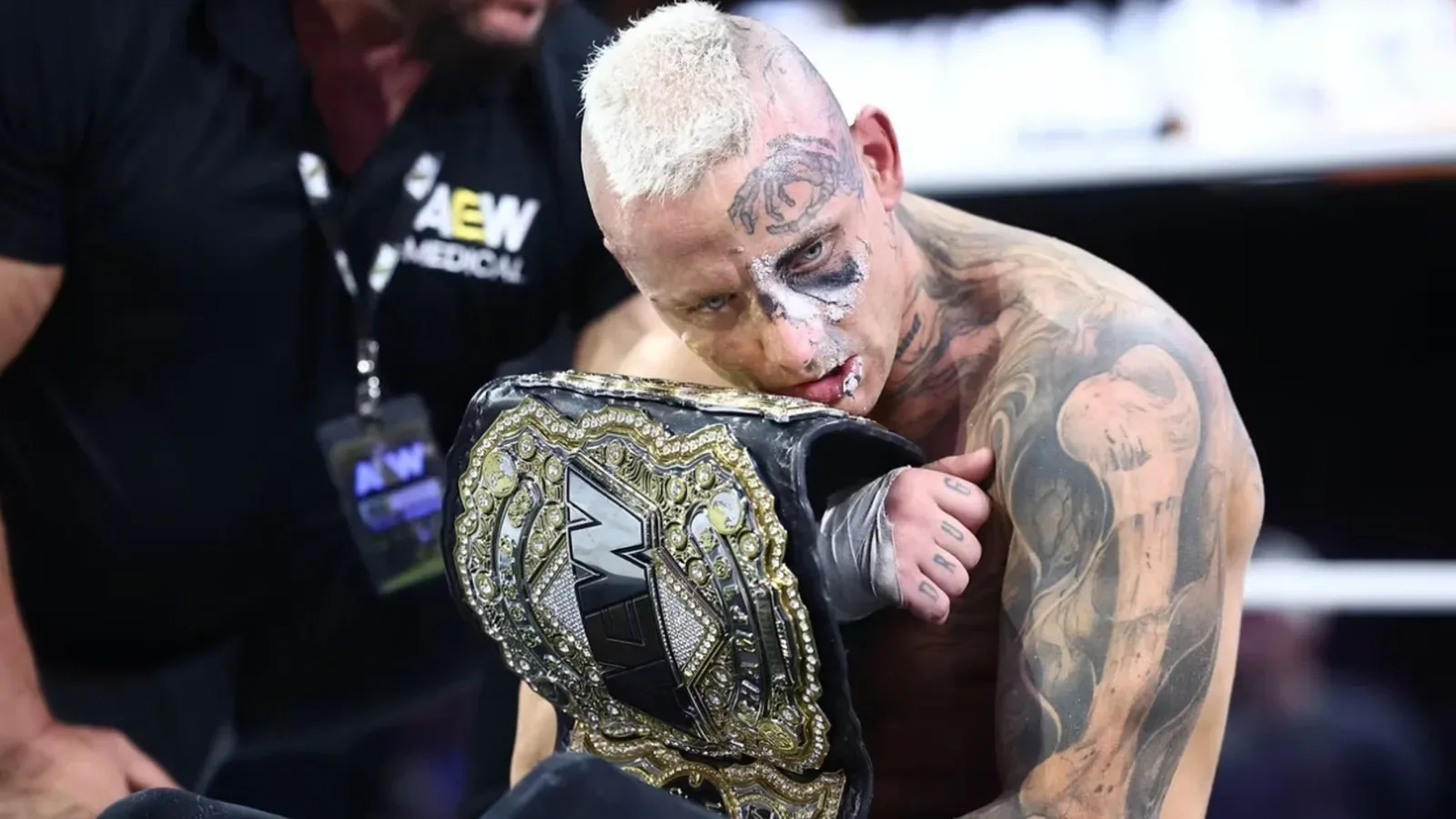
Darby Allin has made a career out of embracing the difficult route, and that perspective is central to how he views the championships he has held in AEW.
The current AEW TNT Champion said the title means more to him personally than the AEW World Championship. For Allin, the distinction is not about diminishing the company’s top prize. Instead, it reflects the role the TNT Championship played in establishing him during a defining period for both his career and AEW.
Allin is currently in his third reign with the TNT Championship, a belt he first captured in 2020. Speaking on Going Ringside, he explained that his first run as champion came at the point when he felt he had truly found his place in the company. That timing, during the pandemic era, forged a lasting connection between Allin and a championship he sees as a platform for action rather than status alone.
“Honestly, I’ll be real, the first time I really found my footing in this company was during the pandemic when I became TNT Champion,” Allin said. “So, this championship means more to me than when I won the World Championship. I felt more winning this than winning that.”
For more background on this topic, read Kairi Sane Makes Emotional In-Ring Return on Chris Jericho’s Rock ’N’ Rager at Sea.
That is a notable statement from a wrestler who has reached AEW’s highest mountaintop. The World Championship is traditionally presented as the ultimate individual prize in the promotion, the title associated with the leading figure in the company. But Allin’s relationship with the TNT Championship is rooted in experience, responsibility, and the work he believes a champion must put in after the title is won.
Allin said the importance of a championship ultimately comes down to the performer carrying it. In his view, a belt can be elevated through consistent activity, memorable defenses, and a willingness to take on every challenge. That philosophy has long matched his identity inside the ring, where he is known for putting his body on the line and fighting from underneath against bigger or more favored opponents.
“And I think it’s up to me, as the performer that I am, to make this TNT Championship mean more than the World Championship because to me, it’s just, it’s like what you do with it,” Allin said. “There’s champions that can sit and do nothing, or there’s champions that can do everything. So, that’s kind of my whole MO with this title.”
A championship built around Allin’s identity
Allin’s comments underline why the TNT Championship has often seemed especially suited to him. Since arriving in AEW, he has been presented as a relentless competitor who does not need ideal circumstances to pursue a win. His matches frequently revolve around endurance, survival, and the willingness to absorb punishment that many competitors would avoid.
The TNT title has offered a natural setting for that approach. It is a championship that can be defended frequently and against a wide range of opponents, giving its holder repeated opportunities to define the reign through performance. Allin does not view that workload as an obligation separate from being champion. He sees it as the entire point.
His first TNT Championship victory in 2020 represented an important breakthrough. The pandemic changed the atmosphere around professional wrestling, creating a period in which performers had to connect with audiences under unusual circumstances. For Allin, winning the championship during that stretch marked the moment he felt he had found his footing in AEW.
That history explains why the current reign carries emotional weight beyond the title itself. Allin is not simply returning to a belt he has won before. He is returning to a symbol of the stage where he became a more fully realized version of himself as an AEW performer.
There is also a clear personal logic to his description of the TNT Championship as an underdog title. While the World Championship occupies the highest position in the company’s title hierarchy, Allin has never built his persona around being the obvious favorite. His appeal has come from the opposite direction: taking risks, confronting obstacles, and refusing to be counted out.
“It’s kind of the underdog title, per se, you know, in the grand scheme of everything, but that’s what I live by,” Allin said. “So, yeah, I feel a lot more passionate about this.”
The contrast with his World Championship reign
Allin’s assessment is particularly revealing because he has experienced the intensity of holding the AEW World Championship. His reign lasted 39 days after he defeated MJF for the title, only for MJF to win it back. Becoming World Champion put Allin in a position many wrestlers spend their entire careers trying to reach, but the circumstances of that victory left little room for him to fully enjoy the moment.
The match against MJF was grueling, fitting the pattern of Allin giving everything he has to overcome the odds. By the time he secured the championship, he was drained of energy. That physical toll meant the victory did not carry the same immediate feeling for him as his first TNT Championship triumph.
It does not change the significance of winning the AEW World title or the accomplishment of defeating MJF. It does, however, offer a window into the way Allin measures success. For him, the feeling attached to a championship is not determined solely by where it sits on a promotional hierarchy. The circumstances, the journey, and the work a wrestler can do while holding it all matter.
That approach is consistent with Allin’s broader career. He has repeatedly pursued difficult goals with a style that invites danger and demands resilience. Whether he is challenging for a top championship or defending the TNT title, his objective is to make the match feel consequential. His comments suggest he believes a champion’s commitment can make that consequence visible to the audience.
What Allin wants from this reign
Allin’s third TNT title run now comes with a direct mission statement. He wants to make the championship feel vital through what he does with it. The phrase “do everything” is especially important because it frames the belt as a responsibility that requires initiative. A champion cannot merely possess a title; in Allin’s eyes, that performer must actively build its value.
For the TNT Championship, that means Allin is likely to continue leaning into the traits that made him a central figure in its history in the first place. He thrives when a match presents a mountain to climb, whether that is a physical mismatch, an established opponent, or the cumulative consequences of a punishing schedule. Those are the situations in which his underdog mentality is most visible.
His words also create an interesting standard for the reign. By openly saying the TNT title means more to him than the World Championship, Allin has placed a high level of expectation on himself. The statement is not a declaration that the title is automatically more important. It is an insistence that he intends to treat it with enough urgency and ambition to make its significance impossible to ignore.
That is the distinction at the heart of Allin’s view. Prestige can be inherited, but meaning has to be created. The AEW World Championship carries the status of being the company’s premier prize. The TNT Championship, in Allin’s hands, carries the story of when he found his footing, when he developed as a champion, and when he came to understand what he wants his role to be.
Allin has held both championships, and his preference is clear. The World title represented a remarkable achievement, but the TNT Championship represents something more personal: the underdog path, the willingness to fight through exhaustion and adversity, and the chance to prove that a title reign is defined by what its champion is prepared to give.
In pictures

Darryl Polo
Darryl Polo is a passionate wrestling fan covering WWE, AEW, TNA and beyond. He loves great rivalries, breakout stars and the moments that keep fans talking long after the bell. How we work.