
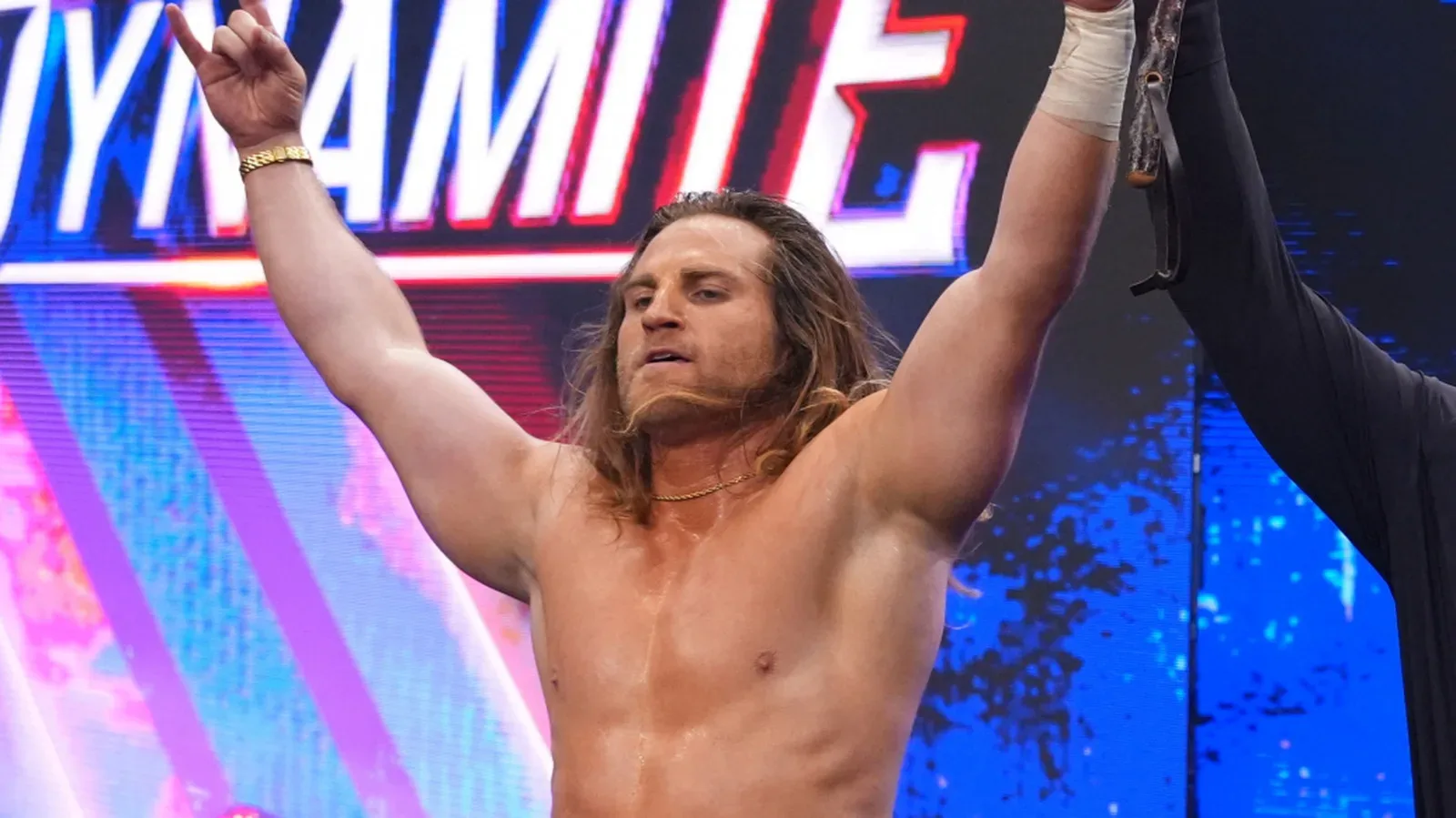
Clark Connors didn’t wait long to find out what an AEW match looks like when it spills out of the ring. In his first year with the promotion, the former NJPW wrestler competed in Stadium Stampede at Double or Nothing and Anarchy in the Arena at Full Gear. Those two appearances gave him a distinction he was happy to point out: Not many wrestlers have worked both of AEW’s sprawling match formats, let alone done so before completing a full year with the company.
Connors officially signed with AEW at the beginning of the year after wrestling a January match on Collision. Speaking with TMZ’s Inside the Ring, he put his tenure at less than 10 months, then had some fun with the idea that he still qualified as a newcomer.
“For a ‘rookie’ in this company, I feel pretty damn good,” Connors said. “I feel pretty ready to go.”
The distinction matters to Connors. He came to AEW with years of experience in Japan, but he didn’t expect that experience to make him a familiar face to everyone watching in the United States. His first year has been about what he could show those fans here, and AEW has given him some unusual settings in which to do it.
For more background on this topic, read MJF Asks Wrestling Fans to Set Aside Brand Rivalries After Bronson Reed’s Death.
From Stadium Stampede to Anarchy in the Arena
Full Gear was Connors’ most recent outing, with Anarchy in the Arena adding another major-event appearance to a run that already included Double or Nothing’s Stadium Stampede. He also wrestled in a double chain match at Redemption. The three bouts tell a more specific story than a simple list of event appearances: A significant part of Connors’ introduction to AEW has come in matches where the stipulation is as much a draw as the names involved.
Stadium Stampede and Anarchy in the Arena put a different demand on a newcomer than a conventional singles match. The setting lets several wrestlers split off and carry their own pieces of the action. It creates opportunities for someone like Connors to stand out, but it also means he has to do so while viewers are keeping track of what is happening elsewhere. The double chain match gave him another stipulation to work with without relying on the scale of an arena-wide brawl.
Working both of the larger formats is the milestone Connors singled out in the interview. It isn’t a claim about his win-loss record or where he stands in a title picture. It’s a measure of how quickly he’s had to get comfortable with some of AEW’s most distinctive matches. For a wrestler still introducing himself to part of the audience, having more than one shot at that kind of match also means his first impression doesn’t rest on a single appearance.
Familiar partners helped bridge the move from NJPW
Connors hasn’t made the transition alone. He has competed alongside fellow former NJPW wrestler David Finlay as The Dogs, with Gabe Kidd also having been part of their stable. Connors and Finlay have since teamed up with Jay White and The Cut. The company and the audience may be different, but Connors has had an established partnership to build on rather than starting from scratch.
For viewers who followed Connors in Japan, Finlay’s presence provides continuity. For fans meeting both men through AEW, the partnership is an introduction in its own right: They can see how Connors fits with the people around him without needing to know the group’s history. That’s useful in the sort of multi-person matches Connors has worked this year, where knowing who is aligned with whom helps make sense of the action when it leaves the ring.
There’s a difference, though, between recognizing The Dogs and recognizing Connors on his own. The group gives him a place in the story, but in the interview he spoke about making his own name stick with viewers. His assessment of the year hinged less on being associated with familiar wrestlers than on getting enough time in front of fans to show them what he can do.
Connors remembers a very different first year in Japan
To explain why he feels so good about his start in AEW, Connors went back to his first year in Japan. He joked that he was doing “about a thousand squats a day” and handling Manabu Nakanishi’s laundry. He also cracked that the current arrangement was better than getting paid in chankonabe, the Japanese hot pot dish. The food line was a joke about his early days, not a claim about how NJPW paid him.
Behind the jokes was a useful comparison. When Connors talked about starting out in Japan, the details he remembered were the training and chores. When he talked about starting out in AEW, he pointed to matches at Double or Nothing and Full Gear. Both were first years, but they came at very different stages of his career. Starting over with a new audience hasn’t meant starting over as a wrestler.
“Now, this year, I couldn’t be happier,” Connors said. He acknowledged that some American fans might have caught glimpses of him before he signed, but he didn’t assume those appearances had left much of an impression. As he put it, “I think a lot of the American audience didn’t necessarily have any idea who I am.”
The next test is keeping the audience’s attention
That admission makes his enthusiasm about the big matches easier to understand. Prior experience helped prepare him for the work, but it couldn’t substitute for viewers seeing him do it. Stadium Stampede and Anarchy in the Arena gave him two prominent chances to reach fans who hadn’t followed his NJPW run. His point in the interview was that those fans are now getting to see him often enough to form an opinion of their own.
“But, I got to show everybody that I am that dude,” Connors said. “I’m proving it every week, week in and week out.”
The question coming out of Full Gear is whether the recognition Connors has built in those big group matches will carry over when the setting is less spectacular. An arena-wide brawl can put him in front of a lot of people at once; the work between major events is where those people have a chance to get to know him. Connors sounds as keen on that part of the job as he does on the chaos. Still short of his first anniversary, he no longer has to rely on fleeting appearances to make his case.
In pictures

Darryl Polo
Darryl Polo is a passionate wrestling fan covering WWE, AEW, TNA and beyond. He loves great rivalries, breakout stars and the moments that keep fans talking long after the bell. How we work.