
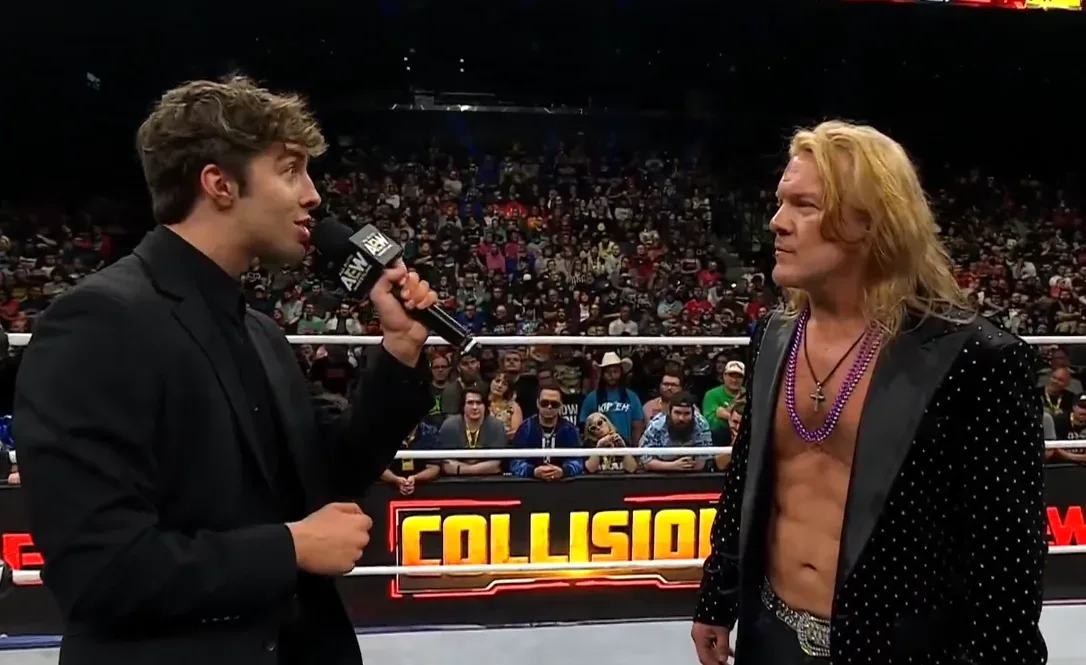
Chris Jericho believes the current chapter of his AEW rivalry with Nick Wayne is about far more than a necklace. As the two prepare to meet for a second time in singles competition at AEW Grand Slam France, Jericho has explained that the puka necklace associated with Wayne became a useful symbol for a broader story: the 21-year-old’s effort to move beyond the version of himself that could be beaten by the veteran.
Jericho and Wayne began feuding in September, setting up a generational clash between a wrestler with decades of major-match experience and one of AEW’s youngest talents. But Jericho said the creative direction was deliberately not built around the most obvious age-based framing. Instead, the focus shifted to experience, evolution and whether Wayne can transform himself into a more complete performer.
That transformation has been represented by Wayne’s decision to get rid of the necklace. Jericho said the item was never intended to be important simply as an accessory. In the context of the rivalry, it has served as a visual marker of the old Nick Wayne being left behind as a new version attempts to emerge.
“The reason why we started that, we sat down before we did that initial promo and it’s like, what is our angle going to be?” Jericho said. “I mean, once again, 2005, he’s 21 years old. I’m 55. You don’t want to make it old guy versus young guy because that doesn’t translate and I don’t feel like an old guy, I don’t work like an old guy.”
For more background on this topic, read Chris Jericho Explains Why AEW Talent Must Find Solutions, Not Simply Say No To Tony Khan.
Jericho’s point is that a simple veteran-versus-prospect narrative would not have given the issue enough substance. Wayne’s age is a major part of the story, particularly because he has already spent roughly a decade in wrestling despite being only 21, but Jericho sees the more relevant difference as the lessons that time in the industry has yet to teach him.
While Wayne has accumulated an unusually substantial amount of ring experience for someone his age, Jericho’s assessment is that the next decade could be even more consequential for his development. The AEW veteran said Wayne has the tools to become exceptional, while stressing that there are elements of professional wrestling a young talent cannot fully understand until they have lived through them.
“It’s experience,” Jericho said. “He’s got 10 years of experience at 21, 10 years from now he’s going to be unbelievable but right now, you don’t know what you don’t know.”
That idea gives their match at AEW Grand Slam France an added layer. Wayne is not merely trying to score a win over a decorated opponent. He is trying to demonstrate that his evolution is real and that he can stand across from a performer of Jericho’s stature without being defined as the younger wrestler who still needs to learn every lesson the hard way.
Jericho said he and Wayne considered different possible concepts when they initially discussed their program. One possibility involved legacy, but the direction ultimately became more specific: Wayne changing his identity and presentation to show that he is no longer the same competitor Jericho could defeat. The necklace offered an immediate, tangible image for that shift.
“He was saying that he wants to get rid of the puka necklace and I thought, well, let’s try and make that part of the story where it’s not about the necklace, it’s about the representation of the old Nick Wayne,” Jericho said.
In that framing, the necklace is a totem rather than the feud’s true prize. It represents the version of Wayne that is being discarded. Jericho described that former version as one who could lose to him, while the new version is supposed to be more serious, more composed and better equipped to handle pressure on a major AEW stage.
Wayne’s presentation has changed alongside that message. Jericho specifically pointed to Wayne wearing a suit and being able to hold his own verbally against him as signs of the character’s progression. Those details matter because they communicate the story before the bell rings. A wrestler’s gear, demeanor and confidence can all reinforce whether the audience believes an internal change has taken place.
For Wayne, the challenge is making that evolution feel earned in the ring. A new look and a sharper speaking presence can establish an intention, but Jericho’s role in the story is to test whether that intention holds up when the younger wrestler faces a seasoned opponent. Their upcoming singles match provides the clearest opportunity yet for Wayne to prove that the new phase is more than a declaration.
“The old Nick Wayne that could lose to Chris Jericho, well, that’s not going to happen ever again,” Jericho said. “This necklace is gone, the old Nick Wayne is out, the new Nick Wayne is in. The new Nick Wayne that wears a suit, the Nick Wayne that can hold his own in a promo against Chris Jericho. The Nick Wayne that might have a chance to beat Chris Jericho, well don’t know yet.”
The uncertainty in Jericho’s final point is central to the appeal of the contest. Wayne may believe he has grown past the competitor Jericho initially confronted, but he still has to validate that belief. Jericho is not presenting the outcome as a foregone conclusion. He is presenting it as the test that determines whether Wayne’s claimed growth has reached the point where he can defeat an opponent with vastly more experience.
At 55, Jericho also made clear that he does not view himself as an “old guy” in the conventional sense of that storyline label. He rejected the notion that the rivalry should hinge on a declining veteran trying to fend off youth. His perspective is that he remains capable of performing at a high level, which changes the dynamic. Wayne is not being handed a symbolic generational victory; he is facing someone who believes he can still outwork and outthink a younger opponent.
That gives the match a natural competitive tension. Jericho’s experience is presented as an advantage that cannot be replicated quickly, even by a wrestler who began training and competing at a young age. Wayne’s upside, meanwhile, is the possibility that he can absorb those lessons, adapt and become a different level of performer before his prime has even fully arrived.
Jericho went as far as saying the next version of Wayne has the potential to become a world champion. That is a significant endorsement, particularly in the context of a feud designed around Wayne’s growth. It does not guarantee a title run, nor does it erase the questions Jericho raised about Wayne’s current level. Rather, it identifies the ceiling Jericho sees if Wayne continues developing through the next stage of his career.
“The point being it wasn’t about the necklace itself, it was like a totem of where that was signifying the end of this version and now we’re going into the next version, next phase of Nick Wayne, who has potential to be a world champion,” Jericho said.
AEW Grand Slam France now becomes the next major checkpoint in that process. Their second singles encounter will test the central claim of the storyline: that Nick Wayne has shed the earlier version of himself and is prepared to become something greater. A win would provide the strongest possible evidence for Wayne’s argument. A loss would not necessarily end the story of his potential, but it would reinforce Jericho’s point that experience remains a difficult barrier to overcome.
Whatever happens in France, Jericho’s comments have clarified the intent behind one of the rivalry’s most recognizable details. The puka necklace is not the destination. It is the symbol of a departure, with Wayne attempting to step into a more polished, more confident and potentially championship-caliber identity. The question heading into their rematch is whether the new Nick Wayne is ready to make that identity undeniable against Chris Jericho.

Darryl Polo
Darryl Polo is a passionate wrestling fan covering WWE, AEW, TNA and beyond. He loves great rivalries, breakout stars and the moments that keep fans talking long after the bell. How we work.