
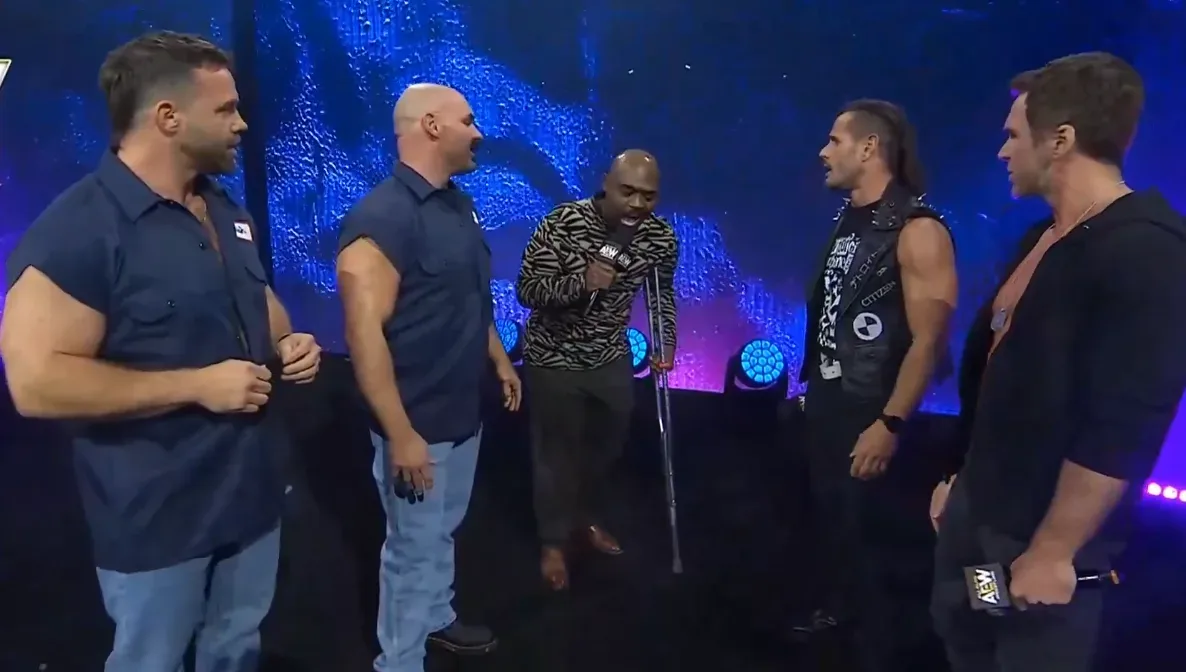
FTR and the Motor City Machine Guns have already established that their best-of-five series will not be decided by reputation alone. Alex Shelley and Chris Sabin drew first blood at WrestleDream, only for Cash Wheeler and Dax Harwood to answer on the following episode of Collision. With the series level at one victory apiece, Wheeler believes the longer the rivalry continues, the more it shifts toward FTR.
The third meeting is scheduled for AEW Fright Night Dynamite, putting both teams in position to take a pivotal 2-1 advantage. A win there would not end the series, but it would put enormous pressure on the losing side and move the rivalry one step closer to its potential final chapter. Wheeler, however, is confident that a fifth and deciding match would be especially favorable territory for FTR.
His reasoning is rooted in the style that has defined FTR throughout its run: patience, physicality, ring awareness, and an ability to extend a match until the opposition is forced to operate beyond its preferred pace. Wheeler acknowledged the explosive qualities of Shelley and Sabin, but argued that FTR has repeatedly proven it can thrive when a contest becomes a test of stamina as much as execution.
Wheeler sees endurance as FTR’s greatest advantage
Wheeler said he expects the series to work out in FTR’s favor, particularly if it goes the distance. In his view, the team has built a career around excelling after matches move beyond conventional length and into deeper, more physically demanding territory.
For more background on this topic, read Kofi Says Young Bucks and Kenny Omega Were the Main Draw Behind AEW Move.
“I mean, shockingly, I see it working out in FTR’s favor. Everybody knows that for us in particular, the longer a match goes or the longer a series goes, the better off we are. We thrive in those marathon style matches.”
FTR’s history offers support for that confidence. Wheeler pointed to the team’s 58-minute match with Jay White and Juice Robinson, as well as its 45-minute battle with Mark and Jay Briscoe. Those examples represent more than simply long matches on a résumé. They reflect the kind of pacing FTR wants to impose: a methodical structure that turns every early exchange into an investment and makes fatigue increasingly important as the clock advances.
For FTR, extended matches are often opportunities to tighten control. The team is comfortable slowing an opponent down, isolating one member of a tag team, targeting injuries, and turning transitions into moments where experience matters. That does not mean their opponents lack conditioning or technical ability. Shelley and Sabin are among the most accomplished tandem wrestlers of their generation. But Wheeler’s argument is that a match can change dramatically when it reaches the point where both teams have exhausted their familiar patterns.
“When you get into those deep waters, when you get past the point of a normal match and you’re in a new realm, I think we thrive there. I think that’s our milieu.”
That distinction could become central as the best-of-five moves forward. A series creates a different challenge from a single high-profile encounter. Each team is not only trying to win the next match, but also trying to identify tendencies, exploit wear and tear, and make adjustments that will carry over into the next round. The physical toll can compound quickly, especially when four wrestlers with decades of high-level tag team experience are determined to establish superiority.
Motor City Machine Guns bring a different type of danger
Wheeler did not dismiss what the Motor City Machine Guns bring to the ring. Instead, he framed Shelley and Sabin as a team that may be at its most dangerous early in a contest, when speed, urgency, and their rapid-fire chemistry can create an advantage before FTR has the chance to settle into its preferred rhythm.
“I don’t know if Motor City can say the same thing. They might be more explosive in those first 15 minutes or those first 20 minutes, but once you get past that, which we are very good at making sure that we can drag that out a little bit to get that advantage, I think it plays to our favor.”
That assessment establishes a clear strategic contrast for the third match and any possible matches that follow. The Machine Guns may look to seize the pace immediately, using their longstanding timing and quick combination offense to force FTR to react. FTR, meanwhile, will likely seek to make every exchange more deliberate, turn the contest into a grinding fight, and deny Shelley and Sabin the chance to string together the type of momentum that can overwhelm even experienced opponents.
The opening two bouts have already ensured that neither side can rely solely on a familiar game plan. Shelley and Sabin proved at WrestleDream that they can defeat FTR under the brightest circumstances. FTR’s Collision victory then prevented the Machine Guns from gaining the kind of early series control that can be difficult to overcome. At 1-1, both teams have a result they can point to as evidence that their approach works.
The difference now is that each side has more information. FTR has experienced firsthand the pressure Shelley and Sabin can create. The Machine Guns have also seen FTR respond after a setback. As the series enters its middle stage, execution remains important, but adaptation may be equally critical.
All Out aftermath remains part of FTR’s explanation for Match One
Wheeler also addressed the circumstances surrounding FTR’s defeat in the series opener. He attributed the loss in part to the condition both teams were in after AEW All Out, where FTR and the Machine Guns had competed in a ladder match. Wheeler described that ladder match as an especially punishing experience and suggested that the consequences carried into WrestleDream.
“Then, you think about the fact that we lost match one, sure. But, we were both coming out of a ladder match that took a couple years off our careers each. So, we’re just still getting back to full health.”
That context does not erase the result at WrestleDream. Shelley and Sabin earned the first victory, and FTR’s subsequent Collision win made the series even. Still, Wheeler’s comments make clear that he sees FTR’s physical condition as a major factor in evaluating the opening match and forecasting what comes next.
He specifically noted that he is working to regain healthy range of motion in his shoulders. In a tag team series built around hard strikes, suplexes, submissions, and repeated collisions, that kind of limitation can influence everything from a wrestler’s ability to absorb impact to the execution of offense and defensive positioning.
“I’m getting my shoulders back into a range of motion that is actually healthy again. So, I think if those goes the full five, then that favors FTR.”
Wheeler’s outlook is therefore not simply that FTR can outlast the Machine Guns in a vacuum. He believes his team is continuing to recover and improve physically as the series unfolds. If that is the case, every additional match could give FTR more time to regain form while also adding mileage to a rivalry that has already included a demanding ladder match and two series bouts.
Match Three could determine the direction of the rivalry
The third match at AEW Fright Night Dynamite will be significant regardless of whether the series ultimately reaches five matches. A 2-1 lead is not insurmountable, but it changes the entire emotional and tactical landscape. The winning team would need only one more victory, while the other would face a situation where every match becomes an elimination bout.
For FTR, a victory would reinforce Wheeler’s contention that the team is gaining ground as the rivalry continues. It would also validate the response to their WrestleDream loss and give Harwood and Wheeler a chance to close the series before it reaches the fifth match Wheeler believes would be their ideal scenario.
For the Motor City Machine Guns, another win would offer the opposite statement. It would show that their WrestleDream result was not a one-night breakthrough, but evidence that Shelley and Sabin have the answers for one of tag team wrestling’s most decorated pairings. It would also put them on the verge of winning a series that has quickly become a showcase of contrasting philosophies.
FTR’s preferred route may be to transform this into an increasingly brutal endurance test. The Machine Guns’ task is to keep their speed and precision from being neutralized before the match reaches the type of late stages Wheeler has identified as FTR territory. Either path could lead to victory, and the 1-1 score means the series remains wide open.
What is already clear is that Wheeler expects no decline in intensity if the teams continue trading wins. He sees more matches not as a burden, but as an opportunity for FTR to take the rivalry somewhere deeper. Whether Shelley and Sabin can prevent that outcome, or prove that their own experience is just as valuable in the closing stages, will begin to be answered in Match Three at AEW Fright Night Dynamite.

Darryl Polo
Darryl Polo is a passionate wrestling fan covering WWE, AEW, TNA and beyond. He loves great rivalries, breakout stars and the moments that keep fans talking long after the bell. How we work.