
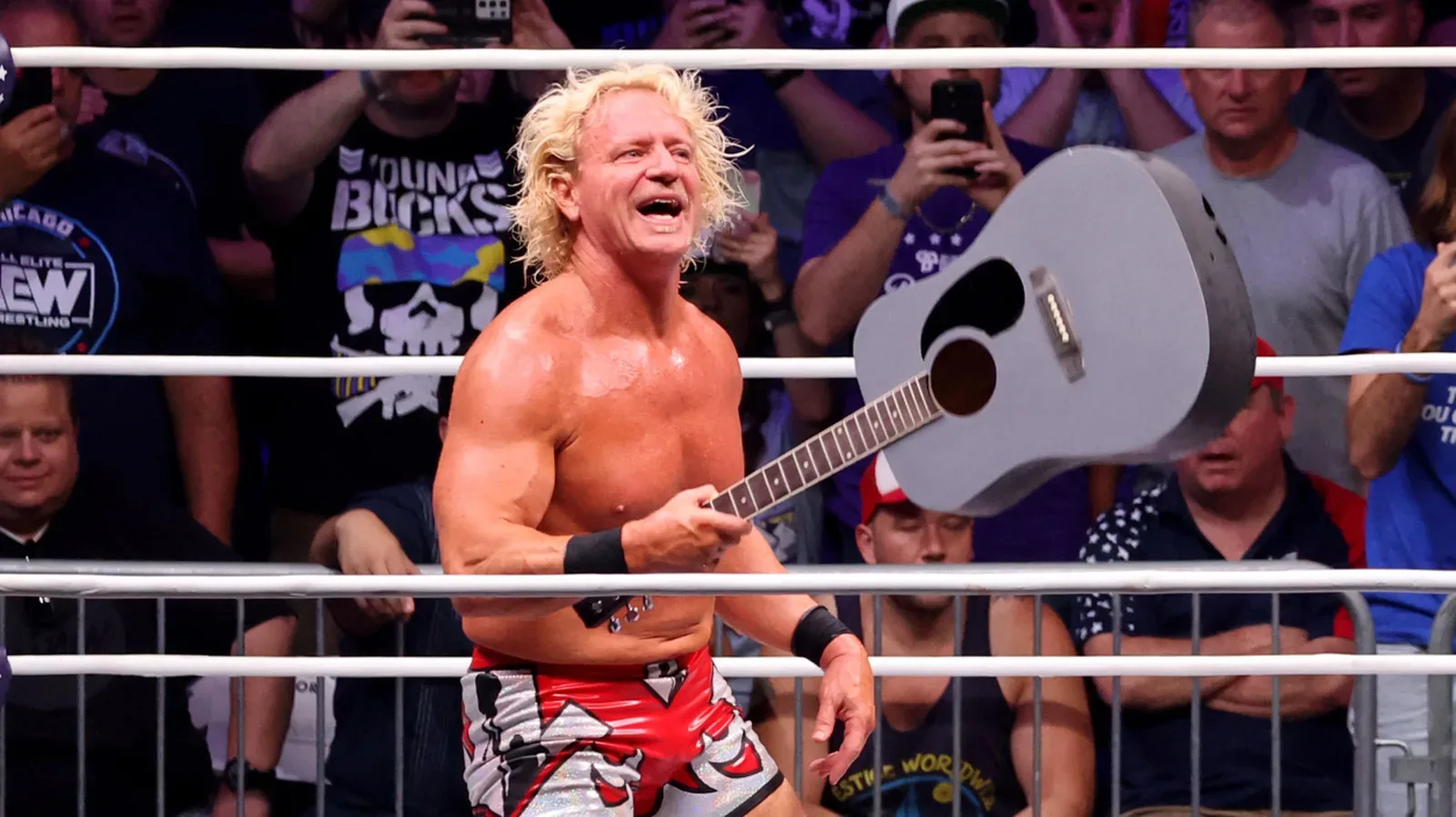
Jeff Jarrett has offered a firm defense of the comedic exchange between Andrade El Idolo and Tommaso Ciampa at AEW WrestleDream, arguing that a wrestling angle’s effectiveness should be measured by the audience in the building rather than by a blanket belief that comedy cannot be profitable.
Andrade retained the AEW National Championship against Ciampa at WrestleDream, but much of the immediate discussion around the contest centered on an unusual sequence involving Andrade’s ring pants. Removing the pants has become a familiar part of Andrade’s presentation. Ciampa answered the moment in a deliberately absurd fashion, taking off his own trunks to reveal another pair underneath before attacking Andrade’s pants and attempting a pinfall on them.
The spot produced divided responses among viewers watching from home. For some, it was a memorable bit of personality in a championship match. For others, it did not fit their preferred tone for a major AEW bout. Jarrett, however, emphasized that the response from the live audience was the most significant evidence available when evaluating whether the segment connected.
Jarrett Rejects a One-Size-Fits-All Rule for Comedy
Speaking on My World, Jarrett pushed back on the familiar criticism that humorous wrestling angles inherently undermine drawing power. He described the phrase “funny don’t draw money” as too broad to be useful in every circumstance.
For more background on this topic, read Brandon Cutler Explains The Young Bucks’ Stunning AEW Dynamite Squash Loss.
“‘Funny don’t draw money’ is such a situational...I just don’t think you can paint...creative is subjective,” Jarrett said. “Period, just period.”
Jarrett’s larger point was not that every comedy spot will work with every crowd, performer, match, or promotion. Instead, he stressed that wrestling is a subjective form of live entertainment. A sequence that turns off one fan may be exactly what another audience finds memorable, entertaining, or worth reacting to. In his view, it is not productive to treat one creative philosophy as an absolute rule across the industry.
That distinction matters in the reaction to the Andrade-Ciampa sequence. The debate did not center on confusion over what happened; the visual was designed to be clear, exaggerated, and comedic. The disagreement was about whether that type of humor belongs in the middle of a match involving a title. Jarrett’s response is that the live crowd has an immediate role in answering that question.
The Live Crowd as Wrestling’s Instant Feedback
Jarrett cited the breadth of his career while explaining why he puts considerable value on a live audience reaction. He has worked in a wide range of wrestling television environments, from regional programming to nationally visible weekly broadcasts, and he believes the crowd serves as a real-time indication of whether a creative idea is landing.
“But here’s the thing...look I’ve had a long career, so I have been a part of Saturday Morning Memphis TV, I’ve been apart of ‘Superstars’ and ‘Challenge’ and ‘Raw’ and ‘Nitro’ and ‘Thunder’ and ‘Worldwide’ and ‘Impact,’ we can go on and on and on,” Jarrett said.
That experience spans different eras, formats, and audience expectations. Wrestling has included serious personal rivalries, athletic exhibitions, supernatural characters, broad physical comedy, celebrity-driven material, and everything in between. Jarrett’s comments place the WrestleDream moment within that wider history, rather than treating comedy as something automatically separate from successful wrestling presentation.
Jarrett then pointed to the reaction inside the venue as the practical test for the segment.
“And when you have a live, quote unquote, focus group, for the most part they’re going to tell you ‘Did that work or not?’ Conrad, you had a live studio audience watching, but we also had, I don’t know, what was it, 7 or 8K at the financial arena? Did you hear the reaction? So I just think, and I get it, to each his own. It’s not for everybody.”
The comments do not dismiss fans who disliked the spot. Jarrett directly acknowledged that it would not be for everyone. But he drew a line between personal preference and a conclusion that the angle failed. If the arena responded strongly, his argument is that the performers achieved an important objective: they made the audience react.
Why the Pants Spot Became the Match’s Main Talking Point
Championship matches are often discussed first through their finish, their in-ring quality, or their implications for the title picture. Andrade’s successful defense over Ciampa remains the official result at WrestleDream. Yet the pants sequence became the visual people continued discussing afterward, illustrating why unconventional moments can have value even when they generate disagreement.
In wrestling, memorable does not always mean universally praised. A dramatic finishing stretch can be memorable. A major return can be memorable. A bizarre comic visual can also be memorable. The Andrade-Ciampa exchange clearly gave fans something specific to debate, and Jarrett’s perspective is that the energy created by such a moment should not be ignored simply because it is not aligned with every viewer’s taste.
There is also a character element to the exchange. Andrade’s removal of his ring pants has become recognizable enough that Ciampa could turn it into a response and an attack target. Ciampa was not merely participating in a disconnected joke; he was using an established Andrade trait to antagonize him. The attempted pinfall on the pants added another layer of mockery, playing directly into the rivalry’s increasingly unusual tone.
For audiences who want every title match presented with total seriousness, that approach may remain a point of contention. Jarrett’s assessment does not require those fans to change their preference. It simply argues that wrestling creative cannot be judged solely through that preference, especially when the crowd reacts audibly and the segment creates continued interest.
Andrade and Ciampa’s Rivalry Is Still Moving Forward
The WrestleDream match did not bring a clean end to the issues between Andrade and Ciampa. Ciampa attacked Andrade on the following Saturday’s Collision, continuing the conflict after Andrade’s AEW National Championship defense.
“Speedball” Mike Bailey, Andrade’s stablemate, stopped Ciampa’s attack. That intervention left the situation unresolved and strongly suggests that Andrade and Ciampa are headed toward another confrontation. With neither man appearing ready to move on, the championship rivalry has room to develop beyond the first WrestleDream meeting.
The continuing angle also means the controversial comedy could return in some form. Andrade’s pants are now established as a point Ciampa can exploit, ridicule, or use to provoke the champion. Whether AEW revisits that exact type of spot or takes the feud in a different direction remains to be seen, but Ciampa’s attack on Collision made clear that the conflict is not finished.
A Debate That Reflects Different Wrestling Tastes
The response to Andrade and Ciampa underscores a recurring reality in professional wrestling: fans can agree on the basic facts of a segment while reaching very different conclusions about its value. Andrade won. Ciampa used a comic tactic to antagonize him. The crowd reacted. Viewers at home were divided. All of those points can coexist.
Jarrett’s position is ultimately a defense of creative flexibility. He is not presenting comedy as a universal solution, nor is he saying that fans must enjoy every humorous wrestling sequence. His point is that the effectiveness of an idea is situational, and that performers and promoters should pay attention when a live building responds.
For Andrade and Ciampa, the immediate task is more straightforward: their rivalry is still active, Ciampa has escalated matters after WrestleDream, and Andrade remains AEW National Champion. The debate over the pants spot may continue, but it has also ensured that their feud has a distinct identity heading into its next chapter.
In pictures

Darryl Polo
Darryl Polo is a passionate wrestling fan covering WWE, AEW, TNA and beyond. He loves great rivalries, breakout stars and the moments that keep fans talking long after the bell. How we work.