
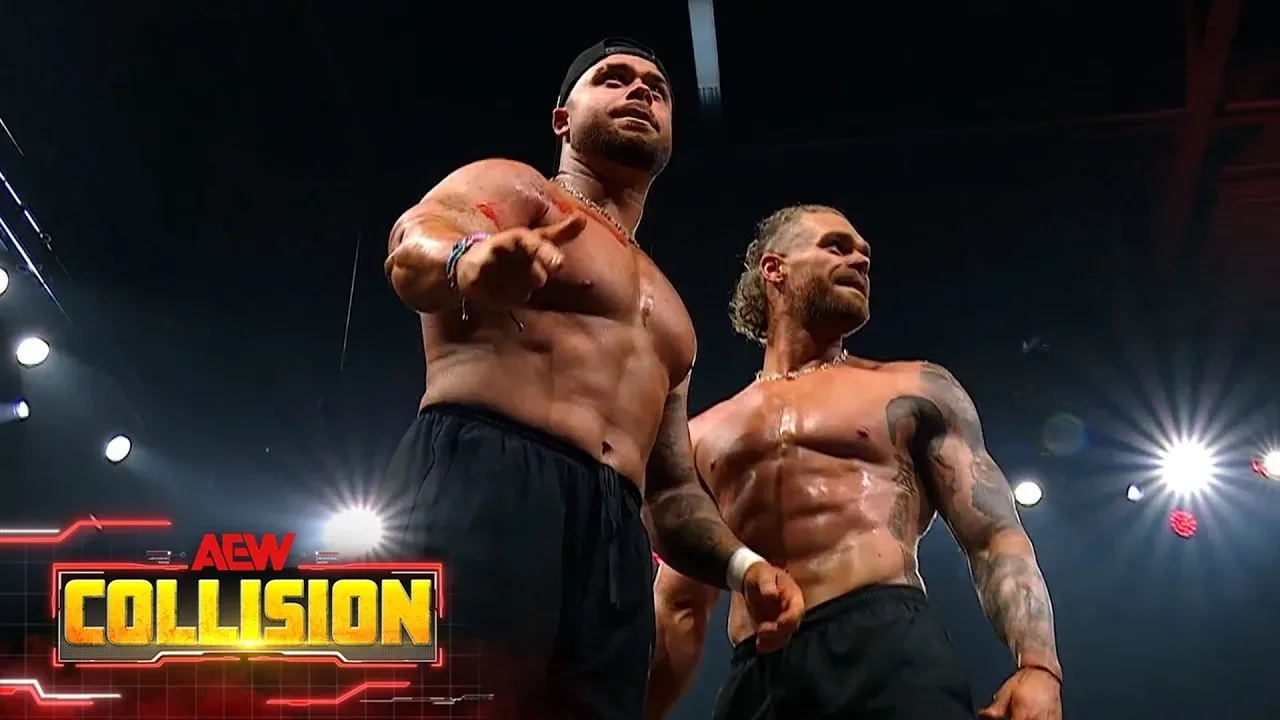
Austin Gunn has spent years learning professional wrestling under the guidance of someone with uncommon experience in the business: his father, Billy Gunn. While Billy has served as a coach and producer in AEW since the promotion began in 2019, his role as a teacher to Austin and Colten Gunn started long before the family became part of the company’s on-screen landscape.
That history has apparently included plenty of direct feedback. Speaking with Tony Schiavone and Conrad Thompson on What Happened When, Austin and Colten were asked about Billy’s pet peeves during training. Colten’s answer suggested that their father’s list of corrections can be substantial.
“I think that list might be longer than something he likes,” Colten Gunn said.
Austin then identified one critique that followed him whenever he was handed a microphone: he needed to stop shouting through every promo. It was a note that went beyond simply speaking louder or softer. Billy’s point was that a wrestler has to guide an audience emotionally, vary their delivery, and remember that the microphone already does the work of making them audible.
For more background on this topic, read Jamie Hayter vs. Lena Kross, Eight-Man Tag Set for September 16 AEW Dynamite.
“I’ve been better at it, but when I used to get on the microphone and have promo time, he would say, ‘Stop yelling at everybody,’” Austin Gunn said. “I was like, ‘That’s just my voice. I’m getting hype. I’m getting energized.’ He would say, ‘No, you have to take them here. Trust me, they can hear you. You have a microphone.’”
Austin acknowledged that controlling his tone was an issue early on. His comments also offer a revealing look at the kind of coaching that can matter as much as ring training. A wrestler can have confidence, energy, charisma, and a memorable presentation, but a promo may lose impact if every sentence is delivered at the same heightened level. The audience needs room to react, and a performer needs shifts in intensity to make the biggest lines stand out.
“I had problems with my tone, and he didn’t like that, that I would just yell at people all the time during promos,” Austin added. “Other than that, I’m just a perfect child, aren’t I?”
Billy Gunn’s experience remains a major resource for AEW
Billy Gunn’s coaching advice carries weight because of the breadth of his career. He has worked in front of major audiences for decades, with a career that has required him to adapt to radically different roles, partners, audiences, and eras of wrestling television. That experience is particularly valuable in a company where performers are often asked to establish their own voices and connect quickly with a national audience.
For Austin and Colten, the dynamic is naturally different from receiving a note from any other coach or producer. The feedback is coming from their father, but it is also coming from a veteran who understands how promos are built for television and live crowds. Austin’s recollection of pushing back by saying he was simply getting excited is familiar to performers in many fields. High energy can feel authentic in the moment. The challenge is recognizing that an audience may receive it differently than the person delivering it intends.
Billy’s response was concise: the microphone means volume alone is not the objective. Instead, the goal is to bring listeners along and build toward a destination. Austin paraphrased that lesson with Billy’s instruction that he had to “take them here,” a simple description of the emotional direction behind an effective promo.
A promo does not need to be quiet to be compelling, and an intense voice can absolutely suit the moment. But if a wrestler stays at maximum volume from the opening line to the closing line, there is little room to escalate. A lower, more deliberate opening can make a later outburst feel bigger. A pause can give a crowd time to respond. A change in pace can underline a threat, a joke, an insult, or a challenge. Billy’s advice to Austin was centered on that control.
Austin and Colten Gunn continue as the Bang Bang Gang
The Gunn brothers are signed to AEW and remain part of the Bang Bang Gang. Their presentation has put a premium on personality, timing, and confidence, whether they are speaking as a unit or contributing to a larger group segment. In that environment, promo discipline becomes especially important. Group promos require performers to know when to take the spotlight, when to leave space for another voice, and how to make a line land without overwhelming the rest of the segment.
Austin’s willingness to discuss the criticism with humor suggests that he understands the value of the lesson. Rather than framing Billy’s note as an unwanted restriction, he said he has become better at it. That is the essential part of development for any wrestler: identifying a weakness, listening to experienced feedback, and finding a way to improve without losing the personality that made the performer stand out in the first place.
The Gunns have had the benefit of growing in an environment where their father is not only family, but also an active part of AEW’s backstage structure. Still, Austin’s story makes clear that having access to a respected mentor does not mean receiving easy praise. Colten’s joke about Billy having more pet peeves than things he likes reinforces the image of a coach who is willing to be blunt when a detail needs work.
That kind of honesty is often one of the most useful tools available to young wrestlers. A supportive coach can encourage a performer, but a valuable coach also points out habits that might limit them once the stakes get higher. In Austin’s case, the habit was relying too heavily on yelling to convey excitement and aggression. The correction was not to remove emotion from his promos. It was to make the emotion more intentional.
The difference between energy and escalation
Austin’s anecdote also speaks to a larger principle in wrestling interviews and televised segments. Wrestlers often need to project confidence and urgency, particularly when they are promoting an upcoming match or responding to an opponent. The temptation is to approach every promo as though it needs to begin at its loudest possible point. Yet the strongest performances usually create contrast.
That does not mean every performer should speak in the same rhythm or adopt the same style. Some wrestlers thrive on rapid-fire intensity, while others are more effective when measured and restrained. The point is not a single approved promo voice. It is understanding why a particular choice is being made and whether that choice helps the message connect.
Billy Gunn’s note to Austin was rooted in exactly that distinction. Austin could still be fired up. He could still be animated. He could still deliver a loud line when the moment called for it. But he needed to trust that the audience could hear him and that his words would carry greater force if he did not treat every line as the climax.
For a tag team performer, that awareness can be even more crucial. Austin and Colten need to complement one another when they speak. If both men are constantly at the same volume and pace, their voices can blend together rather than add layers to the segment. Controlled delivery allows each wrestler to establish a distinct presence while also making the team feel cohesive.
The Bang Bang Gang setting adds another element, as multiple personalities can be involved in the same presentation. Effective speaking is not just about taking charge; it is about listening, reacting, and choosing moments. Billy’s instruction about taking the audience along applies to all of those responsibilities.
A father’s advice and a performer’s growth
There is also an unmistakably personal element to Austin’s story. He did not merely say that a producer once gave him a technical note. He recalled an exchange with his father, including his own initial defense of the habit and Billy’s patient but firm explanation. Austin thought he was showing energy. Billy wanted him to understand how that energy could be shaped into a better performance.
That type of exchange is a natural part of a wrestler’s development. Improvement is rarely about abandoning every instinct. More often, it is about learning when an instinct works, when it becomes repetitive, and how to add more options to a performer’s toolbox. Austin’s comment that he has been better about it indicates that the advice stayed with him.
As Austin and Colten continue their AEW careers with the Bang Bang Gang, the microphone remains one of the most important places where that growth can show. Matches establish athletic ability and chemistry, but promos give wrestlers the chance to define themselves, frame rivalries, and create anticipation for what comes next. Billy Gunn’s lesson was straightforward, but its purpose was much larger: make the audience listen by giving them somewhere to go.
For Austin Gunn, that has meant learning that intensity does not always have to be measured by how loudly he speaks. Sometimes the most effective way to make a big moment feel big is to save the yell for when it truly counts.

Darryl Polo
Darryl Polo is a passionate wrestling fan covering WWE, AEW, TNA and beyond. He loves great rivalries, breakout stars and the moments that keep fans talking long after the bell. How we work.