
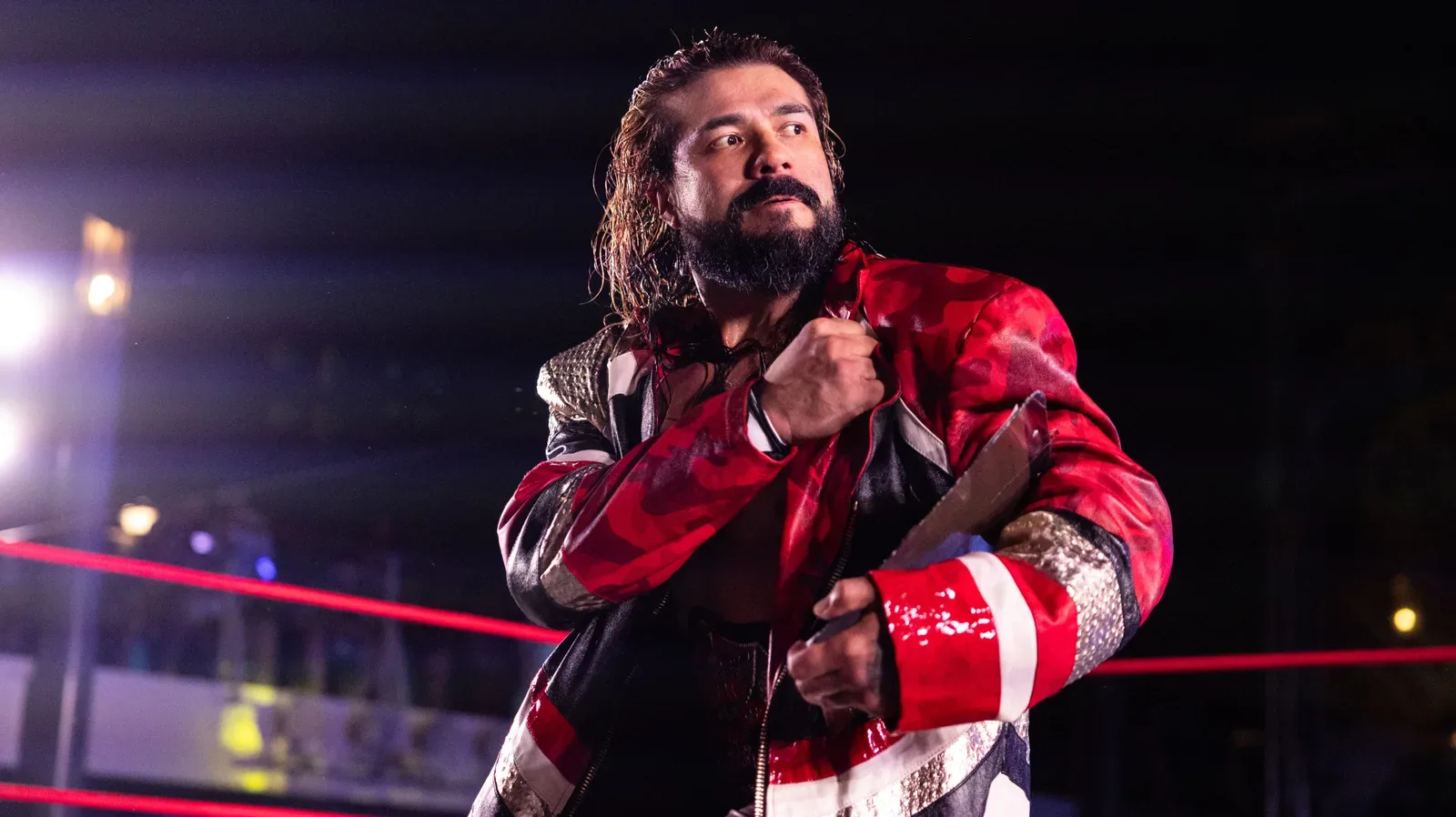
Andrade El Idolo has offered a candid explanation for the decision that took him from AEW back to WWE, stressing that he was not leaving AEW because he was unhappy with his position there.
Speaking on Talk Is Jericho, Andrade reflected on the end of his first AEW tenure and described it as a decision shaped by his personal life and the realities of two demanding, incompatible travel schedules. At the time, Charlotte Flair was working WWE weekends while Andrade’s AEW commitments generally fell in the middle of the week. The difference left the couple with limited time together, and they ultimately discussed whether a WWE return made more sense.
“My contract expired. I had a conversation with my wife,” Andrade said on Talk Is Jericho. “Maybe you want to go back to WWE? I said, ‘I’m happy now in AEW.’ My last seven months, I was so happy in AEW.”
That distinction is significant. Wrestling departures are often presented in simple terms: a talent either wants out, is unhappy creatively, or sees a better opportunity elsewhere. Andrade’s account presents a more personal and complicated situation. He said he and Flair had been operating on different schedules, with her working weekends and him working through the week, making it difficult for them to spend meaningful time together.
For more background on this topic, read Kyle Fletcher Explains How AEW’s Angelico Helped Inspire the ‘Protostar’ Name.
“She worked like on the weekends. I was working in the middle of the week,” Andrade continued. “So, it’s like the schedule was different, we didn’t see each other a lot. We were talking, [got] on the same page.”
Andrade’s first AEW run began after his WWE departure and gave him a new stage in a company built around an expanding roster of international stars, established veterans and younger talent. While the details of any wrestler’s standing can shift quickly in a promotion with a deep lineup, Andrade’s comments make clear that he viewed the closing stretch of that run positively. His eventual move back to WWE was instead tied to what he and Flair felt was best for their life away from the ring.
The former WWE and AEW star said he spoke with AEW President Tony Khan as his contract came to an end. Andrade expressed appreciation for the opportunity and indicated that the conversation was not framed as a scorched-earth exit.
“I thanked” Khan, Andrade said, adding that he hoped their paths would cross again in the future.
That sentiment fits the broader tone of his comments. Andrade did not portray AEW as a place he needed to escape, nor did he suggest that his return to WWE erased the value of his previous experience. Instead, he described a professional choice influenced by a personal priority. For performers whose work requires regular flights, live television appearances, house shows and promotional obligations, aligning schedules with a partner in the same industry can be a major consideration.
A Different Second WWE Experience
Andrade also looked back on his second WWE run and said the experience differed from his first time with the company. He maintained that WWE had always treated him well, but said he felt he received more opportunities after coming back.
“They always treat me good,” Andrade said. “Give me more opportunities. I feel like getting more opportunities, it’s like, ‘Okay. I’m here. So, what?’ It’s difficult to say, but it wasn’t bad. I want to show more, but later, it was a little hard.”
His comments capture the tension that can exist even when a wrestler is being used consistently. Opportunities matter, but so do the ability to build on them, establish momentum and show a full range of skills over an extended period. Andrade said his second WWE run was better than the first, while also acknowledging that the later portion became more difficult.
One major factor was Flair’s knee injury, which kept her out of action for more than a year. Andrade said that period was hard. His original return to WWE had been prompted in part by the desire for the couple to be on a more compatible schedule, so losing that shared element of the arrangement to a lengthy injury absence naturally changed the situation.
There is an important difference between saying a run was difficult and saying it was a failure. Andrade did not characterize his WWE return in negative terms. He said he had received several storylines and reiterated that he does not feel bad about the experience. His remarks instead suggest an honest assessment: the second run brought more chances than the first, but not every phase of it unfolded as he hoped.
The Carmelo Hayes Series Stood Out
Among the programs Andrade highlighted was his best-of-seven series with Carmelo Hayes. Andrade said WWE liked the two wrestlers working together, making the series a particularly notable component of his second stint.
The pairing made sense on paper and in the ring. Both men are known for athletic, fast-paced performances and for bringing confidence and precision to their work. A best-of-seven format also gives wrestlers a rare opportunity to develop a rivalry across multiple matches rather than relying on a single encounter to define their chemistry. Each bout can add a new layer, whether through escalation, counters, strategy or simply the cumulative physical toll of repeatedly facing the same opponent.
For Andrade, the series was evidence that WWE saw value in putting him in a prominent in-ring situation with Hayes. It also gave him a chance to demonstrate a style that has long been central to his appeal: explosive offense, technical fluidity and the ability to make a match feel competitive even when the audience has seen the matchup before.
Andrade did not suggest that this was the only meaningful program of his second WWE tenure, but it was the one he specifically identified when discussing the stories he was given. That makes it a useful measure of how he views that period. He was not absent from the creative picture; he had material to work with and opponents with whom the company believed he could deliver.
No Regret Over the Move
Perhaps the clearest takeaway from Andrade’s appearance is that he does not express regret over returning to WWE. He said the second run was better than his first, even while conceding that there were moments when he wanted to show more and felt circumstances became harder later on.
That perspective avoids the usual all-or-nothing interpretation of a wrestler’s career moves. Andrade was happy during his final seven months in AEW. He then chose WWE for personal reasons after conversations with Flair. Once back, he felt he was given more opportunities than during his initial WWE stint, though the experience was also affected by a difficult period surrounding Flair’s long injury absence.
All of those things can be true at once, and Andrade’s telling of the story makes that clear. A move from AEW to WWE did not have to be a rejection of AEW. Likewise, finding more opportunities in a second WWE run did not mean every creative objective was fulfilled. His reflections are less about declaring a winner between companies than about explaining how career decisions are frequently shaped by circumstances that fans do not see on television.
Andrade remains one of the more unusual modern examples of a wrestler who has crossed between WWE and AEW more than once. That path gives him a perspective few performers can offer, particularly when discussing the contrast between professional satisfaction, creative opportunity and personal considerations. His comments on Talk Is Jericho underline that the decision to return to WWE was rooted in the latter.
For Andrade, the end of his first AEW contract opened a conversation rather than forcing an abrupt conclusion. He and Flair discussed their schedules, reached an understanding, and he thanked Khan for the chance he had been given. He then entered a second WWE stint that he regards as an improvement over his first, one that included a well-received series with Hayes while also presenting challenges he could not entirely control.
It is a measured view of a career that has involved major transitions. Andrade was happy in AEW, returned to WWE for personal reasons, and says he does not feel bad about what followed. In an industry where every departure can invite speculation, his explanation is straightforward: the choice was about making room for life beyond the ring.
In pictures

Darryl Polo
Darryl Polo is a passionate wrestling fan covering WWE, AEW, TNA and beyond. He loves great rivalries, breakout stars and the moments that keep fans talking long after the bell. How we work.