
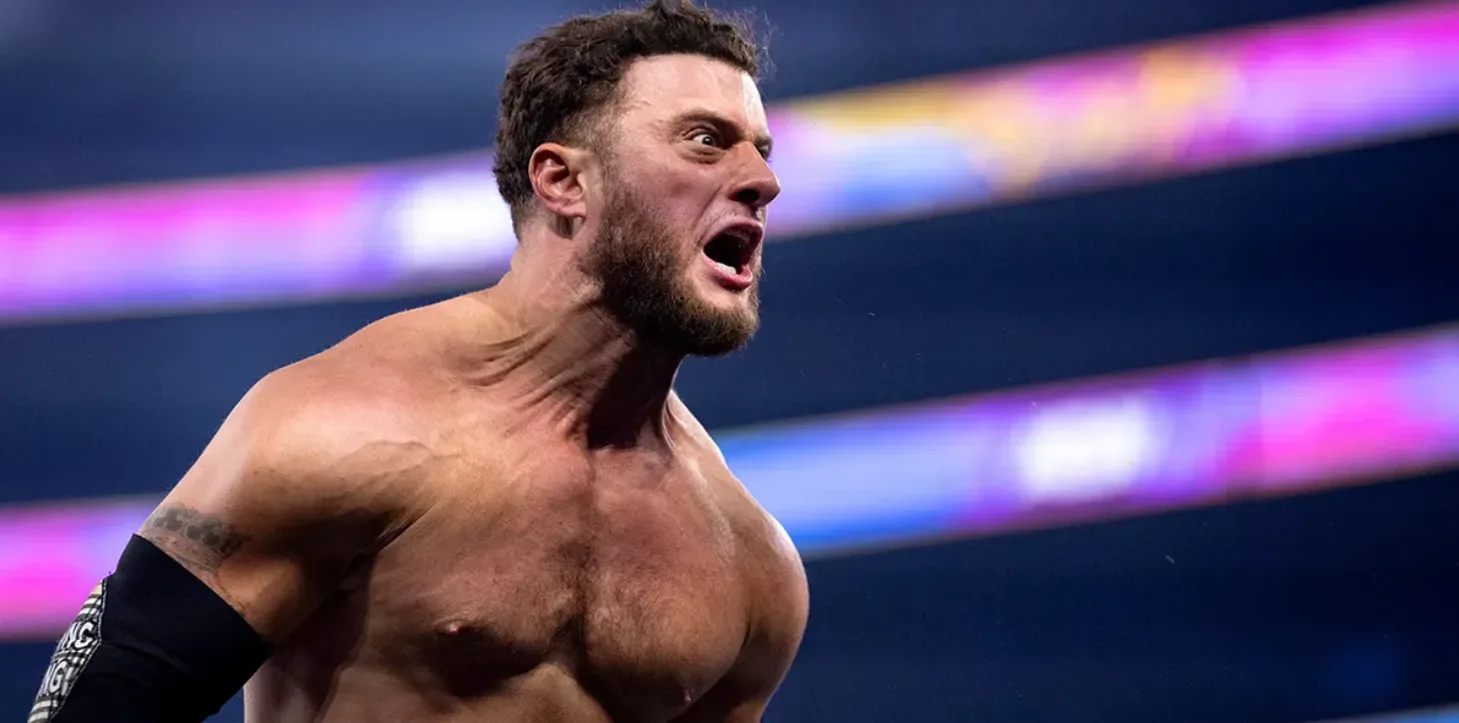
MJF has delivered a forceful response to the suggestion that remaining with AEW was the “safe bet,” using a social-media post to defend both his career choices and the role he believes he has played in the company’s growth.
The comments revisit one of the most closely watched contract stories in modern wrestling. Throughout 2023 and 2024, MJF’s future was a major subject of discussion as his AEW deal approached its expiration. His status became entwined with public speculation about a potential bidding battle, particularly given his standing as one of AEW’s most recognizable and decorated homegrown stars. MJF ultimately re-signed with AEW, ending that period of uncertainty.
When a social-media user characterized the decision as a safe one, MJF rejected the premise outright. Rather than presenting his AEW tenure as a secure or cautious route, he described it as participation in building an alternative promotion from its earliest stages—one that faced skepticism from many observers but has continued to establish major milestones.
View the referenced post on X
“Safe bet? Part of the crew that Built an alternative from the ground up that every ‘analyst’ felt should have failed,” MJF wrote. “A company that has steadily grown in every single metric that matters. Inspiring the next generation. Main evented in front of 82k Main evented more million dollar houses than I can count. Multiple major motion pictures. One of the biggest names in this sport. 3x holder of the most desired championship in the game. Hall of fame career by 30.”
For more background on this topic, read Marina Shafir Calls AEW Women’s Fight for Equal Opportunity a ‘Forever Battle’.
MJF’s post was not solely a defense of AEW as a company. It was also a statement about the identity of his own career. For years, he has positioned himself as a figure who can move between ruthless, antagonistic character work and frank reflections on his accomplishments. This message leaned heavily into the latter, pointing to major-event main events, box-office success, championship achievements and appearances in film as evidence that staying with AEW did not limit his reach.
His reference to performing in front of 82,000 people invokes the scale of the largest stages AEW has reached during its existence. It also underlines the central point of his argument: a choice to remain with the company should not be viewed as settling when that company has provided opportunities to perform in record-setting environments and to headline events with major commercial significance.
MJF Frames His Legacy Around AEW
At the heart of MJF’s response was a declaration that he takes particular pride in creating his legacy outside the traditional structure that defined the careers of so many previous top names. He made clear that he does not have a problem with WWE, but he contrasted his path with wrestlers whose legacies were built with what he called “a machine.”
“I have no issue with WWE. I just take pride in what I’ve built without a machine,” MJF continued. “Unlike every other top name in the history of this sport, My legacy has been built on three letters. M.J.F.”
That final line is a familiar expression of MJF’s confidence, but it also captures why the contract discussion around him drew so much attention in the first place. He is among the defining talents of AEW’s first generation. His rise happened in public alongside the company’s rise, and he became a central championship figure while AEW was still proving it could sustain itself as a major national promotion.
MJF’s reign as AEW World Champion remains a key piece of that story. He referred to himself as a three-time holder of the championship he called the most desired in wrestling, reinforcing the stature he assigns to AEW’s top prize and to his own record within the promotion. His response treats those accomplishments not as a consolation compared with a move elsewhere, but as proof that his body of work has already reached an elite level.
There is also a broader point in MJF’s framing. Wrestlers who spend their formative years in one promotion are frequently measured by whether they eventually leave for another opportunity. MJF’s post challenges that expectation. He is arguing that building a career around AEW, and helping make the company viable at the highest level, is itself an achievement with lasting significance.
The Contract Story That Dominated AEW Discussion
The anticipation surrounding MJF’s contract situation was intensified by the way he publicly embraced the conversation. During the period leading into his decision, the possibility of a bidding war became part of the wider discourse around his future. Given his age, visibility, verbal ability and in-ring reputation, MJF represented the kind of talent whose next move could have been viewed as a statement about the industry’s competitive landscape.
His eventual decision to re-sign with AEW closed the immediate question, but it did not erase the debate over what motivated the choice. The “safe bet” label clearly remains a criticism MJF considers worth answering. His message suggests that he sees risk differently than the person who posed the claim. In his view, the risk was in helping launch and establish an alternative that many predicted would fail—not in continuing to stand behind it after it had grown.
That distinction matters because MJF has never presented himself as simply another performer on the AEW roster. Whether in character or in more direct remarks, he has consistently conveyed the belief that he belongs near the center of the company’s history. Saturday’s post extended that argument. He placed himself among those who “built” the promotion and emphasized that the success he has attained came without relying on an already established system.
His mention of multiple major motion pictures further broadens the case he is making. MJF is not describing his career only through championship belts or match results. He is pointing to crossover work and mainstream visibility as signs that AEW has been a platform from which he could expand his profile beyond the ring.
Will Ospreay Challenge Adds a New Competitive Focus
While MJF addressed his past decision and long-term legacy, he also has a major present-day target. He recently challenged Will Ospreay to a world title match at AEW World’s End.
The proposed match would bring together two performers widely regarded as among the company’s biggest attractions. MJF’s strengths have long included his command of audience reactions, his promotional presence and his ability to make personal conflicts feel consequential. Ospreay, meanwhile, has established himself as one of the most prominent high-level competitors in AEW. A world title collision between them would naturally carry substantial stakes, particularly with MJF again emphasizing his three-time championship record.
For MJF, the challenge fits neatly alongside his latest remarks. He is not merely looking back at what he says he has helped build. He is continuing to seek a defining place in AEW’s current championship picture. That is an important distinction in a message built around legacy: MJF is presenting that legacy as active rather than complete.
His claim of having a Hall of Fame-level career by age 30 is deliberately bold, in keeping with the self-assurance that has long defined him. Yet the post also reveals genuine investment in the company with which he has become synonymous. MJF’s response was not a neutral explanation of a contract choice. It was a direct defense of AEW’s value, of his own accomplishments there and of the idea that choosing to remain part of its future was anything but ambitious.
As World’s End approaches and MJF’s challenge to Ospreay remains a key development, his comments ensure that the discussion around him will continue to extend beyond one potential match. He wants his AEW decision understood as part of a larger story: not the safe option, but the continuation of a career he believes has been built on his own terms.

Darryl Polo
Darryl Polo is a passionate wrestling fan covering WWE, AEW, TNA and beyond. He loves great rivalries, breakout stars and the moments that keep fans talking long after the bell. How we work.