
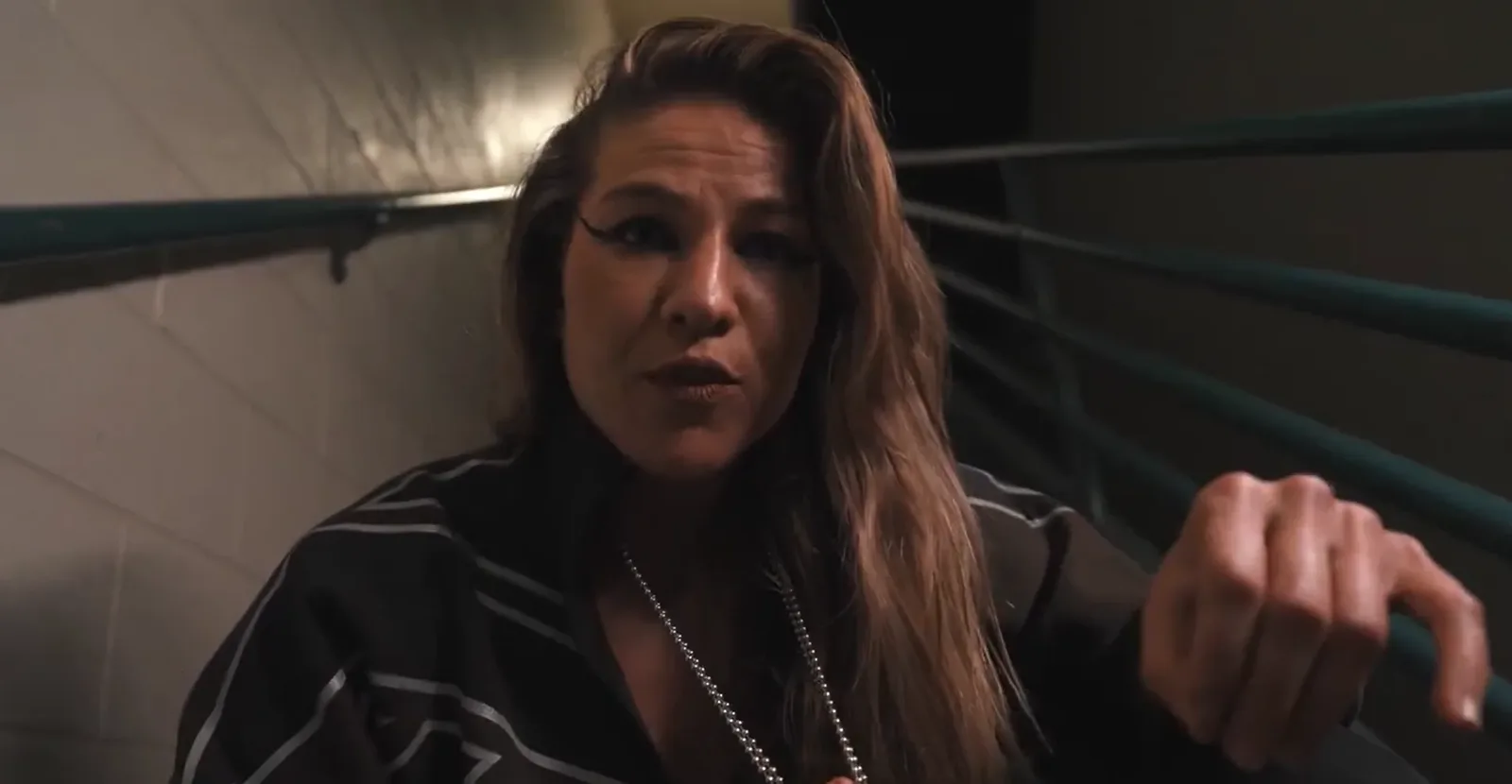
Marina Shafir believes the central competitive battle facing women in professional wrestling extends beyond wins and losses inside the ring.
The AEW performer, who has become a regular presence alongside the Death Riders, spoke candidly about the women’s locker room continuing to fight for time, visibility, and the chance to demonstrate that it can deliver at the same level as the men’s side of the roster. In Shafir’s view, that struggle is not a temporary issue with a simple finish line. It is a continuing part of the industry.
“I think I am currently breaking barriers with defining what the real competition in this business is,” Shafir said. “I am very proud of the locker room we have, and I think for women in general, like we are in competition with for time and our biggest competition is the male locker room, and that is going to be a forever battle.”
Shafir’s comments frame the discussion in practical terms. Professional wrestling promotions have limited television minutes, limited featured match slots, and limited opportunities to build momentum around every act on the roster. For any division, those constraints create competition. Shafir’s point is that women are not merely competing among themselves to become the next challenger or champion; they are also making the case that women’s stories, matches, personalities, and rivalries deserve major space on the same cards as the men’s.
For more background on this topic, read Marina Shafir Calls Professional Wrestling ‘Action Theater’ Ahead Of AEW Collision In Green Bay.
Shafir sees the issue as a fight for opportunity
AEW has featured a growing list of women’s talent across its programming, with established names and newer acts alike working to create a deeper division. Shafir has occupied a distinct position within that environment. Her work with the Death Riders has placed her in a factional setting that can bring her into physical confrontations and segments involving male talent, rather than limiting her presentation strictly to women’s division programs.
That role fits the way Shafir describes her place in the broader conversation. She has not shied away from the physical side of AEW programming, including confrontations with male members of the roster. Rather than treating those moments as an exception, Shafir views them as part of an effort to challenge assumptions about where women can fit in the structure of a wrestling show.
“I mean, it’s just the way that it is, and we are constantly using those opportunities to, prove that we have just as much to offer and probably more than the men do,” Shafir said.
The statement is deliberately forceful, but it is rooted in a familiar reality for women’s wrestling. A division can possess talented performers, compelling matchups, and clear character direction, yet still face an uphill fight for consistent placement in prominent spots. The question is not solely whether women can have a standout match or a successful title program. It is whether that level of investment becomes routine enough that audiences expect women’s wrestling to be a foundational part of a promotion’s identity.
Shafir’s use of the phrase “forever battle” suggests she does not expect the conversation to disappear simply because individual performers or divisions make progress. Wrestling has historically been shaped by changing perceptions of what can headline shows, draw interest, and command attention. Those perceptions can shift, but the need for performers to keep proving their value remains.
A larger vision for professional wrestling
Shafir also presented the issue as an opportunity rather than only a complaint about available minutes. She believes greater acceptance of women as major contributors across the wrestling landscape can create possibilities that are still not fully explored.
“I think if people really embrace this, we can expand the landscape of professional wrestling and just open up a world of opportunity to what could be,” she said.
That outlook is especially relevant to Shafir’s current AEW presentation. Faction-based storytelling can offer wrestlers different paths to relevance: acting as an enforcer, becoming involved in larger group conflicts, sharing screen time with established names, or developing a character through alliances and confrontations. For Shafir, being associated with the Death Riders has been a platform for continued growth as a performer while also allowing her to move in spaces that are not always reserved for women on wrestling television.
There is a difference between featuring women separately and integrating them meaningfully into the overall fabric of a promotion. Both can be valuable, and a strong women’s division requires its own championships, feuds, and signature matches. But Shafir’s remarks point toward a wider ambition: women being viewed as capable of adding stakes to any type of story, including faction rivalries and physical angles involving the roster at large.
That does not eliminate the importance of dedicated women’s programs. If anything, it reinforces why those programs must be treated as essential. A wrestler can benefit from crossover opportunities while still needing a credible division with defined championship stakes, recurring rivalries, and sufficient television time for audiences to invest in its personalities.
Standing her ground in AEW
Shafir connected her professional outlook to her personal determination, saying that she and her husband stand on different “war lines” in wrestling while she remains committed to her own position.
“Me and my husband are on two different sides of the war lines, and I stand my ground,” Shafir said. “Like, I have to for the sake of professional wrestling.”
The phrase reflects the intensity with which Shafir approaches the subject. She is not describing equal opportunity as an abstract industry talking point. To her, it is a responsibility tied to the future of the medium. Her argument is that wrestling grows when it makes room for more performers, more types of stories, and more presentations that can connect with fans.
Shafir’s comments also arrive at a time when performers are increasingly willing to articulate the business side of opportunity. Television time matters because it determines who gets a chance to become familiar to viewers. Prominent matches matter because they establish credibility. Long-term storytelling matters because it gives audiences reasons to care about outcomes beyond a single appearance. When wrestlers speak about competing for time, they are speaking about the mechanisms that create stars.
For the AEW women’s locker room, the challenge Shafir outlines is therefore layered. It involves competing internally, where every wrestler wants championship opportunities and featured roles. It also involves convincing audiences and decision-makers that women’s matches and stories should be consistently positioned as major attractions. Shafir’s belief is that the latter competition is the more consequential one.
‘Action theater’ and the role of presentation
Elsewhere in the same interview, Shafir described wrestling as “action theater,” a phrase that aligns closely with her larger point. Wrestling depends on athletic execution, but it also depends on presentation, character, emotion, and the ability to make an audience invest in conflict. The more varied the performers and stories that receive meaningful platforms, the wider the creative range of that action theater can become.
Shafir’s own on-screen role has often leaned into intensity and physicality. That makes her comments about breaking barriers particularly consistent with her presentation. She is not positioning herself as someone waiting to be invited into a larger fight. She is presenting herself as someone already involved in it, willing to stand alongside male faction members and to insist that women can contribute on equal footing.
Whether that battle is “forever” may be open to debate, but Shafir is clear about her assessment of the current landscape. Women in AEW are still working to prove the depth of what they can offer, not only against one another but against the longstanding assumptions that determine who gets the most time and attention.
For Shafir, the objective is bigger than a single segment, match, or storyline. It is about expanding the idea of what professional wrestling can be when women are given the opportunity to shape its most important moments.

Darryl Polo
Darryl Polo is a passionate wrestling fan covering WWE, AEW, TNA and beyond. He loves great rivalries, breakout stars and the moments that keep fans talking long after the bell. How we work.