
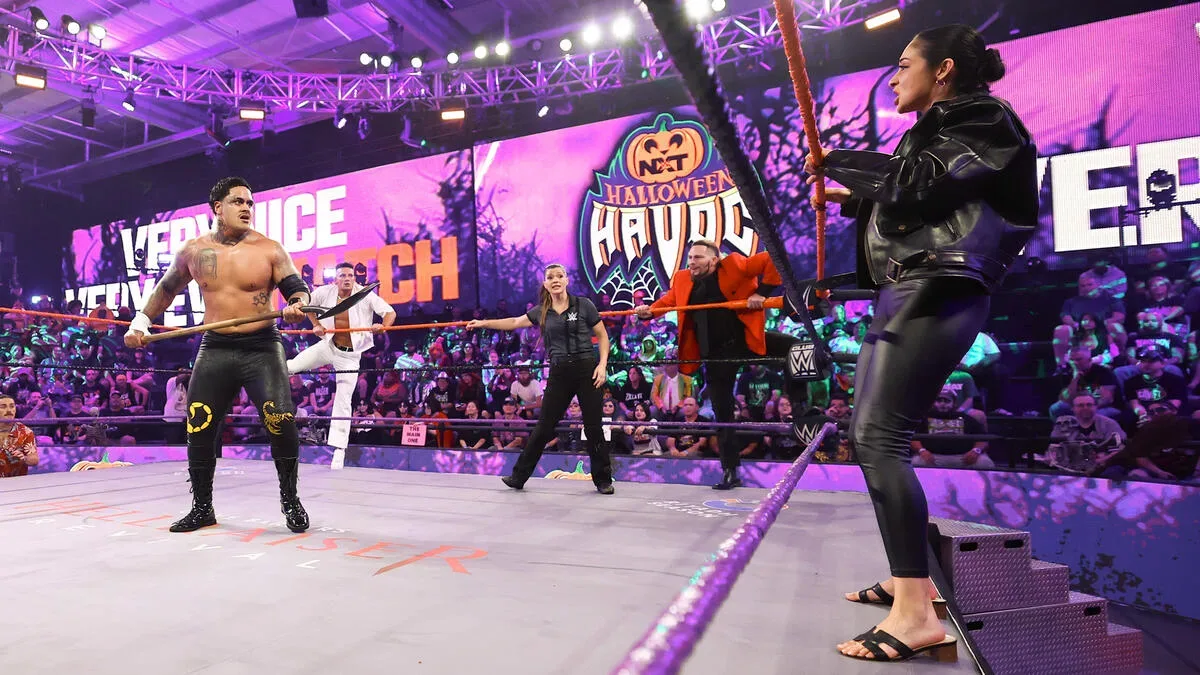
Zilla Fatu’s issue with BirthRight reached its decisive point at NXT Halloween Havoc 2026, but the rivalry was about more than the outcome of one match. For Fatu, the conflict provided a chance to underline the identity he has been building throughout his rise: a competitor determined to be recognized for the work he put in rather than for the family name attached to him.
At Halloween Havoc, Fatu defeated Charlie Dempsey in the appropriately named Very Nice, Very Evil Match. The bout served as the conclusion of Fatu’s feud with BirthRight, the group made up of Dempsey, Channing “Stacks” Lorenzo, Arianna Grace, Lexis King and Uriah Connors. Fatu not only overcame Dempsey in the ring, but also fought off the faction members who attempted to influence the situation around the match.
Before the Premium Live Event, Fatu discussed the program during an appearance on Busted Open. He made clear that he does not view himself as another talent who simply arrived in WWE through a recognizable wrestling lineage. While he comes from one of professional wrestling’s most famous families, Fatu said the road he traveled before reaching NXT was one he built through independent wrestling.
“We have a different story, uce. I have a way different story from all these individuals in BirthRight. They don’t have The Main One’s story. I got here a different way. I didn’t rely on my family’s name. I didn’t rely on my dad’s legacy or none of that. I literally grinded on the independents and worked my way here. I got here, you know?”
For more background on this topic, read Nia Jax Says She, Naomi and Tamina Are Available to The Bloodline When Needed.
Fatu’s comments framed the BirthRight rivalry as a clash between different ideas of what it means to earn a place in WWE. The group’s name alone evokes heritage, entitlement and the perceived advantages that can come with having a celebrated background. Fatu, however, positioned himself as someone who refuses to let his background become the sole explanation for his opportunity or his accomplishments.
That distinction is especially meaningful because Fatu is the son of Umaga. His place in the wider Anoa’i family tree ensures that fans will always recognize the legacy surrounding him, whether he embraces that discussion or not. The family has produced generations of prominent WWE performers and remains one of the most influential dynasties in the history of the industry. Still, Fatu’s point was not that his family history does not exist. It was that his own professional journey involved a separate period of development, struggle and independent work before he reached this stage.
A Rivalry Centered on Identity
BirthRight was a fitting opponent for Fatu because every member of the group gave the storyline additional layers. Dempsey entered the feud as its central in-ring threat, while Lorenzo, Grace, King and Connors gave the stable numbers and a constant sense that Fatu would have to contend with more than one opponent. Their presence made it difficult for Fatu to secure a clean path through the rivalry, forcing him to repeatedly stand against a coordinated unit.
The Halloween Havoc stipulation gave the feud an appropriately theatrical setting, but the core message remained straightforward. Fatu was not looking for approval from BirthRight, nor was he accepting the idea that they could define where he belonged in NXT. By defeating Dempsey and holding his own when the rest of the group became involved, Fatu provided a forceful final statement in the feud.
For a developing WWE star, that kind of victory matters. A win over a faction leader can establish momentum, but surviving the wider group can be just as important in presenting someone as resilient and capable of handling the pressure that comes with a higher-profile position. Fatu emerged from Halloween Havoc having beaten the man at the center of the program while also demonstrating that BirthRight’s collective strength was not enough to stop him.
His interview comments add another dimension to that result. Fatu did not present his independent wrestling background as a talking point meant to dismiss his heritage. Instead, he used it to explain the personal standard he has set for himself. In his view, the work he completed before WWE is part of why he believes his story differs from those around him. He wants the audience to see the journey, not merely the surname.
Independent Wrestling as the Foundation
Wrestling family connections can create instant interest, but they also invite scrutiny. A second- or third-generation performer can be judged on the accomplishments of relatives before they have had a full chance to define themselves. That pressure can be amplified in WWE, where past generations and historical legacies are often a major part of the presentation surrounding new talent.
Fatu’s emphasis on the independents speaks to the desire to control that narrative. Independent wrestling offers performers opportunities to develop in front of different audiences, work varied styles and learn how to establish a character outside of the WWE system. It can also be an unforgiving environment, where wrestlers must build a reputation one event and one opponent at a time. Fatu described that grind as the path that earned him his current opportunity.
His language also reflects the confidence of “The Main One,” the persona he has brought into NXT. Fatu is not attempting to downplay his ambition. He believes he belongs in WWE, and he believes he arrived there through the effort he invested in his career. The message is equal parts pride and challenge: he respects the reality of his family’s legacy, but he insists that he has a distinct story worth telling.
That approach can resonate with fans who have watched Fatu’s progression. A wrestler can carry a famous name while still trying to show that they possess their own voice, ring presence and ability to connect with an audience. Fatu’s rivalry with BirthRight gave him an opening to articulate that perspective in direct terms, then reinforce it through his actions at Halloween Havoc.
John Cena Classic Opportunity Awaits
The end of the BirthRight feud has opened the door for Fatu’s next major opportunity. On the November 4 episode of NXT, 17-time WWE World Champion John Cena invited Fatu to the ring and offered him a place in the John Cena Classic. Fatu accepted.
Being personally invited by Cena is a notable moment for any rising WWE talent. Cena’s standing in WWE is unmatched, and the John Cena Classic immediately gives Fatu a platform that extends beyond the aftermath of one NXT rivalry. The invitation also arrives at a time when Fatu has fresh momentum following his victory over Dempsey at Halloween Havoc.
The tournament setting should provide a different type of test. Faction warfare often focuses on survival, outside interference and personal grudges. A classic-style competition instead puts attention on consistency, preparation and the ability to defeat a series of opponents. For Fatu, it represents a chance to continue demonstrating the qualities he highlighted in his interview: persistence, self-belief and a willingness to earn every step forward.
There is also a natural contrast between the John Cena Classic and the message Fatu delivered about his own path. Cena became one of WWE’s defining stars through longevity, adaptability and an enduring work ethic. Fatu’s insistence that he grinded his way through the independents does not make his experience identical to Cena’s, but it does make the tournament an appropriate next arena for someone presenting himself as a worker who values the road taken to reach the spotlight.
Defining His Own Name in NXT
Fatu’s immediate task is no longer BirthRight. He has already defeated Dempsey, survived the faction’s presence and moved into the John Cena Classic. Yet the themes of the rivalry are likely to remain relevant as he pursues bigger goals in NXT.
His family name will always be part of the conversation, particularly given the legacy of Umaga and the broader Anoa’i dynasty. Fatu is not in a position where that history can be erased, and there is no indication that he wants it erased. What he is arguing is that legacy should not be treated as the complete story. His independent wrestling work, his individual growth and his performances in NXT are the pieces he wants to put at the center of his identity.
Halloween Havoc gave Fatu a defining win. The November 4 invitation from Cena gave him a major new destination. Now, the John Cena Classic offers him the opportunity to turn that momentum into an even more significant statement.
Fatu has made his position clear: he did not rely on his family’s name or his father’s legacy to arrive in WWE. As his NXT career continues after the BirthRight rivalry, he will have further chances to prove that “The Main One’s” story stands on its own.

Darryl Polo
Darryl Polo is a passionate wrestling fan covering WWE, AEW, TNA and beyond. He loves great rivalries, breakout stars and the moments that keep fans talking long after the bell. How we work.