
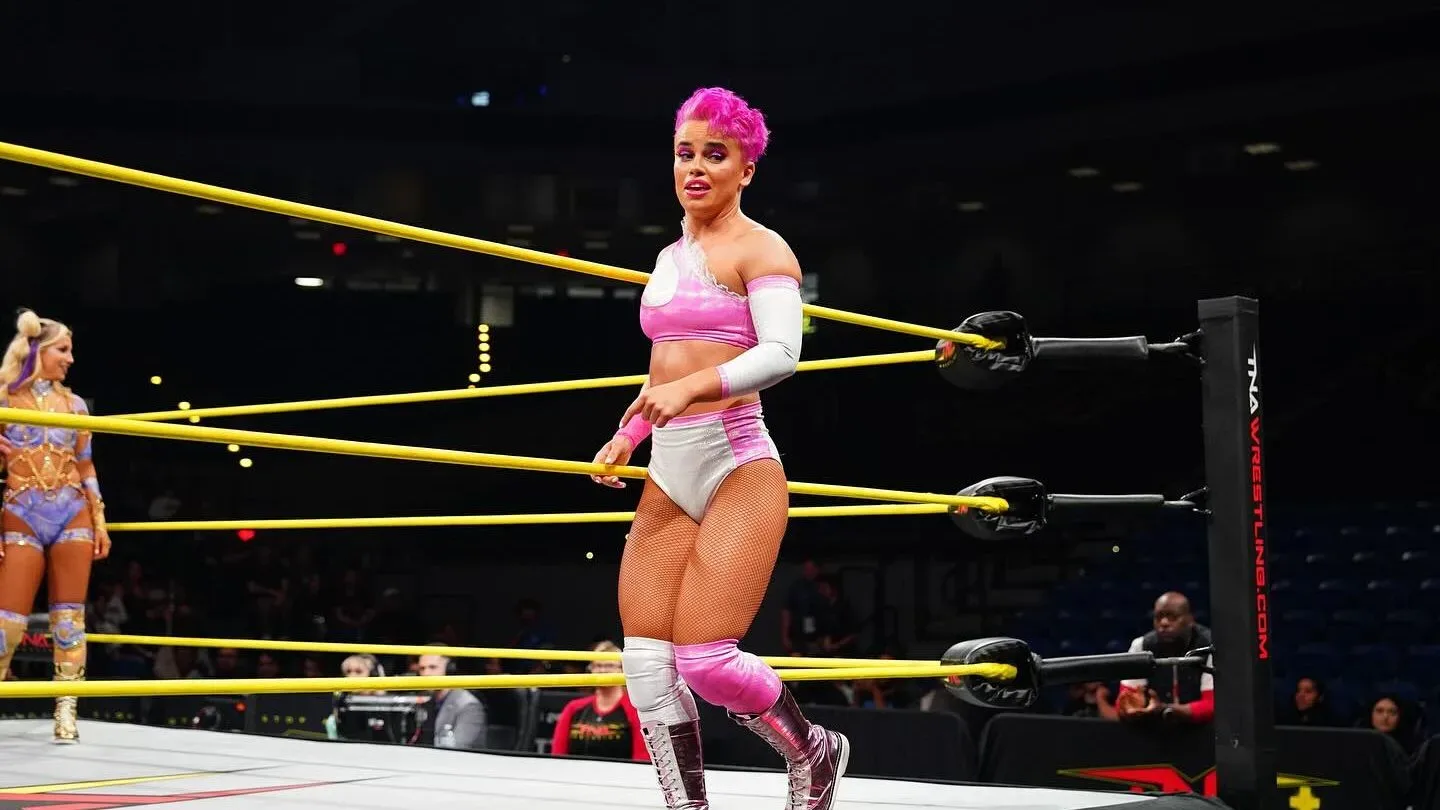
Harley Hudson has identified The Undertaker as her favorite wrestler of all time, pointing to the WWE Hall of Famer’s larger-than-life WrestleMania presence as the kind of spectacle that captured her imagination as a fan and continues to shape her ambitions as a performer.
Hudson, who signed with TNA Wrestling in May 2025 and has since been welcomed into The Dollhouse by Taryn Terrell, discussed the wrestlers who influenced her during a recent interview. While she acknowledged that her presentation is very different from the ominous, supernatural character made famous by The Undertaker, Hudson said there is one move that gives her a direct in-ring connection to her childhood favorite.
“My favorite wrestler ever is The Undertaker. I think the only similarities that we share is that I do the same leg drop on the apron that he does. Other than that, that’s probably where it ends.”
The apron leg drop was one of The Undertaker’s most recognizable signature attacks across his long career. It was a move that fit the character’s commanding style, often used to punish an opponent draped over the edge of the ring while emphasizing the physical danger of the ringside environment. For Hudson, using the move provides a small but meaningful link to a wrestler whose work left a lasting impression on her long before she joined a national wrestling roster.
For more background on this topic, read The Creed Brothers Depart WWE After Contract Expirations.
More importantly, Hudson’s admiration is rooted in the feeling surrounding Undertaker matches rather than an attempt to replicate his persona. The Undertaker became synonymous with spectacle, especially at WrestleMania, where his entrances, character work and major-match aura turned his appearances into must-see moments for generations of viewers. Hudson recalled being drawn to that sense of anticipation and wanting the people around her to share it immediately.
“But I think, in a way though, it’s like someone so different, and I can just remember watching WrestleMania and just being blown away by the whole spectacle of every match that he’d have. That’s something that I hope one day I can do that people are like, ‘Let me sit down to watch this unfold.’”
That description speaks to the power of wrestlers who are able to turn a match into an event before the opening bell even rings. The Undertaker’s career featured numerous WrestleMania performances that carried an unusual level of occasion, with audiences tuning in not only for a result but for the atmosphere, presentation and expectation attached to his entrance into the arena. Hudson’s comments make clear that this is the standard she hopes to pursue: not simply having fans watch a match, but giving them a reason to stop what they are doing and feel that they need to see it in real time.
Hudson also shared a personal memory that illustrates just how strong that pull was during her years as a fan. Because WrestleMania aired late where she lived, she would wake up her mother whenever The Undertaker was about to appear rather than watch the moment alone.
“I would wake my mom up and be like The Undertaker’s on because obviously WrestleMania’s on really late for us at home, so I’d be like waking her up like, ‘The Undertaker’s on now. You need to come down. Watch it right now.’”
For Hudson, that memory is not only about fandom. It is an example of the emotional response she wants her own work to create. Professional wrestling has always been built on those shared reactions—one fan calling another into the room, an entire crowd rising for a familiar entrance, or viewers making time because they believe something memorable might happen. Hudson sees the ability to inspire that type of investment as an achievement worth chasing.
“So, I hope one day that I could affect somebody else like that or make someone else have to turn on the TV. That’ll be great. We’ll see.”
It is a grounded goal from a wrestler who is still building her position in TNA Wrestling. Hudson did not frame herself as the next version of The Undertaker, nor did she suggest that their careers or characters are closely aligned. Instead, she highlighted the particular impact that a singular star can have on a viewer. Her objective is to find her own way of creating that same urgency and excitement.
Hudson’s TNA Opportunity Continues to Take Shape
Since signing with TNA Wrestling in May 2025, Hudson has continued to establish herself within the promotion’s women’s roster. Her recent association with Taryn Terrell and The Dollhouse gives her a clear on-screen connection as she looks to gain momentum in a competitive division.
The Dollhouse name carries history within TNA, and Hudson’s inclusion under that banner places added focus on what she can bring to the group moving forward. Terrell’s welcome brings Hudson into a recognizable act, but her comments about The Undertaker underline that she is also motivated by a larger individual ambition: to develop a presence that makes viewers take notice whenever she appears.
That is often the difficult transition for a developing talent. Joining an established group can create visibility and open new story possibilities, but sustained success depends on finding distinct traits that fans associate with one performer. Hudson already has a personal touchstone in The Undertaker’s apron leg drop, yet her perspective is broader than borrowing a favorite move. She is focused on the effect of a performance and the lasting feeling it can leave with the audience.
The Undertaker’s influence is especially understandable for performers who grew up watching WrestleMania as an annual cultural event within wrestling. His entrances and marquee matches were designed to feel different from the rest of the card, and that sense of scale made him an attraction even to viewers who may not have followed every weekly development. Hudson’s recollection of waking her mother reflects how those moments could become family memories rather than merely segments on a broadcast.
Building a Connection Rather Than Copying a Legend
Hudson’s answer also offers a useful distinction between influence and imitation. Wrestlers frequently point to past stars as favorites, but the strongest influences do not always lead to identical in-ring styles or characters. Hudson openly recognized that she and The Undertaker have little in common beyond the apron leg drop. What she is taking from his legacy is the value of making an audience feel compelled to watch.
That approach leaves room for Hudson to define success on her own terms in TNA. Whether she is competing as part of The Dollhouse or seeking to stand out in singles competition, the central target remains the same: making her matches and appearances feel important enough that fans want to be present for them.
In wrestling, that level of connection cannot be manufactured by a single move, entrance or affiliation. It is developed through consistency, personality, match performances and the ability to make fans believe that an appearance matters. Hudson’s comments show that she understands the difference. The apron leg drop may honor one of her favorite wrestlers, but the broader lesson she has taken from The Undertaker is about creating anticipation.
As Hudson continues her TNA run, her admiration for The Undertaker provides a clear window into the kind of performer she hopes to become. She wants to give viewers the same feeling she had as a fan watching WrestleMania late at night—an instinct that a moment is unfolding that cannot be missed.

Darryl Polo
Darryl Polo is a passionate wrestling fan covering WWE, AEW, TNA and beyond. He loves great rivalries, breakout stars and the moments that keep fans talking long after the bell. How we work.