
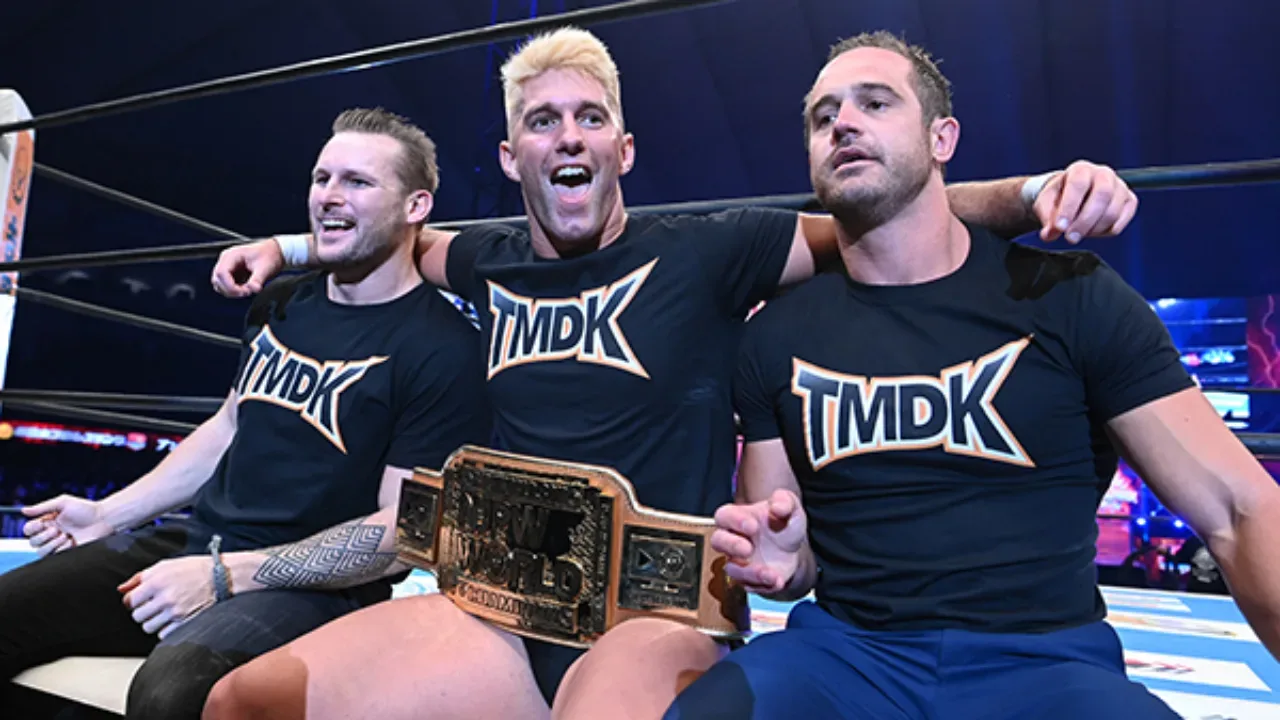
Zack Sabre Jr. has made clear that he does not view himself as the leader of TMDK, despite being one of the group’s most prominent international representatives and a central figure in its New Japan Pro-Wrestling presence.
Speaking on CMLL’s Esto es Lucha Podcast, Sabre discussed the identity of The Mighty Don’t Kneel and emphasized that its history reaches far beyond any one member. In his view, the group belongs first and foremost to Australian wrestling and to the people who established it during a formative period for the country’s independent scene.
“Shane Haste very smartly came up with ‘The Frontman’ because there is no leader,” Sabre said. “Mikey Nicholls and Shane Haste started T.M.D.K. in 2006, 2007, when the Australian independent wrestling scene was really sort of still trying to create something.”
That distinction is important to Sabre. While he has become an established face of TMDK in NJPW, he does not believe prominence within the group gives him ownership of a name and legacy built by Haste and Nicholls. Rather than placing himself above the stable, Sabre framed his place within it as part of a larger collective that has expanded across promotions, generations, and countries.
For more background on this topic, read Cody Rhodes Says WWE Retirement Could Arrive ‘Sooner Than Later’.
“I would never claim to be the leader of T.M.D.K., because it would never be mine,” Sabre said. “T.M.D.K. belongs to Australian wrestling.”
TMDK’s Foundation Remains Central to Its Identity
TMDK’s origins are inseparable from Haste and Nicholls, two wrestlers who helped build their careers from Australia before becoming internationally recognized performers. The faction’s name, The Mighty Don’t Kneel, reflects a defiant identity that has remained intact even as its membership and reach have evolved.
Haste and Nicholls are scheduled to reunite in Pro Wrestling NOAH on October 25, a fitting reminder of the history they share not only as the original TMDK pairing, but also through their work in Japan. Sabre specifically pointed to the time he spent with both men in the NOAH Dojo, recalling the effort they put into turning their ambitions into something lasting.
For Sabre, that background makes it especially significant that wrestlers from outside Australia can now carry TMDK colors into major moments in Japanese wrestling. The stable is not being presented as a static group attached only to its founders. It has become a platform through which newer members can establish themselves, while still acknowledging where the name came from.
That outlook also explains why “The Frontman” is a more appropriate description for Sabre than a traditional leadership title. The phrase recognizes his visibility without rewriting the group’s history. TMDK can have a front-facing figure in a particular promotion or era without suggesting that its original creators have been displaced or that the faction is defined by a single wrestler.
Sabre Finds Fulfillment in Fujita and Oiwa’s Growth
The current NJPW branch of TMDK includes Sabre, Robbie Eagles, Kosei Fujita, Ryohei Oiwa, Bad Dude Tito, and Hartley Jackson. Each brings a different background and role to the group, but Sabre’s comments focused particularly on Fujita and Oiwa as examples of what the stable can mean beyond its original lineup.
Fujita and Oiwa represent a younger generation within the faction, and Sabre said their accomplishments have given him a greater sense of fulfillment than any designation as the group’s leader could provide. He described the impact of seeing them wear TMDK colors and wave TMDK flags while achieving major tournament success in Japan.
“When I see Fujita and Oiwa with the T.M.D.K. colors and T.M.D.K. flags, winning the biggest tournaments in Japan, that’s much more fulfilling for me rather than claiming to be a leader,” Sabre said.
The sentiment speaks to a faction structure that is designed around development as much as star power. Sabre is unquestionably an elite in-ring presence, and his standing makes him an influential figure for younger talent around him. But he is drawing a line between influence and ownership. A wrestler can help guide teammates, share experience, and represent a unit at the highest level without claiming that the unit belongs to him.
That is a meaningful distinction in a wrestling landscape where faction leadership is often a major part of a group’s on-screen identity. Stables frequently revolve around a clear boss, a founder who commands the group, or a centerpiece whose success becomes the measure of everyone else’s role. Sabre’s description of TMDK instead puts the focus on a shared legacy, with the group’s success extending from Haste and Nicholls’ early work in Australia to the achievements of the wrestlers now representing it in Japan.
A Group With Branches Across Wrestling
TMDK has developed different branches throughout professional wrestling, giving the name a wider presence than a conventional single-promotion stable. Its NJPW lineup alone illustrates that evolution: an English technical standout in Sabre, Australian representatives such as Eagles and Jackson, Japanese talents Fujita and Oiwa, and Bad Dude Tito all exist under the same banner.
The group’s reach also extends beyond the current NJPW unit. WWE’s Bronson Reed is a member of TMDK as well, underscoring the fact that the faction’s history and relationships are bigger than any current television roster. The collective identity has endured as members have worked in different places and progressed through different stages of their careers.
That broader footprint reinforces Sabre’s argument that no one wrestler should simply declare himself the leader of TMDK. The group was not created around him, and it is not limited to him. Its history includes Australian independent wrestling, the founders’ experiences in Japan, its modern NJPW representation, and the careers of members operating in other major environments.
Sabre’s answer also places appropriate attention on the labor behind TMDK’s existence. He said Haste and Nicholls “really worked their asses off to make something from nothing in Australia.” The point was not merely nostalgic. It was an acknowledgment that the group’s current profile rests on work done long before its present members began winning in NJPW under the TMDK flag.
What “The Frontman” Means for Sabre
Sabre’s refusal to take the leadership label should not be mistaken for detachment from the group. His comments instead show a deep respect for TMDK’s past and a clear investment in its future. He is proud to be associated with the unit, but he is careful to define that association in a way that honors Haste and Nicholls.
The “Frontman” terminology provides a useful balance. It acknowledges Sabre’s place as a major representative of TMDK, especially within NJPW, while avoiding the implication that he controls or owns its legacy. In practical terms, he can be the person at the front of the group in a given setting while the group itself remains a collaborative project with roots that cannot be reduced to one individual.
It is also a perspective that places the spotlight on success shared across the stable. Sabre did not use the discussion to elevate his own importance. Instead, he pointed toward the founders’ contribution and the rise of Fujita and Oiwa. That approach is consistent with his central point: TMDK’s most meaningful accomplishments are not those that establish a hierarchy, but those that show how far the group has traveled from its beginnings.
For TMDK, the story is therefore one of continuity. Haste and Nicholls created the name in Australia during the mid-2000s. Their work helped give it a foundation. Sabre’s generation has carried it prominently in NJPW and elsewhere. Fujita and Oiwa’s tournament victories show that it continues to provide a banner for emerging wrestlers to make their own statements.
Sabre may be TMDK’s frontman, but he has no interest in calling himself its leader. In his eyes, the group’s identity is bigger than a position at the top of a stable. It belongs to the Australian wrestling environment that gave it life, to the founders who built it, and to the wrestlers now adding their own chapters while carrying its colors forward.

Darryl Polo
Darryl Polo is a passionate wrestling fan covering WWE, AEW, TNA and beyond. He loves great rivalries, breakout stars and the moments that keep fans talking long after the bell. How we work.