
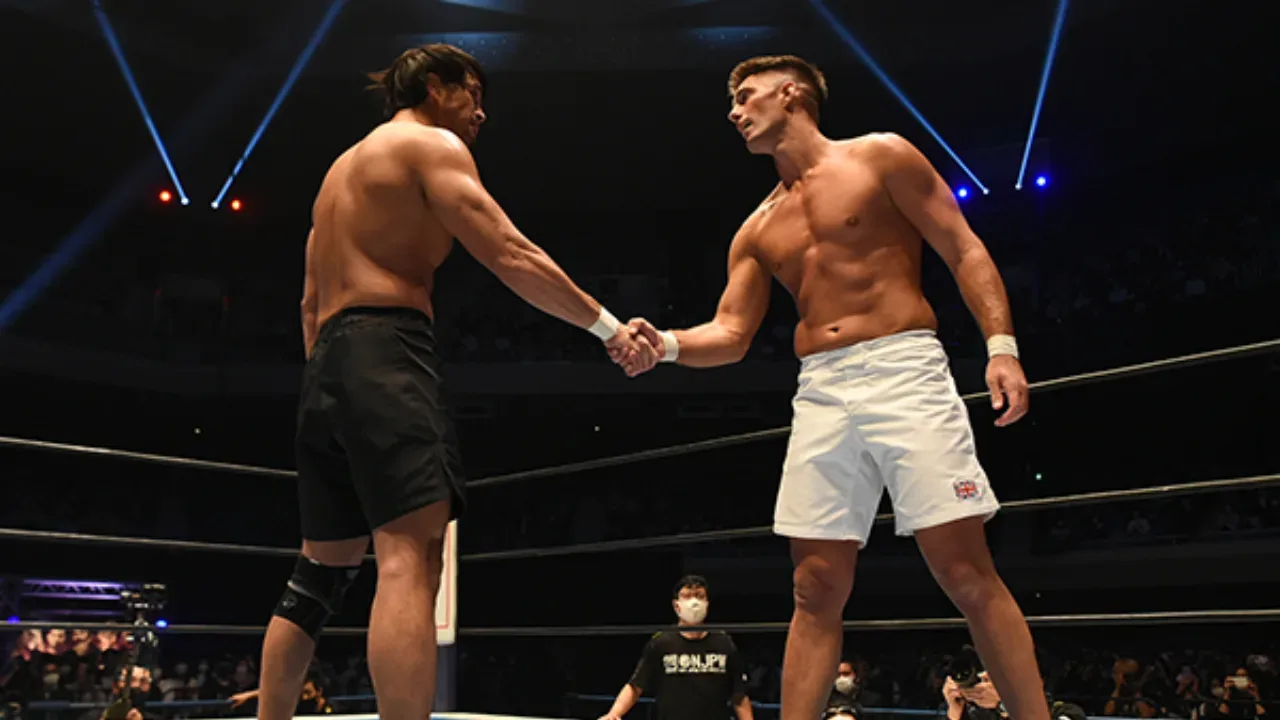
Zack Sabre Jr. has reflected on the extraordinary atmosphere surrounding his exhibition match with Katsuyori Shibata during the 2021 NJPW G1 Climax, recalling a reaction that remains unlike anything he has experienced in professional wrestling.
The moment took place on night 19 of the tournament, when Sabre entered for an exhibition match without knowing who would be standing across the ring from him. The uncertainty was quickly replaced by one of the most emotional surprises in recent NJPW history: Shibata emerged as his opponent.
At that stage, Shibata had not wrestled for NJPW since 2017. His appearance immediately carried enormous significance, and the response inside the building was made even more striking by the conditions under which it happened. Japanese crowds were operating under COVID-era restrictions that prevented fans from giving the vocal cheers and chants typically associated with a major return. Yet the audience still found a way to make the significance of the moment felt.
Speaking on CMLL’s Esto es Lucha Podcast, Sabre looked back on the opening notes of Shibata’s entrance music and the collective reaction that followed.
For more background on this topic, read NJPW Super Jr. Tag League 2026 Results: The Swirl Open B Block With Victory.
“It was an exhibition, but, his return… it was obviously during the COVID restrictions where the Japanese fans were restricted from being able to vocally cheer or make any noise and I’ve never experienced anything like the silent gasp of when the first bars of his theme music played where it was like, I felt in sync with the audience. That epitomized the power of pro wrestling.”
A Return That Needed No Words
Sabre’s recollection underscores why the segment has retained such a strong place in the memories of fans and performers alike. The match was presented as an exhibition, but it was never merely about the designation attached to it. The key development was Shibata’s presence, his music, and the realization that he was once again walking toward an NJPW ring.
In a conventional wrestling environment, the first blast of a returning star’s entrance music can trigger a deafening response. Fans shout, chant names, sing along, and create a wall of noise that tells the story before the wrestler even appears. The restrictions in place during the pandemic removed that familiar outlet. Spectators could not respond in the usual manner, which altered the rhythm and sound of events throughout that period.
That limitation did not erase emotion. In Sabre’s view, it concentrated it. Rather than a traditional roar, the arena produced what he characterized as a silent gasp. The audience’s surprise and recognition were still immediate, even if they could not express them through unrestricted cheering. For Sabre, that shared instant of realization created a rare connection between the ring and the crowd.
The phrase “silent gasp” captures the unusual nature of the scene. It was not silence in the sense of indifference. It was a restrained but unmistakable emotional reaction from an audience that understood the weight of Shibata’s appearance. The absence of normal crowd volume arguably made the response feel more intimate, with the audience’s astonishment becoming visible in the building rather than audible in the way wrestling fans are accustomed to hearing.
Sabre Jr. at the Center of a Defining NJPW Moment
Sabre was the ideal opponent for an exhibition built around technical wrestling and the significance of the occasion. His career has been defined by a highly specialized mat-based style, one that places a premium on control, leverage, counters, joint manipulation, and the ability to turn small positional advantages into decisive openings. Shibata’s reputation as a hard-hitting, disciplined wrestler made the pairing especially compelling.
But Sabre’s comments show that the emotional core of the moment was not limited to the moves performed after the bell. The entrance itself was the catalyst. Before the exhibition could unfold, Shibata’s theme told the audience who was coming out and what that appearance represented. In wrestling, music is often a signal. On this occasion, it became the source of an immediate, arena-wide wave of recognition.
Sabre said he felt “in sync with the audience” as the moment unfolded. That is notable because performers often experience crowd reactions from a uniquely close perspective. They are not simply watching an entrance from the stands; they are in the ring, on the entrance stage, or directly within the scene. The performer can feel the timing change, sense the audience processing what is happening, and recognize when a moment has become larger than a standard match presentation.
For Sabre, the response to Shibata was precisely that kind of experience. It was a reaction generated not by a lengthy speech or an extended angle, but by a few bars of music and the knowledge of who was about to emerge. It demonstrated how much history, anticipation, and feeling can exist around a single entrance.
The Power of the Exhibition Format
The exhibition label also mattered. Presenting Shibata’s involvement in that format placed the focus on the moment itself rather than positioning it as an ordinary tournament match or a routine addition to the card. An exhibition can exist outside the conventional stakes of wins, losses, standings, and title implications. That can allow the audience to absorb an appearance for what it is, especially when the wrestler involved carries major historical importance.
Night 19 of the G1 Climax was therefore remembered not simply for the broader tournament setting, but for the surprise of seeing Shibata opposite Sabre. The announcement was effectively made through Shibata’s arrival. In an industry built around surprises, returns, and emotional confrontations, the simplicity of that reveal proved highly effective.
Sabre’s description of the moment as something that “epitomized the power of pro wrestling” speaks to the broader appeal of the medium. Wrestling depends on athleticism and competition, but it is also driven by audience investment. Fans bring their memories of performers, their understanding of prior events, and their hopes for what may happen next. When those elements converge, even a crowd restricted from making noise can create an unforgettable atmosphere.
The Shibata exhibition demonstrated that major reactions are not measured only in decibels. Crowd noise remains one of wrestling’s most recognizable features, but the emotional response inside an arena can be just as profound when communicated through a hush, a collective intake of breath, or the visible shock of thousands of people realizing that an unexpected moment is happening in front of them.
Shibata’s Current AEW and ROH Role
Shibata is currently signed to AEW and ROH. He is part of The Opps alongside Samoa Joe, HOOK, and ROH World Television Champion Action Andretti.
While Shibata’s current work has placed him in a new chapter of his career, Sabre’s reflection makes clear that the 2021 exhibition remains a singular memory. It represented more than a match assignment. It was an encounter shaped by Shibata’s return, the distinctive reality of pandemic-era crowd restrictions, and a reaction that cut through those restrictions without relying on conventional cheers.
For fans, wrestlers, and promoters, the scene remains an example of how wrestling can create lasting impact with remarkably little exposition. A familiar theme began to play. An audience recognized its meaning. A wrestler in the ring felt the building change around him. And a moment that could not be expressed through a normal roar still communicated everything it needed to say.
Sabre’s memory of that silent gasp ultimately highlights the enduring value of anticipation in professional wrestling. The most meaningful reactions do not always need to be loud. Sometimes the defining sound is the one an entire arena is unable to make, because everyone is too stunned by the moment unfolding before them.

Darryl Polo
Darryl Polo is a passionate wrestling fan covering WWE, AEW, TNA and beyond. He loves great rivalries, breakout stars and the moments that keep fans talking long after the bell. How we work.