
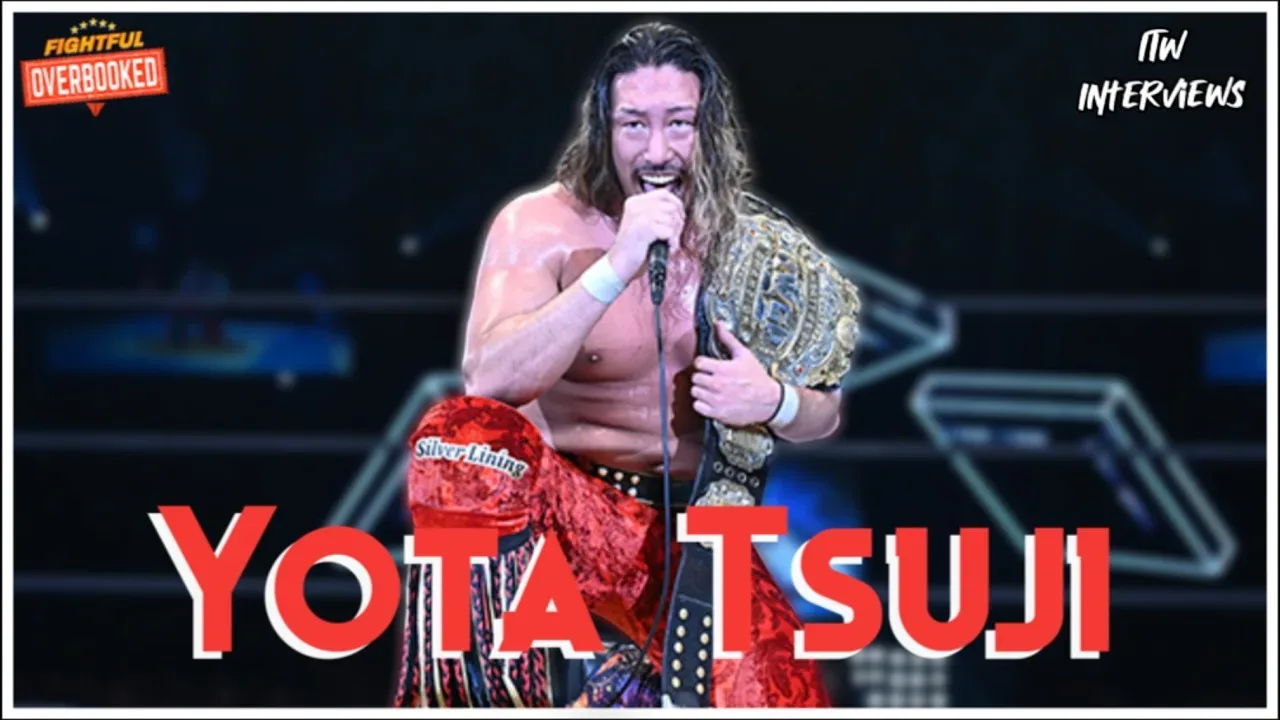
Yota Tsuji has responded to Callum Newman’s recent criticism of what has been described as a “new era of strong style” in New Japan Pro-Wrestling, offering a broad defense of the different approaches currently represented across the promotion’s roster.
Newman, the United Empire leader known for his explosive athleticism and high-speed offense, had taken aim at Tsuji and Yuta-Ice while questioning whether the more traditional, less acrobatic direction associated with some wrestlers truly represents strong style. Tsuji, who holds the IWGP Heavyweight Championship, did not dismiss the challenge. Instead, he said he appreciates that Newman is willing to raise the issue.
Speaking about the comments, Tsuji framed the disagreement as part of what makes New Japan’s roster compelling. He recognized that Newman’s style is built around spectacular athletic movement, while other wrestlers express themselves through a more grounded and conventional fighting approach.
“I honestly appreciate that,” Tsuji said of wrestlers such as Newman questioning the direction of the roster.
For more background on this topic, read Ryohei Oiwa and Hartley Jackson Declare for 2026 World Tag League After Power Struggle Win.
Tsuji’s response did not attempt to establish one fixed definition of strong style. In fact, he argued that no wrestler, himself included, can provide a final answer that applies to every match and every performer. For the champion, the point is not to make every New Japan wrestler look alike. The point is for every wrestler to pursue victory through the style that best represents them.
That distinction is important in the conversation between Tsuji and Newman. Newman’s identity has been closely connected to remarkable speed and athletic execution. His criticism centers on whether a move away from that kind of offense risks moving away from the intensity that strong style is supposed to represent. Tsuji acknowledged the contrast, noting that Newman performs “all kinds of athletic moves,” while describing a recent movement within the New Japan roster toward more traditional techniques.
Rather than present those styles as incompatible, Tsuji viewed them as separate means to the same end. Every member of the roster has, in his view, a unique fighting style used to express who they are in the ring. The shared objective is much more basic: win the match.
For Tsuji, Victory Is the Core of Strong Style
Tsuji repeatedly returned to the idea that professional wrestling competition in New Japan is ultimately decided by results. He said the winner takes all, and he believes the willingness to do whatever is necessary to secure that win should be central to any understanding of strong style.
“The idea is that you have to win in the end,” Tsuji said. “Whatever it takes to have secured win, I think that should be what strong style is.”
That answer leaves room for Newman’s aerial and athletic approach without asking Tsuji to abandon his own. It also avoids declaring that traditional offense is inherently more authentic than modern, high-speed wrestling. Tsuji’s position is that the defining value is effectiveness under competitive pressure, not adherence to a single visual template.
There is a practical edge to that viewpoint, especially coming from the reigning IWGP Heavyweight Champion. A championship wrestler has to adapt to opponents with radically different strengths, strategies, and levels of experience. A roster with multiple distinct in-ring identities creates different problems from one match to the next. Tsuji’s comments suggest he sees that variety as an asset rather than a threat to New Japan’s identity.
Newman’s remarks also appear to have landed as intended. Tsuji did not portray the United Empire leader as someone who does not belong in the strong-style conversation. He said he accepts Newman’s comments and understands why Newman made them. That is not a full concession, but it is a notable sign of respect for the underlying argument.
At the same time, Tsuji made clear that he does not question his own approach. He does not believe he needs outside approval to validate it as strong style, nor does he believe any individual can claim complete authority over the term. In his view, a wrestler’s responsibility is to compete, find a path to victory, and let the result speak for itself.
A Debate That Reflects New Japan’s Diverse Roster
The exchange between Tsuji and Newman highlights a familiar tension in professional wrestling: whether a promotion’s identity should be protected through a narrow set of traditions or expanded through evolving styles. New Japan has long been associated with physical competition, resilience, and the importance of winning. Those principles can be expressed through a wide range of offense, from punishing conventional strikes and throws to fast-paced athletic maneuvers.
Tsuji’s comments favor the broader reading. He did not say that acrobatic wrestling is outside the boundaries of New Japan. He did not argue that traditional moves should replace all other forms of offense. Instead, he described a roster in which wrestlers have individual ways of presenting themselves, with the shared competitive standard of securing the victory.
That is why Newman’s challenge is more than a disagreement about move selection. The discussion is about what wrestlers should prioritize when they call their work strong style. Newman emphasizes the athletic dimension of the style and has openly questioned a shift toward more traditional wrestling. Tsuji emphasizes the purpose behind the style: overcoming the opponent and leaving with the win.
Both perspectives place a premium on competition, even if they differ on how that competition should look. Newman’s willingness to call out the perceived direction of the roster reflects confidence in his own approach. Tsuji’s answer reflects confidence that New Japan has room for contrasting approaches, provided the wrestlers using them remain focused on results.
The champion’s language also avoids turning the issue into a personal feud based solely on disrespect. He did not reject Newman’s criticism outright. He said he understands it. That measured response could be read as an invitation for the debate to be settled in the most appropriate setting: through performance and outcomes in the ring.
Tsuji Does Not Claim a Final Definition
One of the most revealing elements of Tsuji’s response is his refusal to offer a definitive rulebook for strong style. Wrestling promotions often have signature concepts that become subjects of constant debate among performers and fans. Tsuji did not try to close that debate. He said he does not think anyone, including himself, has the definite answer.
That stance allows strong style to remain a living competitive idea instead of a rigid label. It can include physicality and traditional technique, but it can also include the athletic innovation represented by Newman. What cannot be removed from it, in Tsuji’s estimation, is the urgency to win.
For Tsuji, the simplicity of that premise is its strength. He described the competition in direct terms: the winner takes all. A wrestler can bring a distinctive style, a different pace, or a different collection of techniques, but the end goal remains unchanged. The strongest expression of a wrestler’s identity is not merely how they perform their offense; it is how they use that identity to prevail.
This response also places responsibility on every New Japan wrestler to make their own style matter. Distinctiveness alone is not enough. A fighter’s approach must be capable of producing victories. Under Tsuji’s definition, that is the test Newman, Tsuji, Yuta-Ice, and everyone else on the roster must meet.
What Comes Next for the IWGP Heavyweight Champion
Tsuji’s comments arrive while he continues to carry the status and expectations attached to the IWGP Heavyweight Championship. His response to Newman was not framed as a retreat from his own style, nor as an attempt to impose it on the rest of the locker room. It was a defense of competitive diversity within New Japan, with winning as the common demand.
Elsewhere in the same interview, Tsuji also discussed an upcoming appearance with MLW, indicating that the champion’s activities extend beyond this particular New Japan debate. Still, the discussion with Newman remains significant because it addresses how one of the company’s leading figures sees the promotion’s present direction.
Newman has raised a pointed question about the new era of strong style. Tsuji’s answer is that the phrase cannot be owned by one wrestler or reduced to one kind of offense. New Japan, he believes, is at its best when performers maintain their individual identities while pursuing the same unforgiving objective.
In Tsuji’s view, the argument will always come back to the bell, the contest, and the result. Whatever form strong style takes from wrestler to wrestler, the winner is the one who proves their style worked.

Darryl Polo
Darryl Polo is a passionate wrestling fan covering WWE, AEW, TNA and beyond. He loves great rivalries, breakout stars and the moments that keep fans talking long after the bell. How we work.