
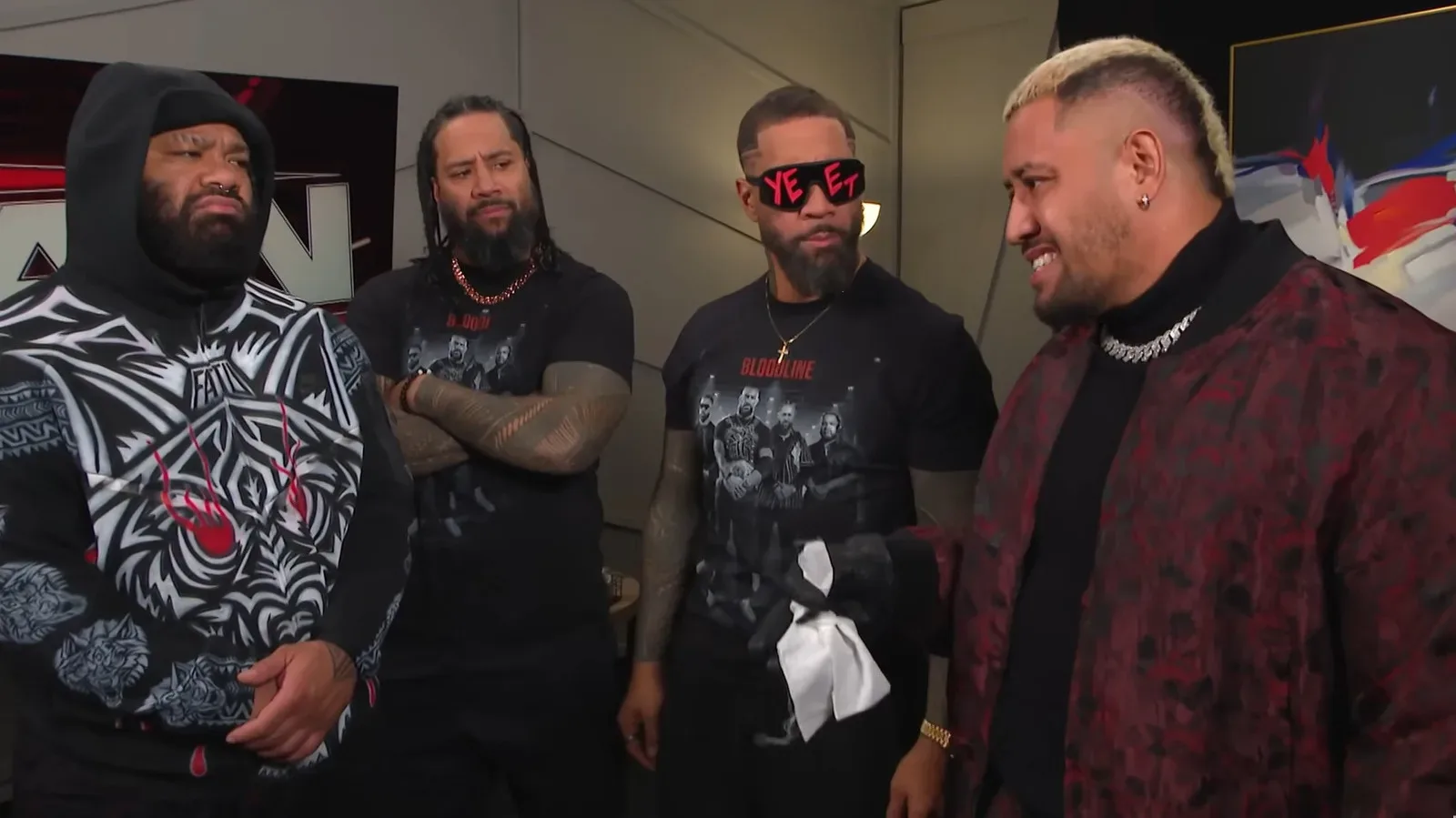
The Bloodline’s on-screen direction has made its babyface-or-heel status one of WWE’s more intriguing character questions in recent months. Roman Reigns, The Usos, Jacob Fatu and Solo Sikoa are currently connected under the Bloodline banner, yet the group’s actions, crowd reactions and ongoing program have not always pointed in precisely the same direction.
A backstage update has now added another layer to that discussion. The Bloodline as a unit is reportedly categorized internally as heels on WWE’s roster. However, the individual alignment of its members is not entirely uniform. Roman Reigns, Jacob Fatu and The Usos are said to be listed as heels, while Solo Sikoa is reportedly viewed internally as a babyface.
That distinction reflects the unusual position Sikoa has occupied since being brought back into the group. While he remains associated with Reigns and the rest of The Bloodline, his story has not been built around an enthusiastic return to the faction. Instead, WWE has emphasized that his renewed allegiance was imposed upon him following a major stipulation loss.
The Bloodline’s Collective Direction Remains Heel-Leaning
The current version of The Bloodline consists of Reigns, Jey Uso, Jimmy Uso, Fatu and Sikoa. Despite the history and star power attached to the group, its presentation has included heelish behavior over the last several months. That has made the faction’s reported internal heel designation a logical fit on the surface.
For more background on this topic, read Roman Reigns Sees Tribal Chief Parallels in Street Fighter’s Akuma.
The group is also involved in a feud with another heel act led by Royce Keys. Programs between two groups that both carry villainous tendencies can create a more complicated crowd dynamic than a traditional face-versus-heel rivalry. Audiences may cheer certain performers based on their popularity, personal history or immediate opponents even when WWE’s internal character labels tell a different story.
That appears particularly relevant with Reigns. The “Original Tribal Chief” has long been one of WWE’s defining figures, and reactions to him can be influenced by his stature as much as by any single action in a storyline. The same can be said for The Usos, whose connection to the Bloodline saga has made them central figures in some of WWE’s most emotional family-based angles.
Fatu’s reported heel listing also places him alongside Reigns and The Usos in WWE’s internal view of the faction. Although all of those names are aligned under one banner, the reported distinction involving Sikoa suggests WWE is deliberately preserving an important degree of separation within the group.
Solo Sikoa’s Return Was Not a Voluntary Reunion
Sikoa’s path back to The Bloodline began in August, when he lost to Jey Uso under a stipulation requiring him to pledge allegiance to Reigns. The condition tied Sikoa directly to “The Original Tribal Chief” and removed his ability to simply walk away from the family unit after the match.
The story did not portray Sikoa as eagerly accepting the arrangement. He initially rejected the demand to return, only to be coerced into rejoining The Bloodline. That reluctance has remained a meaningful part of his characterization. Rather than presenting Sikoa as a fully committed follower, WWE has shown a performer who is connected to the group but hesitant to embrace its identity or leadership structure.
It is a key difference when considering why he may be regarded as a babyface backstage despite the overall heel categorization of The Bloodline. A character who is forced into an allegiance can draw sympathy, especially when that character does not conceal his discomfort or immediately adopt the goals of the people around him.
The tension also gives WWE multiple possible storytelling paths without requiring an immediate split. Sikoa can remain inside the group while still questioning its direction. He can be used in the faction’s conflicts while maintaining the sense that his place is conditional, uneasy and potentially temporary. The uncertainty itself becomes part of the ongoing Bloodline story.
Audience Reactions Have Supported Sikoa’s Shift
Reports in July indicated that WWE officials were pleased by the babyface reactions Sikoa began receiving while teaming with LA Knight. Those responses were significant because crowd reaction is often one of the clearest indicators of whether a character’s presentation is connecting in the intended way.
Sikoa’s work alongside LA Knight offered a setting in which fans could respond to him outside of a straightforward Bloodline power structure. The reported positive reaction did not necessarily erase his long association with the faction or the aggressive reputation he established during earlier chapters of the story. It did, however, provide evidence that audiences were open to viewing him differently.
That response is consistent with his present reluctance to fully accept his role in Reigns’ group. WWE has continued to portray Sikoa as hesitant about embracing The Bloodline, and that hesitation can make him easier for fans to support. He is not simply standing beside the group and affirming every decision. His presence carries visible reservations.
In wrestling storytelling, alignment is not always determined solely by who a wrestler stands next to. Motivations, reactions and the degree of control a performer has over their circumstances all matter. Sikoa’s reported babyface classification appears rooted in those details. He may be physically associated with a heel faction, but the circumstances of that association make his role different from those of Reigns, Fatu and The Usos.
Why the Internal Labels Matter
Internal roster alignment does not necessarily dictate every reaction from the live audience or every beat of a television segment. WWE can present characters with shades of gray, especially in a story as layered as The Bloodline’s. Still, the reported listings provide a useful indication of the direction the company sees for each member at this stage.
For Reigns, The Usos and Fatu, the reported heel designation suggests that WWE continues to view their collective faction role through a villainous lens, even as their popularity can produce loud reactions. For Sikoa, the babyface listing indicates that his emotional position in the narrative is being treated separately from the group’s broader identity.
That separation could be especially important because Sikoa’s return was built on an obligation rather than a reconciliation. He lost to Jey Uso, was required to pledge allegiance to Reigns, resisted that requirement and was ultimately forced back into the fold. Those are not the actions of someone presented as willingly rejoining a dominant unit on equal terms.
There is also an inherent contrast between Sikoa and Reigns in the current setup. Reigns is the man to whom Sikoa had to pledge allegiance. Sikoa is the man who had to be pressured into doing so. As long as WWE continues to emphasize that imbalance, it leaves room for audience sympathy toward Sikoa even while he shares space with a heel-oriented faction.
An Unstable Unity at the Center of the Story
The Bloodline’s strength has often been its ability to turn family loyalty into a source of drama. Unity, betrayal, obligation and power have all been central themes of the group’s long-running saga. The reported difference between Sikoa’s internal alignment and that of the rest of the faction fits directly into that tradition.
Sikoa is not presented as entirely separate from The Bloodline. He is back within its orbit because of the August stipulation and remains linked to Reigns, The Usos and Fatu. But he is also not being framed as an uncomplicated extension of the group. His reluctance, along with the babyface reactions he has received, makes his status one of the clearest signs that the faction’s current unity may be more fragile than it appears.
For now, WWE’s reported internal positioning paints a nuanced picture: The Bloodline is heel, Reigns, Fatu and The Usos are heel, and Sikoa is the exception. As the feud involving Royce Keys’ heel group continues and Sikoa’s discomfort with his forced reunion remains part of the story, that exception could become increasingly important.
In pictures
Darryl Polo
Darryl Polo is a passionate wrestling fan covering WWE, AEW, TNA and beyond. He loves great rivalries, breakout stars and the moments that keep fans talking long after the bell. How we work.