
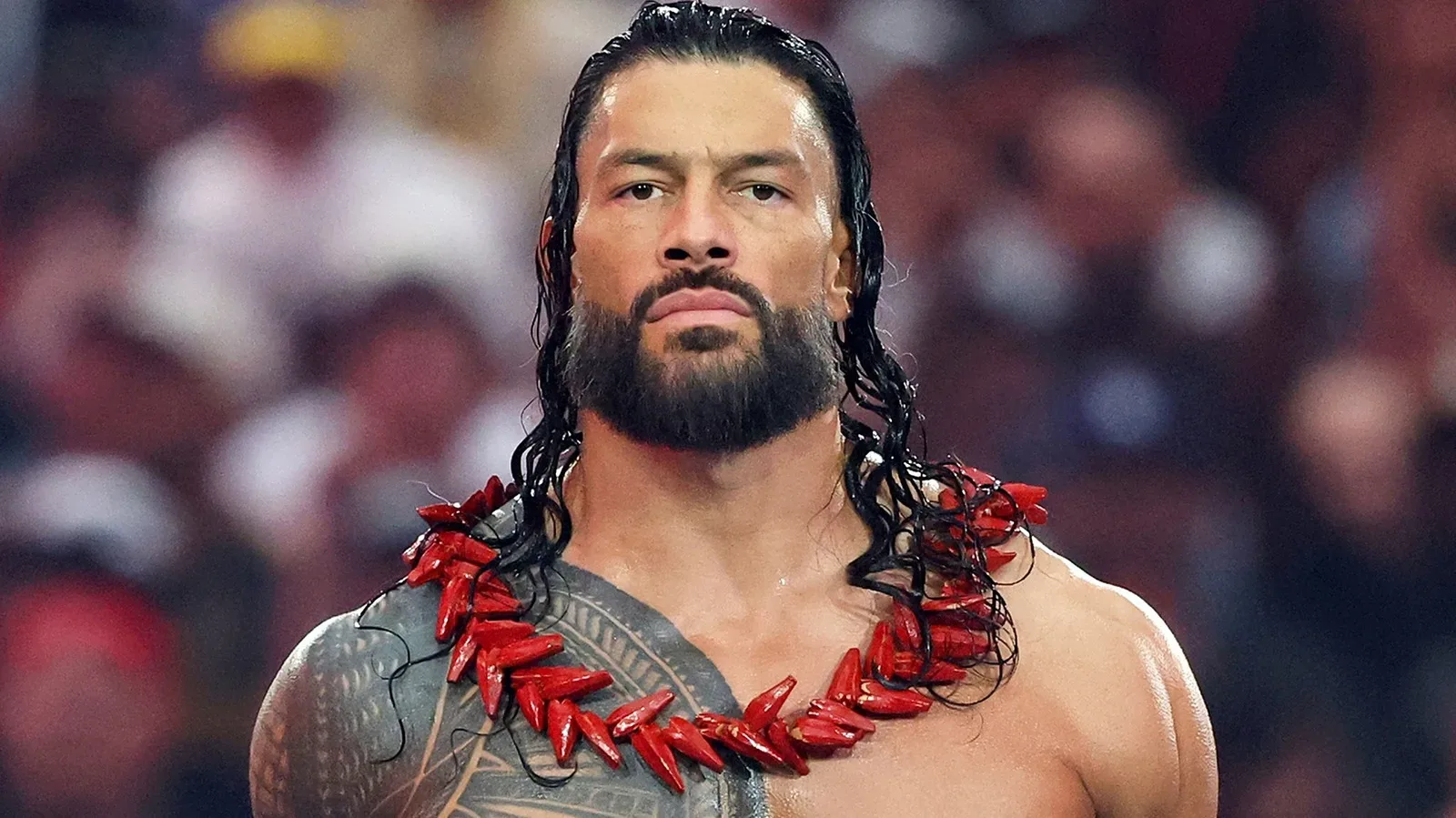
Roman Reigns has spent years presenting himself as one of WWE’s most imposing and layered figures, and he believes that experience made him a natural fit for a major new acting assignment. Reigns will portray Akuma in the upcoming Street Fighter film, taking on one of the video game franchise’s most enduring and recognizable anti-heroes.
For Reigns, the role did not require him to create an identity from nothing. Instead, he found considerable overlap between Akuma’s mindset and the on-screen attitude that has shaped his work in WWE. The former Undisputed WWE Universal Champion has long rejected a conventional hero-or-villain label for his character, and he sees a similar refusal to fit neatly into one category in Akuma.
“I think that’s why I was considered for the part and got it,” Reigns said. “I said it from the beginning. I’m not a good guy. I’m not a bad guy. I’m the guy, and that’s how I’ve always felt in WWE.”
That statement reflects a defining thread in Reigns’ WWE presentation. Whether positioned opposite cheering or hostile audiences, his character has generally been driven by authority, competitive pride, and the belief that he belongs at the center of the company. The “Original Tribal Chief” branding has only intensified that approach, framing Reigns as a figure who expects recognition rather than someone seeking approval.
For more background on this topic, read Rob Conway Reflects On John Cena’s OVW Work Ethic And Untapped Heel Promo Potential.
Akuma arrives from a very different world, but Reigns views the character through a comparable lens. In the Street Fighter series, Akuma is frequently treated as a fearsome presence and a dangerous opponent, yet Reigns emphasized that the character’s purpose is not simple cruelty. He sees Akuma as a warrior motivated by the pursuit of the highest possible level of competition.
“He’s not a villain, he just is only looking for the most honorable fight, the greatest competition. That’s all he cares about. He’s not evil. He just is what he is, and that’s what I love about him,” Reigns said.
That interpretation is especially relevant to the challenge of bringing a game character to film. Akuma’s presence has been built across years of fighting games, where posture, visual design, special moves, and brief pieces of dialogue carry enormous weight. A film performance requires more space for behavior, expression, and character detail, but it also has to preserve the traits that make the figure recognizable to longtime fans.
Reigns said the production gave him an opportunity to examine pieces of Akuma that have not been fully explored in the games while staying true to the character. That balance is central to any adaptation of an established property. Fans may recognize Akuma immediately through his appearance and reputation, but the movie format allows the performer to investigate how that intensity functions in scenes beyond a match or a confrontation.
A WWE Persona Built Around Conviction
The comparison between Reigns and Akuma is not simply about physical presence. Reigns’ comments point to a shared sense of conviction. Both characters, in his view, operate with a clear internal code. They may be perceived as antagonistic by others, but they do not define themselves through that perception.
That is a familiar idea in professional wrestling, where the strongest characters often see themselves as justified regardless of how the audience responds. Reigns has consistently leaned into that principle. His WWE work has thrived on certainty: certainty in his standing, certainty in his leadership, and certainty that any opponent who steps forward must prove they belong in his ring.
Akuma’s search for an honorable and exceptional fight gives Reigns a point of entry that goes beyond surface-level menace. Rather than approaching the role as an outright villain, he is approaching the character as someone devoted to a singular goal. The distinction matters because it shapes the performance. A character motivated by competition can carry intimidation and aggression without becoming one-dimensional.
It is also an idea that translates easily from Reigns’ wrestling background. WWE’s biggest rivalries are often rooted in status and the need to establish superiority. Reigns has performed in that environment for years, working stories in which championships, family legacy, control, and acknowledgment all become stakes in a larger battle for dominance. Akuma’s motivations are different in setting, but Reigns sees a recognizable competitive fire beneath them.
From Live WWE Performances to a Film Set
While Reigns found the character work comfortable, the practical process of acting in a film is naturally different from working a WWE event. Wrestling performance is immediate and communal. A performer must execute in front of a live crowd, hear the crowd’s reactions in real time, and adjust the pace or emotional emphasis as the match and segment unfold.
Film acting removes that direct audience relationship. A scene is built through multiple takes, camera angles, technical setups, and the eventual editing process. Reigns acknowledged that the primary adjustment for him came from no longer performing before a large live crowd.
“When I was on set, I felt very comfortable,” Reigns said. “The main thing is just not performing in front of a lot of people.”
The change in environment did not prevent Reigns from drawing on a familiar internal approach. He said he was able to shift into a competitive mindset during filming, and that members of the crew regularly praised his work after takes. For a wrestler accustomed to treating major WWE moments as high-pressure performances, finding a way to bring that same focus to a set represents an important bridge between the two mediums.
That competitive switch has been one of the most consistent elements of Reigns’ public persona. In WWE, he has frequently carried himself as though every appearance is an opportunity to reinforce his position. On a film production, the goal is not to defeat an opponent in front of an arena, but the discipline of preparation and execution can remain similar. Reigns’ remarks suggest he approached the work with that same desire to deliver when the cameras were rolling.
Akuma Offers Reigns a Different Kind of Spotlight
The Street Fighter role gives Reigns a chance to work within a global gaming franchise while also showing a side of his performance style that WWE audiences do not always see. Wrestling asks performers to communicate clearly and quickly to a live audience. A movie can linger on smaller choices, allowing physicality, silence, and reactions to add dimension to a character.
For Akuma, that could be particularly meaningful. The character’s reputation is rooted in power, discipline, and a relentless commitment to finding worthy opposition. Reigns has identified those qualities as the aspects that connect most directly to his own WWE character, but the film will give him room to portray the person behind that drive in ways the games have not necessarily detailed.
Reigns did not present the role as a departure from everything he has done in wrestling. Instead, he described it as an opportunity shaped by instincts he has already developed in WWE. His ability to portray a dominant personality who is neither seeking to be liked nor concerned with being branded a villain is a clear thematic fit for his view of Akuma.
That does not mean the two characters are identical. Reigns’ WWE identity has been built around the dynamics of a wrestling promotion, its championships, and its evolving alliances and rivalries. Akuma belongs to a fighting-game mythology defined by his own code and quest for the ultimate challenge. Still, Reigns believes the emotional core is close enough that he could step into the part with confidence.
Reigns Embraces the Anti-Hero Role
Reigns’ description of Akuma ultimately centers on authenticity. He does not see the character as evil for the sake of evil, and he does not believe Akuma needs to be softened into a traditional hero. The appeal, in Reigns’ eyes, is that Akuma is fully committed to what he is: a fighter who wants the greatest competition and the most honorable test.
It is a perspective that mirrors the language Reigns has used to define himself in WWE. “I’m the guy” is not a plea for acceptance. It is a declaration of identity and status. By connecting that outlook to Akuma, Reigns has offered a clear indication of the direction he brought to the performance.
As the upcoming Street Fighter film moves closer, WWE fans will have the opportunity to see how Reigns translates that commanding presence into a new arena. He has already made clear that the transition felt comfortable, that the competitive energy remained intact, and that Akuma’s moral complexity was a major part of the role’s appeal.
For Reigns, Akuma is not simply a villain waiting to be played. He is a fighter with purpose, a character defined by his own code, and a figure whose refusal to conform closely resembles the attitude that has made the Original Tribal Chief one of WWE’s defining personalities.
In pictures

Darryl Polo
Darryl Polo is a passionate wrestling fan covering WWE, AEW, TNA and beyond. He loves great rivalries, breakout stars and the moments that keep fans talking long after the bell. How we work.