
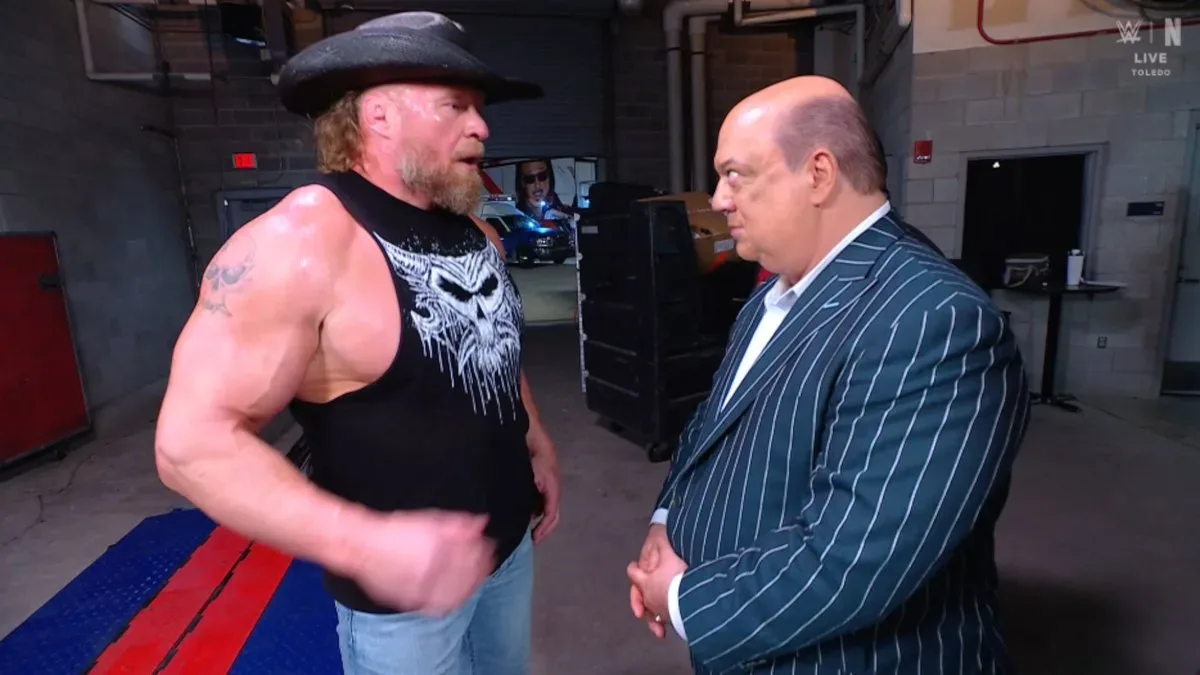
Paul Heyman has never been reluctant to make the biggest possible case for Brock Lesnar, and his latest comments about Lesnar’s mixed martial arts legacy have drawn a familiar reaction from people within WWE.
Heyman recently argued that Lesnar would still be UFC Champion at 49 years old had diverticulitis not altered the course of his fighting career. The statement was deliberately absolute in tone, presenting Lesnar as an athlete no current opponent could survive against for even one round.
“If he didn’t have diverticulitis, he would’ve never been defeated in UFC. Never. He’d still be champion today at 49. There’s nobody on this planet that could hang with him, no one. No one would get out of the first round with him, there’s no way.”
Following those remarks, multiple people in WWE reached out to characterize Heyman’s comments as him being in “promoter mode.” There was apparent agreement among those contacted that the statement should be understood through the lens of Heyman’s long-established role as an advocate, manager, on-screen strategist, and master of hyperbole rather than as a restrained sporting prediction.
For more background on this topic, read Cody Rhodes Names Brock Lesnar’s UFC Speed as His Most Frightening Physical Trait.
That reading fits the nature of Heyman’s public relationship with Lesnar. When Heyman speaks for Lesnar, he does not usually frame arguments in cautious terms or leave room for counterpoints. His role is to make Lesnar feel singular: the most dangerous competitor in the room, the most dominant athlete of his era, and an impossible problem for anyone placed across from him. Whether the setting is WWE or a discussion of Lesnar’s fighting history, the delivery is intended to elevate the aura.
Heyman’s argument centers on diverticulitis
The central point in Heyman’s claim was not merely that Lesnar possessed exceptional ability. It was that diverticulitis was the decisive factor that prevented Lesnar from maintaining an undefeated and uninterrupted reign at the top of UFC.
Heyman’s wording left no ambiguity. He said Lesnar would have “never” been defeated and would “still be champion today” if the illness had not occurred. It is an enormous counterfactual statement, particularly because it extends the hypothetical all the way to Lesnar’s current age of 49.
WWE contacts who discussed the comments did not appear to treat that projection as a literal forecast to be measured against the realities of competitive MMA. Instead, their reaction reflected an understanding of how Heyman sells a premise. The more emphatic the claim, the more it reinforces the image Heyman wants associated with Lesnar.
That does not mean the comments ignored the seriousness of the health issue Heyman referenced. Rather, Heyman used that element to make a broader argument about what Lesnar might have accomplished under different circumstances. In promotional language, a real turning point becomes the foundation for an even larger claim about an athlete’s unrealized ceiling.
The age component makes the statement especially bold
Heyman’s reference to Lesnar being UFC Champion at 49 is the portion of the quote that most clearly illustrates why WWE figures viewed it as promotional rhetoric. The oldest champion in UFC history was 44 years old, making Heyman’s scenario one that would move beyond the existing age benchmark by five years.
That fact does not lessen Lesnar’s standing as an unusually accomplished athlete, nor does it prevent Heyman from presenting his client in the strongest imaginable terms. It does, however, underline the difference between a manager’s proclamation and a measured assessment of an active combat-sports division.
Promoters and advocates are not generally rewarded for offering narrow predictions. Their job is to create conviction, excitement, and a sense that their featured attraction exists beyond normal limits. Heyman’s voice has been central to that kind of presentation for decades. His statements are designed to make an audience picture an outcome before it happens—or, in this case, picture an alternate history in which Lesnar remained unbeatable.
For that reason, the internal response is notable less as a dispute with Heyman than as an acknowledgment of the role he was playing. The phrase “promoter mode” carries an important distinction. It suggests those who reacted did not interpret the comments as Heyman attempting to offer a detached analysis of MMA history. They heard an advocate delivering the most forceful possible version of the Brock Lesnar story.
Lesnar remains a uniquely marketable subject for Heyman
Lesnar’s crossover background has always made him a particularly potent subject for that approach. In professional wrestling, athletic credentials and legitimate sporting accomplishments can become central pieces of character presentation. A performer’s history outside the ring can add weight to the stories told on television, especially when paired with a speaker capable of turning credentials into a broader narrative of intimidation.
Heyman has consistently understood that formula. His presentations often operate on more than results alone. He emphasizes physical threat, preparation, credibility, status, and the psychological effect an opponent faces before the contest even begins. The result is a character framework in which the question is not simply whether Lesnar can win, but whether anyone should want to stand in front of him at all.
The UFC comments followed that same playbook. Heyman did not simply say Lesnar would have remained successful. He said no one could “hang with him” and insisted that no opponent would escape the first round. Such language is purposefully definitive. It is not meant to open a balanced debate; it is meant to close one.
That style also explains why the reaction did not emerge as surprise that Heyman had praised Lesnar. The scale of the praise may have prompted discussion, but the instinct behind it was recognizable. Heyman’s most effective public statements often work by taking a point that supporters already accept and stretching it to its most dramatic conclusion.
A debate without a definitive answer
There is no way to conclusively settle the alternate history proposed by Heyman. The impact of diverticulitis on Lesnar’s UFC path, the opponents he might have faced, the changing landscape of the sport, and the challenge of competing into one’s late forties all make the premise inherently speculative.
Heyman was not presenting that uncertainty as part of his case. He was presenting certainty. That is why the quote has resonated: it is so complete in its confidence that it invites a reaction from both supporters and skeptics.
For supporters, it is an assertion of Lesnar’s extraordinary ability and a reminder of how dramatically health can affect an athlete’s career. For skeptics, the idea of a 49-year-old still holding the UFC Championship goes far beyond what can responsibly be guaranteed. WWE figures who described the comments as promoter mode effectively recognized both sides of that equation. The claim is intentionally outsized, and it is entirely in character for the person making it.
In wrestling, that kind of language is not a flaw in the presentation. It is often the point. A great advocate turns possibility into inevitability, greatness into invincibility, and a respected athlete into an almost mythic figure. Heyman’s comments about Lesnar did exactly that.
Whether anyone agrees with the literal prediction is separate from the message Heyman was trying to deliver. His point was that Lesnar, in Heyman’s view, should be regarded as a once-in-a-generation physical force whose career trajectory was changed by circumstances beyond the cage. The WWE reaction suggests people close to the company understood the message for what it was: a characteristically maximal sales pitch from one of professional wrestling’s most gifted promoters.

Darryl Polo
Darryl Polo is a passionate wrestling fan covering WWE, AEW, TNA and beyond. He loves great rivalries, breakout stars and the moments that keep fans talking long after the bell. How we work.