
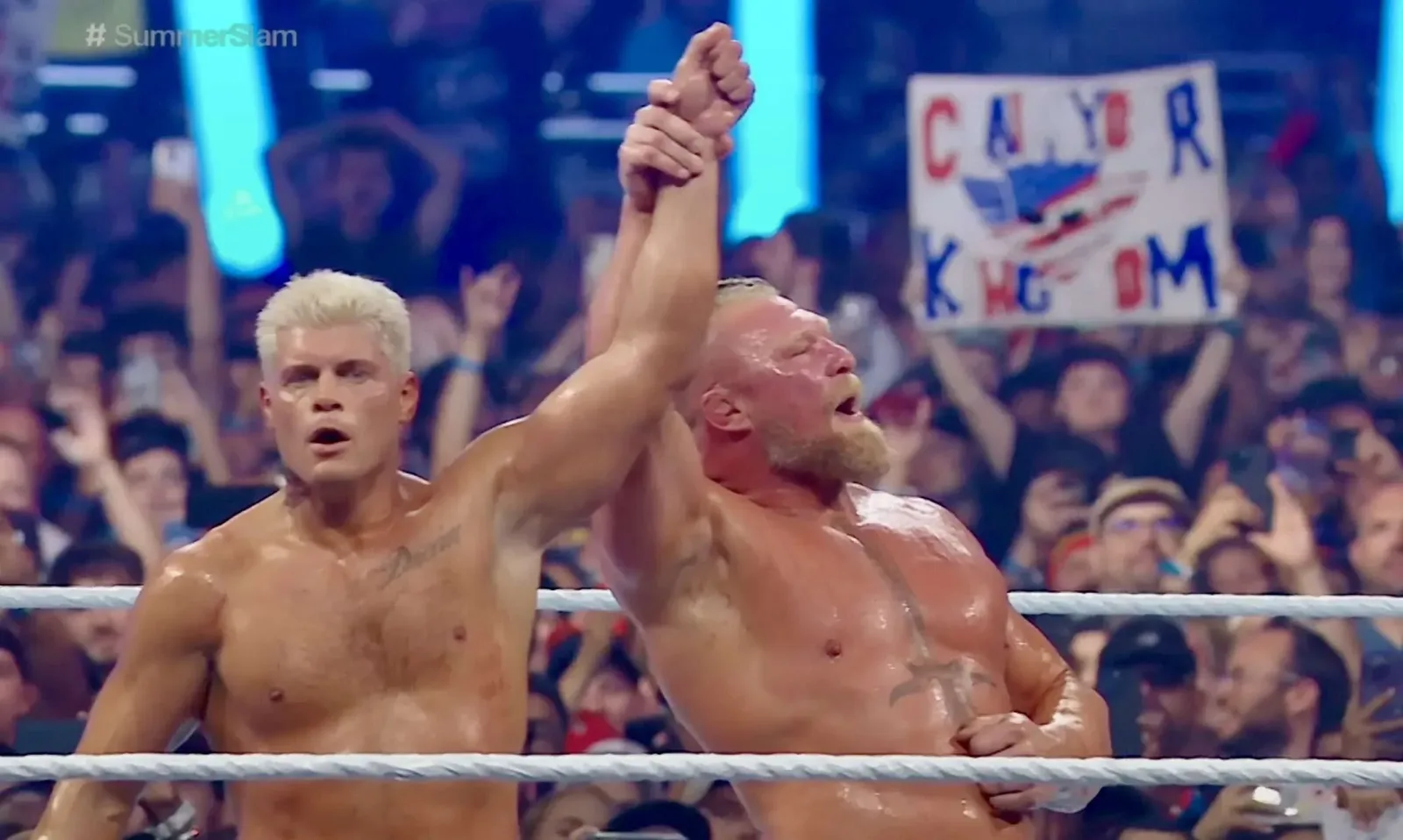
Cody Rhodes has shared the ring, trained, and traveled with some of the most imposing athletes WWE has featured across multiple generations. When asked to name the strongest performers he has encountered, Rhodes did not reduce the answer to one name. Instead, he laid out a group of wrestlers whose power presented itself in very different ways.
Mark Henry’s enduring strength, Big Show’s overwhelming force, Big E’s eye-catching gym feats, Cesaro’s remarkable power, John Cena’s physical credentials and Bron Breakker’s current athletic profile all received praise from Rhodes. Yet when the discussion reached Brock Lesnar, Rhodes focused less on brute force than on the quality that made Lesnar especially alarming: speed.
For Rhodes, Lesnar’s size was obviously intimidating. What made the former WWE and UFC champion uniquely frightening, however, was the way he could move despite carrying the frame of a heavyweight powerhouse. Rhodes said Lesnar’s explosiveness was clear to anyone who watched his UFC career, and it translated into a particularly unnerving presence in a wrestling setting.
Rhodes identifies a broad class of extraordinary strength
Rhodes framed his answer as a combination of names rather than a single definitive choice. He began with Henry, whose reputation as one of the strongest men ever to enter a WWE ring has long been central to his presentation and legacy.
For more background on this topic, read Solo Sikoa’s WWE Raw Promo Was Filmed the Previous Week, Not Green Screened.
“Mark Henry had kind of the reserve strength. The World’s Strongest Man was the world’s strongest man,” Rhodes said.
Rhodes used the phrase “reserve strength” to describe the sense that Henry did not need to demonstrate his full capability at all times. Even during the later stages of his WWE career, including his celebrated Hall of Pain period, Rhodes felt Henry could make subtle movements that immediately reminded everyone around him of the strength he possessed.
“He’d do stuff every now and then where he’d kind of move with those bear paws in a way that he’d remind you of his strength,” Rhodes said.
Henry won the Arnold Strongman Classic in 2002. Rhodes’ broader point was that Henry’s elite strongman background remained evident long after he was no longer regularly focused on that style of lifting. His power was not merely part of an on-screen identity; Rhodes viewed it as an unmistakable, ever-present trait.
Big Show was another immediate choice. Rhodes recalled a moment when Big Show was upset with him and connected with a strike to the chin, saying it may have been the only time he was knocked out before quickly recovering. Rhodes also remembered being shoved by the giant, using that experience to reinforce his view that Big Show had the same kind of stored-up, natural power.
“Big Show had reserve strength. Those two for sure,” Rhodes said of Henry and Big Show.
The comparison is fitting in that both men projected immense force without needing to constantly advertise it. In WWE, their stature alone was enough to establish the danger they represented. Rhodes’ recollections suggest that working physically with either performer made that danger feel even more tangible.
Big E, Cesaro and Cena receive praise
Rhodes also highlighted Big E, calling him an “anomaly” and pointing to the remarkable feats of strength associated with the former WWE Champion. Big E’s athletic reputation has extended well beyond standard wrestling conditioning, and Rhodes described him as someone who seemed capable of setting records whenever he entered a gym.
“Big E was breaking records at every gym across the country when he’d go into it. Big E was an anomaly, unbelievable,” Rhodes said.
Cesaro, now known as Claudio Castagnoli outside WWE, was another name Rhodes included without hesitation. Long admired by peers and fans for his combination of functional strength, balance and technical precision, Cesaro has built a career around making demanding feats look surprisingly smooth. Rhodes simply called his strength “unbelievable,” an economical assessment from somebody well qualified to recognize the difference between impressive conditioning and exceptional power.
John Cena also belongs in Rhodes’ strength category. Cena’s longevity at the top of WWE was built on much more than physical ability, but his weight-training reputation and sustained athletic output have been major aspects of his career. Rhodes did not offer a specific anecdote about Cena, though his inclusion among this group speaks for itself.
Looking at the present WWE landscape, Rhodes sees Bron Breakker as a performer with a similarly rare athletic foundation. Breakker’s explosiveness has become one of his most recognizable attributes, and Rhodes placed him alongside the company’s strongest and most physically gifted names. That comparison does not erase the distinctions between the athletes Rhodes mentioned; rather, it emphasizes the range of extraordinary physical talent he has witnessed in WWE.
Why Brock Lesnar was different
Lesnar was part of Rhodes’ list, but the explanation behind his placement was more specific. Rhodes acknowledged everything that made Lesnar visually intimidating: the size, the muscular build and the fearsome look. Those traits alone would make any opponent stand out. But Rhodes believes observers can miss the element that made Lesnar truly singular.
“I think the thing people forget about Brock, and if you watched him at UFC, you knew this about Brock,” Rhodes said. “It wasn’t the fact that this giant, hulking, fearsome looking individual was coming after you. It was how fast he was.”
Lesnar’s UFC run offered a setting where that speed was especially apparent. Combat sports place a premium on closing distance, changing levels, reacting under pressure and generating force instantly. Lesnar’s physical dimensions made his quickness appear even more startling. A smaller athlete moving rapidly is expected; a heavyweight with Lesnar’s size accelerating with that kind of urgency produces a different reaction.
Rhodes described that quality as “genuinely terrifying from a performative standpoint.” The wording matters because professional wrestling depends on performers creating a feeling of danger while working within a choreographed environment. Lesnar’s speed could enhance that feeling immediately. A sudden burst across the ring, a rapid change from stillness to attack, or the force behind his movement could make his offense seem difficult to anticipate and even harder to stop.
“He just was one of one, unicorn,” Rhodes said. “That’s all those tools, they were meant to take him where he took him.”
That assessment encapsulates Lesnar’s unusual career path. He succeeded at the highest levels of WWE, then became a UFC heavyweight champion before returning to become one of WWE’s defining attractions again. Rhodes did not try to separate Lesnar’s strength from his quickness, durability, size or competitive temperament. In Rhodes’ telling, those tools worked together to create an athlete unlike almost anyone else he has encountered.
A perspective shaped by experience
Rhodes’ list carries particular weight because his WWE career has placed him around a wide range of elite performers. He has worked through different eras, encountered giants and powerlifters, and competed alongside athletes whose abilities vary dramatically. His answer also avoids treating strength as one simple measurement.
Henry and Big Show represented a deep, natural force that could be felt in ordinary contact. Big E represented exceptional gym-based feats and athletic power. Cesaro’s reputation rests on refined, functional strength. Cena’s consistency and conditioning remain benchmarks. Breakker represents a newer generation of explosive physical talent. Lesnar, in Rhodes’ view, combined overwhelming size and force with a speed that changed how an opponent perceived him.
That distinction is why Lesnar remains such an outlier in conversations about WWE’s most formidable athletes. Plenty of wrestlers have looked powerful. Plenty have moved quickly. Far fewer have possessed both traits at Lesnar’s level, then carried them into legitimate high-level competition outside wrestling.
Rhodes’ comments ultimately offer a useful reminder that the strongest person in a locker room is not always defined by a single lift or statistic. Strength can be visible in a shove, a grip, an effortless display of control, an explosive tackle or the unsettling speed with which a massive opponent can suddenly close in. In Lesnar’s case, Rhodes believes that last factor was the one people should never overlook.
In pictures

Darryl Polo
Darryl Polo is a passionate wrestling fan covering WWE, AEW, TNA and beyond. He loves great rivalries, breakout stars and the moments that keep fans talking long after the bell. How we work.