
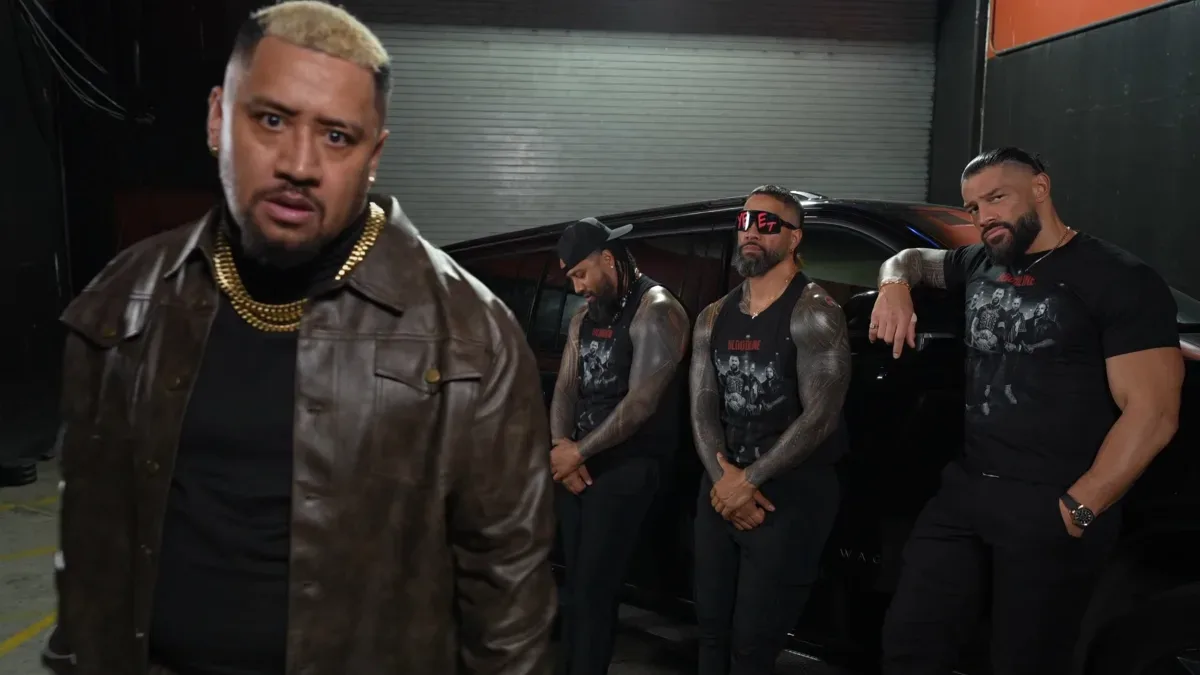
Solo Sikoa’s recent WWE Raw appearance was not created through green-screen effects, despite questions from viewers about how the segment was produced. WWE sources indicated that the footage was filmed the previous week, when Sikoa, Roman Reigns and The Usos were all present, then incorporated into the following Raw broadcast.
The segment saw Sikoa deliver a promo involving Royce Keys while Reigns and The Usos stood behind him and reacted to what was being said. The Bloodline members were not physically live at the Raw event where the promo aired, creating understandable speculation over whether the visual had been assembled through production effects. The explanation is more straightforward: WWE had captured the material in advance during the prior week.
A Pre-Taped Segment, Not a Digital Composite
Professional wrestling television frequently relies on a mixture of live matches, backstage material, sit-down interviews, cinematic packages and pre-taped promos. In this case, the key distinction is that Sikoa was filmed with Reigns and The Usos in the same setting ahead of time. The visual was not a case of performers being inserted into a background through green-screen technology.
That difference matters because the presentation of the scene naturally raised questions among fans watching Raw. Reigns and The Usos were visible behind Sikoa, offering reactions as he spoke, even though they were not at the live episode that ultimately carried the segment. With the group having been at WWE’s prior week of television, the company had the opportunity to record the promo while all of the necessary performers were together.
For more background on this topic, read Report: Proposed Big Cass, Rusev and Ethan Page WWE Stable Has Not Been Communicated Internally.
Pre-taping the material enabled WWE to keep Sikoa connected to Reigns and The Usos on television without requiring the entire group to appear at that particular Raw venue. It also allowed the creative focus to remain on Sikoa’s message and on the dynamics visible in the background, rather than making the absence of the other Bloodline members the central story of the broadcast.
Why the Presentation Drew Attention
The Bloodline has long been presented as a faction in which body language can be as important as dialogue. A stare, a nod, a refusal to react, or a look exchanged between members can carry implications for the group’s internal hierarchy. As a result, the decision to frame Sikoa in front of Reigns and The Usos made the segment feel like a collective Bloodline moment, even though Sikoa was the one speaking.
For viewers familiar with the group’s history, the presence of Reigns and The Usos behind Sikoa was especially notable. The faction’s stories have repeatedly revolved around questions of loyalty, authority, family and who holds influence within the group. WWE did not need the scene to take place live for those visual elements to register. The reactions were recorded when the group was together and then shown when WWE chose to advance the televised angle.
The sequence also illustrates the level of attention that WWE audiences bring to modern wrestling production. Fans regularly examine crowd shots, arena layouts, lighting, commentary references and the availability of talent to determine whether a segment is occurring live. That scrutiny is part of the way weekly wrestling television is consumed, particularly when a major act appears in a setting that seems different from the one shown elsewhere on the same program.
In this instance, the answer does not point to an elaborate visual-effects method. The segment was filmed the week before it aired. That approach is a familiar television practice and gives WWE flexibility in building episodes around a performer’s schedule, storyline pacing and the need to keep important characters visible.
Solo Sikoa Remains the Focus of the On-Screen Moment
While the production discussion has centered on the presence of Reigns and The Usos, the segment itself remained a Solo Sikoa vehicle. Sikoa addressed Royce Keys, with the other Bloodline figures positioned behind him. The arrangement gave the promo an added sense of backing and placed Sikoa in a setting associated with the family’s power structure.
WWE has often used faction backdrops to reinforce a wrestler’s status. A performer speaking alone sends one message; that same performer speaking while allies or relatives stand behind them can change the tone completely. In Sikoa’s case, the appearance of Reigns and The Usos strengthened the visual connection to The Bloodline and gave the promo a larger presentation than a standard solo backstage interview.
It is also notable that the segment did not require a live appearance from every member of the group to deliver that message. Wrestling storylines unfold over weeks and months, and television production can be used to maintain continuity from one episode to the next. Filming the footage during the prior week allowed WWE to utilize a full group image even as the live Raw episode proceeded without Reigns and The Usos in the building.
Pre-Tapes Are a Regular Part of WWE Television
Although Raw is widely identified as a live weekly program, not every piece of content shown during a live broadcast is created in real time. Video packages are prepared in advance, interviews can be recorded before the show, and certain storyline scenes may be taped separately to achieve a particular look or accommodate the availability of talent. WWE has used those tools throughout its television history.
A pre-taped promo can offer several advantages. It gives production staff control over audio and camera placement, allows performers to focus on a concise story beat, and can be edited into a broader episode at the most effective point. It can also be filmed when a group is together, rather than forcing WWE to abandon a planned visual simply because all of the talent will not be on hand for a subsequent live broadcast.
That does not mean every unexpected appearance is pre-taped, nor does it suggest that WWE is attempting to present recorded material as something it is not. It simply reflects the format of contemporary wrestling television. A weekly show must balance live action with promotional content, long-term narrative developments and the practical realities of a large roster.
For this particular segment, the advance recording explains why Sikoa could be shown alongside Reigns and The Usos after the group had appeared at the prior week’s WWE television. Their appearance together was captured then, and the footage was used later on Raw.
What It Means for The Bloodline Story
The available information concerns the production of the Raw segment rather than a newly confirmed storyline development. Still, the choice to feature Sikoa with Reigns and The Usos carries clear on-screen significance. WWE chose to place the three figures in the same shot and to let their reactions accompany Sikoa’s remarks involving Royce Keys.
That image preserves the connection between Sikoa and the wider Bloodline presentation. Even when the group is not physically present at a particular event, WWE can continue to remind audiences of its central relationships and its importance within the company’s programming. The footage accomplishes that purpose without changing the fact that Reigns and The Usos were not live for the Raw episode in question.
It also demonstrates why viewers should separate the mechanics of how a segment was made from the story WWE intended to tell. The promo was pre-taped, but it was still designed for Raw and still featured deliberate character reactions. The absence of green-screen work means the performers were filmed together, making those reactions part of the original scene rather than a digital construction.
Ultimately, the situation is a production clarification rather than a mystery involving special effects. Solo Sikoa’s Raw promo was recorded one week earlier with Roman Reigns and The Usos present. When it aired, the footage gave WWE a Bloodline-focused visual despite those members not being live at the show. For fans assessing the segment, the key takeaway is simple: it was pre-taped television, not green-screened footage.

Darryl Polo
Darryl Polo is a passionate wrestling fan covering WWE, AEW, TNA and beyond. He loves great rivalries, breakout stars and the moments that keep fans talking long after the bell. How we work.