
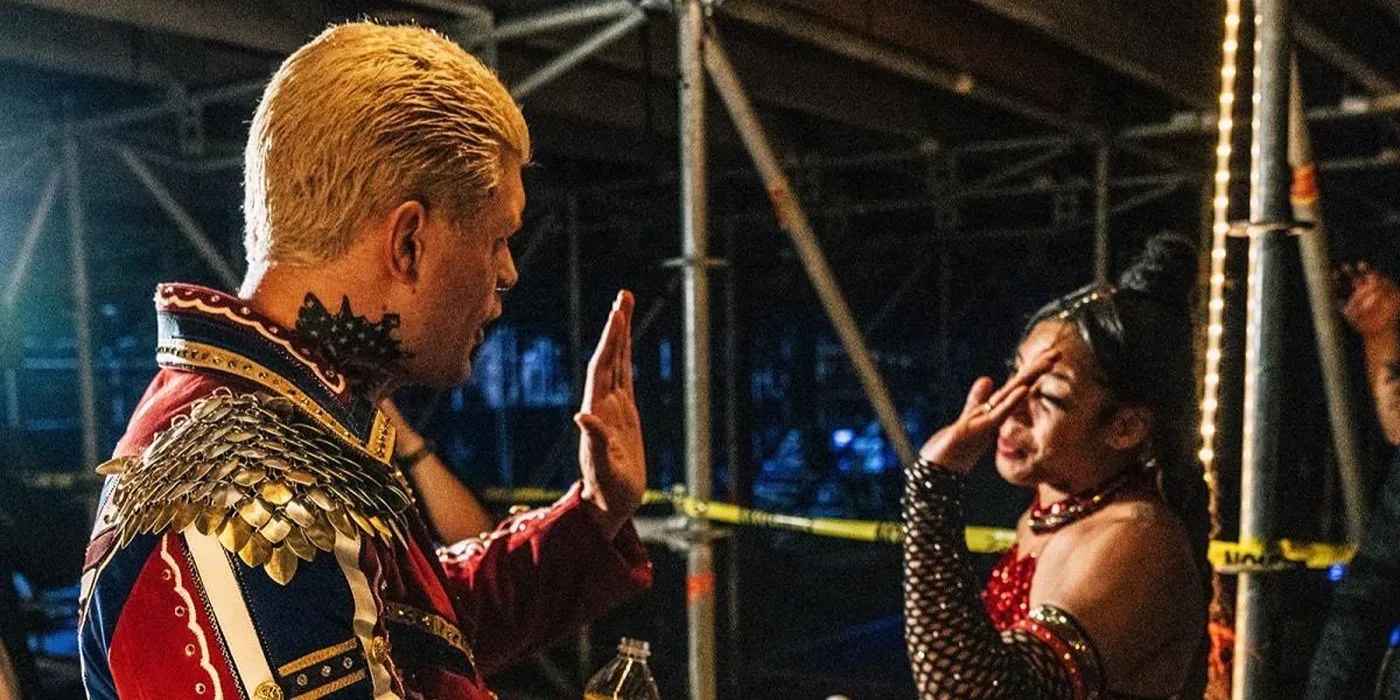
Cody Rhodes has placed Bianca Belair in exceptionally lofty company while discussing the value of athleticism in modern WWE.
During an appearance on the Double Coverage Podcast, Rhodes was speaking with host Zach Hirsch about physically imposing wrestlers, including Brock Lesnar and Roman Reigns. The discussion touched on the remarkable combination of size, speed and explosiveness possessed by athletes built like defensive linemen but capable of running at elite speeds.
That conversation led Rhodes to name several current WWE performers whose backgrounds and physical traits give them a distinct advantage. In the process, he offered an enormous assessment of Belair, saying she may stand alone as the greatest pure athlete WWE has ever had.
“Bianca Belair is maybe WWE’s greatest athlete ever,” Rhodes said.
For more background on this topic, read WWE Figures View Paul Heyman’s Brock Lesnar UFC Claim as Promotional Hyperbole.
It is a striking statement, particularly coming from Rhodes, whose career has put him alongside multiple generations of standout WWE athletes. The names raised during the conversation included Lesnar, Reigns, Oba Femi and Trick Williams, all performers who bring obvious size, power, speed or explosiveness to the ring. Rhodes’ decision to elevate Belair within that type of discussion reflects the complete athletic profile she has displayed throughout her WWE run.
Rhodes sees athleticism as a major advantage, not the only path to success
Rhodes did not frame professional wrestling as an environment reserved only for former high-level athletes. Instead, he emphasized that WWE can benefit from a broad mix of performers and personalities. In his view, the best developmental system is one that makes space for athletes with elite physical tools while also welcoming creative minds, distinctive characters and performers whose strengths lie elsewhere.
He pointed to the current emphasis on tryouts and Name, Image and Likeness recruitment as an opportunity to identify more athletes with uncommon physical attributes. Rhodes also made clear that pro wrestling has room for a wide spectrum of talents. A performer can succeed through imaginative ideas and a singular personality, as Mick Foley did, or through technical ability and balance, as Bret Hart did. Others can thrive through the more visibly athletic traits represented by names such as Femi, Lesnar, Williams and Belair.
“I love that we’re doing these tryouts and the NIL stuff is, let’s find some of these guys who have this defensive tackle type builds,” Rhodes said. “I love to have the performative because you can make it all work in pro wrestling. You can be fully this introvert artist and crazy ideas, kind of like Mick Foley was, right? Or you can be a combination like Bret Hart, or you can be someone like an Oba, like a Brock, like a Trick, like a Bianca Belair.”
The comparison is important because it places Belair in a category beyond conventional wrestling terminology. She is not simply being praised as strong, quick or agile. Rhodes’ point was that genuine athletic capability can become a foundational advantage in the ring, one that informs a performer’s movement, execution and overall presentation.
“The EST of WWE” has built much of her identity around measurable excellence. Her presentation has long highlighted strength, speed, toughness and confidence, and her in-ring work has consistently featured powerful lifts, explosive bursts and impressive body control. Those characteristics have made her one of WWE’s most recognizable performers of her era.
Belair’s athletic background has always been central to her WWE identity
Belair’s reputation as one of WWE’s most gifted athletes did not emerge by accident. Before arriving in WWE, she competed in track and field and CrossFit, experiences that helped shape the strength and explosiveness later seen in her wrestling career. Once she reached WWE television, those traits immediately became part of the foundation for her character and match style.
Her combination of power and mobility has allowed her to work effectively with opponents of different sizes and styles. Belair can incorporate displays of strength into major-match moments, but she also moves with the quickness needed to keep pace in faster sequences. That versatility has been a significant part of her appeal, especially on WWE’s biggest stages.
Rhodes’ comments also speak to the way athleticism can translate into credibility. Professional wrestling is ultimately a performance-based medium, but physical gifts can make that performance feel more immediate. When an athlete demonstrates extraordinary strength or acceleration, the audience can understand the advantage instantly. The visual impact is often as meaningful as any statistic or athletic résumé.
Rhodes described that idea while returning to Lesnar, whose size and reported speed have made him a unique figure in WWE for years. His broader argument was that some performers possess a physical edge that is immediately apparent, while others distinguish themselves through speaking ability, intelligence, consistency or self-belief.
“It can really help in the ring. It can really give you a side of an edge,” Rhodes said. “Some people’s edge is their promo. Some people’s edge is their savvy. Some people’s edge is their sheer consistency or their ability to believe in themselves. Other people’s edge is just like we’re talking about with Brock.”
That is a useful lens for considering Belair’s place in WWE. Her athleticism is a major asset, but it is not the sole reason she became a top-level performer. The physical tools are paired with an established character, a confident presence and the experience gained from performing in high-pressure matches. Rhodes’ praise recognizes the rare level of her athletic ability while also fitting it into the broader set of skills required to thrive in WWE.
Belair has been away from the ring since WrestleMania 41
The praise arrives while Belair remains away from in-ring competition. She has not wrestled since WrestleMania 41. At this year’s WrestleMania, Belair appeared and publicly announced her pregnancy.
Her absence has naturally kept her out of WWE’s active match rotation, but Rhodes’ comments underline the stature she retains within the company. Even while not competing, Belair remains a prominent name in conversations about WWE’s elite performers and the type of athlete the company hopes to develop through its recruitment process.
That standing is especially notable given the depth of the modern WWE roster. The company has increasingly recruited athletes from collegiate programs and other sporting backgrounds, while also continuing to cultivate performers who arrive through more traditional wrestling routes. Rhodes sees value in both approaches. His comments did not argue that every successful wrestler needs a standout athletic résumé; rather, they stressed the potential of finding people whose physical capabilities provide something immediately special.
Belair is one of the clearest examples of that model working at the highest level. Her athletic background did not merely get her noticed. It became an essential element of her WWE identity and gave her a style that can create memorable moments in major matches.
What Rhodes’ praise says about WWE’s evolving talent pipeline
WWE’s NIL initiative and tryout system have made sports backgrounds an increasingly visible part of its talent search. Rhodes’ remarks suggest that he views those efforts as a way to broaden the company’s options, not narrow them. The ideal roster, from his perspective, includes artistic personalities, technically polished wrestlers, charismatic talkers and exceptional athletes.
That variety has always been one of professional wrestling’s strengths. A roster built entirely around one template would be limiting, whether that template is based on size, athleticism, technical wrestling or microphone ability. The contrast between performers is what helps individual acts stand out. Rhodes invoked Foley and Hart alongside modern powerhouses precisely because each represents a different route to success.
Belair’s place in that group is particularly revealing. Rhodes did not describe her merely as a top women’s wrestler or one of WWE’s best current athletes. He said she could be the greatest athlete in WWE history. That is a company-spanning statement, one that encompasses an enormous range of eras and performers.
There is no objective formula for settling a claim of that magnitude, and Rhodes presented it as a personal assessment rather than an undisputed fact. Still, the sentiment is clear: Belair’s gifts rank with the very best physical specimens WWE has featured. As she continues her time away from competition following her pregnancy announcement, that reputation remains firmly intact.
For Rhodes, Belair represents the upside of identifying athletes who can bring elite sporting traits into the wrestling environment. For WWE fans, she remains a performer whose return to the ring will carry immediate significance whenever that time comes.

Darryl Polo
Darryl Polo is a passionate wrestling fan covering WWE, AEW, TNA and beyond. He loves great rivalries, breakout stars and the moments that keep fans talking long after the bell. How we work.