
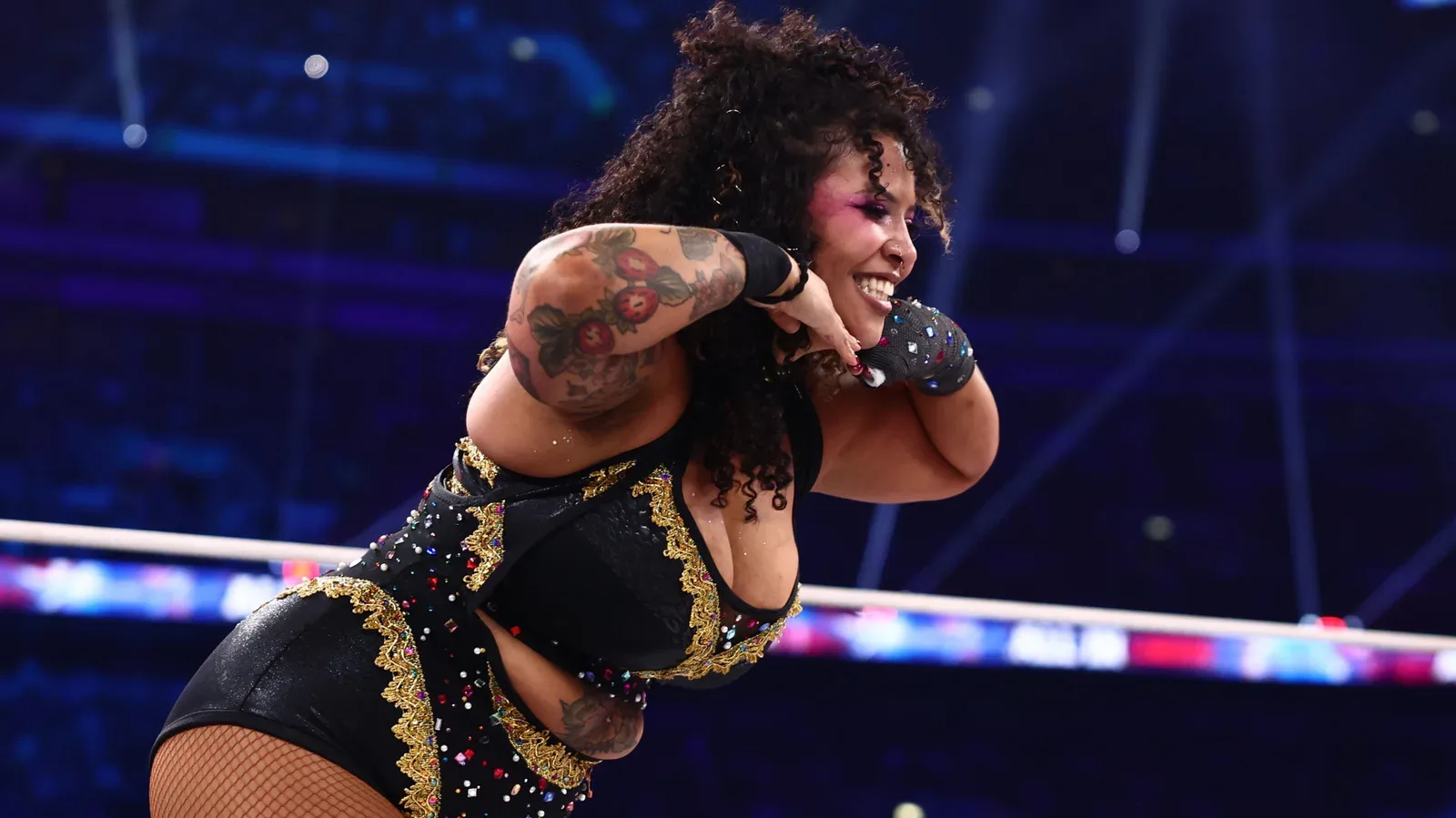
Willow Nightingale has become one of the defining figures in All Elite Wrestling’s women’s division, but she has made clear that performing at that level does not mean every major opportunity feels routine.
During an appearance on The Mick and Kenny Show, Nightingale spoke candidly about dealing with imposter syndrome while competing in some of the largest matches of her career. The AEW star explained that even after reaching the top of the division and wrestling on massive international events, there are moments when she questions how she arrived there and whether she truly belongs in that position.
It is an especially relatable perspective from a performer whose presentation is often built around confidence, energy and an ability to connect with crowds. Nightingale’s on-screen personality has made her one of AEW’s most popular wrestlers, yet her comments illustrate the difference between projecting confidence in front of an arena audience and working through doubt internally before stepping through the curtain.
Nightingale’s reminder before the biggest matches
Nightingale said imposter syndrome can lead her to ask herself how she got to a given point in her career and what she is doing in such a high-profile spot. Rather than allowing those thoughts to overwhelm her, she has developed a straightforward way to answer them.
For more background on this topic, read Mike Bailey Explains Why Wrestling Barefoot Gives Him a Unique Edge in AEW.
“You wouldn’t be in this position accidentally,” Nightingale said on The Mick and Kenny Show. “Nobody would let that happen by mistake, so clearly you’ve been doing something right that helped you get here.”
That message has particular meaning considering the stages Nightingale has reached in AEW. She defended the AEW Women’s World Championship against Mercedes Moné at All In in August. Although Nightingale lost that bout, the match stood as arguably the biggest of her career, placing her in a championship contest at one of AEW’s landmark events.
A wrestler preparing for a match of that magnitude has to manage more than the normal demands of in-ring performance. The physical preparation is substantial, but so is the expectation that comes with representing a championship, performing before a major stadium audience and sharing the ring with an opponent as accomplished as Moné. For Nightingale, the key is not necessarily eliminating nervousness or doubt altogether. It is recognizing that the opportunity itself is evidence of the work that earned it.
That distinction is important. In professional wrestling, high-pressure situations can quickly become all-consuming because the performer has to deliver live, with a crowd reacting in real time and no opportunity to redo a crucial sequence. There is no way to fully separate the emotional stakes from the athletic demands. Nightingale’s approach is to ground herself in the reality that she has already proven she can handle the responsibilities that brought her there.
The scale of All In and the responsibility of being champion
Nightingale described the mental challenge of being world champion while preparing to wrestle at AEW’s biggest show in the United Kingdom. In those moments, the scale of the occasion can make even an established wrestler feel as if the situation is almost too large to process.
“I am the world champion and that’s crazy enough,” Nightingale said. “Now I’m wrestling on our biggest show at the biggest stadium in the U.K. How am I going to do this?”
Her answer was to simplify the situation and return to the fundamentals of her profession. Nightingale said she has to remind herself that, at the end of the day, it is her job and that she is a professional wrestler.
That may sound simple, but it reflects a useful mindset for someone operating under intense public scrutiny. A championship match at All In carries historical importance for AEW, personal importance for the wrestlers involved and immediate pressure from the audience. Breaking that down into the work Nightingale knows how to do allows the moment to become manageable. The stadium, the title and the magnitude of the event remain significant, but they do not have to define every thought leading into the match.
It also speaks to why Nightingale has continued to grow as a major AEW figure. Her appeal has never been limited to one aspect of wrestling. She brings a powerful physical style, a natural crowd connection and an emotional honesty that can make a high-stakes match feel personal. Her willingness to openly discuss uncertainty adds another layer to that connection, particularly because it comes from someone who has already been entrusted with the AEW Women’s World Championship.
Injuries are difficult, but mental challenges can be harder
Nightingale also acknowledged that she has worked through injuries, including a broken hand going into the All In show. A broken hand is not a minor concern for a wrestler. The hands and wrists are involved in nearly every part of a match, from strikes and holds to taking falls, posting on the mat and protecting an opponent during physical exchanges.
Still, Nightingale differentiated the challenge of managing an injury from the more complicated nature of internal doubt. She characterized an injury as a logistical issue: something that requires adjustments, planning and practical solutions. A wrestler and their medical staff can determine what movements must be changed, what needs protection and how to structure the physical demands of a match around the problem.
Imposter syndrome is less tangible. It cannot be taped, braced or worked around as easily as a physical limitation. The fear of not being good enough can emerge despite championship success, crowd support or a long list of accomplishments. Nightingale’s comments show that she does not treat those feelings as proof that she is unprepared. Instead, she counters them by remembering the body of work that placed her in the position to begin with.
That is a notable message within an industry where performers are often expected to appear unshakably self-assured. Wrestlers are asked to perform in front of thousands of people and, in many cases, have their work immediately assessed by audiences across television and social media. Nightingale’s remarks acknowledge that confidence can be a practice rather than a permanent state of mind.
Moving forward after the AEW Women’s World Championship loss
Despite losing the AEW Women’s World Championship to Moné at All In and dealing with the injury concerns she referenced, Nightingale has remained active in the ring. Her schedule after the title loss has continued to place her in meaningful matches, underlining her position as a central contender in the division even without the championship around her waist.
At AEW All Out, Nightingale faced Thekla in a number-one contender’s match. Nightingale came up short in that contest, but the match kept her directly connected to the championship picture. She then competed again at AEW Grand Slam: France, continuing to build momentum through major company events.
The recent results make Nightingale’s comments about self-belief even more relevant. Wrestling careers are rarely defined by a single win or loss, and the period after a championship defeat can test a performer’s ability to maintain focus. Nightingale has been through a major title match, a difficult loss, a physical setback and another missed opportunity to become number one contender. Yet she has continued to compete rather than fading from the conversation.
That resilience has been one of Nightingale’s strongest traits throughout her rise. She has become an important part of AEW’s women’s roster not simply because she has had success, but because her performances and personality have given fans a reason to invest in her through both victories and setbacks.
A grounded perspective on a growing career
Nightingale’s reflections provide a clear look at how she handles the pressure that accompanies success. She does not claim that the doubts disappear once someone becomes champion or wrestles on a stadium show. Instead, she meets those doubts with a reminder that opportunities at that level are earned over time.
For Nightingale, the proof is in the position itself. She did not arrive in an AEW Women’s World Championship defense against Mercedes Moné by accident. She did not end up on All In by chance. The path there came through the work, matches and growth that made AEW confident in placing her in such a prominent role.
As Nightingale continues her pursuit of another championship opportunity, that perspective could remain just as important as any in-ring adjustment. The physical challenges of wrestling will always be present, and injuries can require careful management. But Nightingale’s own words suggest that the greater battle can sometimes be the internal one: accepting that she belongs on the same stages she has worked so hard to reach.
In pictures

Darryl Polo
Darryl Polo is a passionate wrestling fan covering WWE, AEW, TNA and beyond. He loves great rivalries, breakout stars and the moments that keep fans talking long after the bell. How we work.