
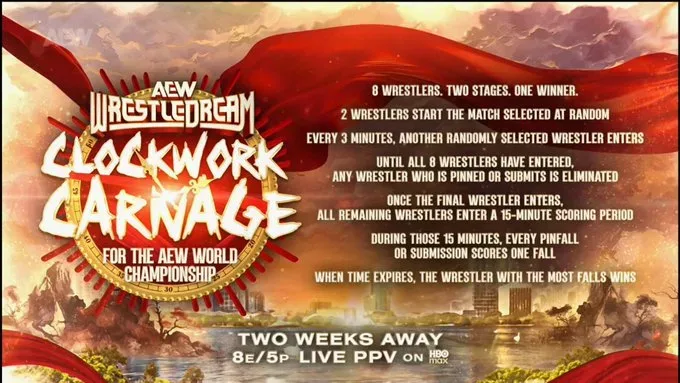
Will Ospreay will put the AEW World Championship on the line in a distinctly different kind of multi-person contest at AEW WrestleDream. During the October 3 edition of AEW Collision, it was announced that Ospreay had spoken with AEW President Tony Khan about introducing Clockwork Carnage to All Elite Wrestling.
The result is a major title match with eight competitors, staggered entrances, eliminations, and a final points-based stage that will determine whether Ospreay leaves WrestleDream with the AEW World Championship. No other participants were announced as part of the initial reveal, leaving a significant question hanging over the event: who will join the champion in one of AEW's most unusual championship matches?
Clockwork Carnage is a match concept created by Ospreay. It debuted in Pro Wrestling EVE last month and was first used at EVE Global Thunder Queens to decide the next challenger for the EVE Championship. Its arrival in AEW marks the first time the format will be used on that scale, and it will do so with the promotion's top prize at stake.
View the referenced post on X
How the Clockwork Carnage Match Works
The announced rules divide Clockwork Carnage into two separate stages. Eight wrestlers will be involved overall, but the contest does not begin with all eight in the ring. Instead, two competitors are selected at random to start the match.
For more background on this topic, read Scorpio Sky Has Not Signed a New AEW Contract as October Nears.
Every three minutes, another wrestler selected at random enters the bout. That process continues until all eight participants have entered. The random-entry component immediately separates the stipulation from a conventional four-way, battle royal, or ladder-style multi-person title match. A wrestler could draw an early spot and be forced to survive much longer than the rest of the field, while another could enter late with far less physical damage accumulated.
During the entry phase, pinfalls and submissions carry elimination consequences. Any wrestler who is pinned or submits is eliminated before the final competitor has entered. That creates a straightforward survival battle early in the match: competitors must avoid defeat while also trying to remove opponents before the field is complete.
Once the eighth and final wrestler enters, the contest changes entirely. All remaining wrestlers move into a 15-minute scoring period. In that final stage, every pinfall or submission is worth one fall. When the clock expires, the wrestler with the most falls wins the match.
That means the championship cannot simply be protected through one successful pinfall or by escaping danger at the decisive moment. The eventual winner must either eliminate the field before the scoring period begins or, more likely, establish the best record across a compressed 15-minute sprint. A wrestler who scores repeatedly can overcome an earlier setback, while someone who secures an important fall may still need to keep competing rather than celebrate.
A Championship Match Built Around Survival and Scoring
For Ospreay, Clockwork Carnage presents a title defense unlike a traditional singles match. In a one-on-one contest, the champion's task is clear: defeat one challenger. In this format, Ospreay will have to account for seven potential opponents whose roles can change by the minute.
The opening portion rewards ring awareness and endurance. Starting early could be a major disadvantage, particularly if a competitor is targeted by fresh entrants as the match grows. Starting later, however, does not guarantee safety. A late arrival could walk into a ring full of wrestlers who have already formed temporary alliances, settled grievances, or identified a vulnerable target.
Then comes the scoring stage, where strategy may become even more complicated. Wrestlers will be competing for falls, but they will also have to stop rivals from accumulating points. A participant who is not leading the match may decide that preventing another wrestler from scoring is more important than pursuing a pinfall of their own. In a field with several wrestlers active at once, an attempted cover could be interrupted by anyone, and a submission attempt could create an opening for another competitor to steal a fall elsewhere in the ring.
The format also places enormous value on timing. A competitor who survives the eliminations and enters the final 15 minutes with energy left may have a major advantage. Conversely, a wrestler who spends the first phase fighting from the opening bell could enter the scoring period exhausted, even if they have avoided elimination. The random selection of entrants ensures that no one will know their path until the match begins.
Will Ospreay Brings His Creation to AEW
Clockwork Carnage carries a personal connection for Ospreay beyond its status as a new stipulation. The match was created by the AEW World Champion, making WrestleDream an opportunity for him to defend the title inside a format he helped devise.
That familiarity could be an advantage, but it does not remove the uncertainty built into the rules. Ospreay may understand the pacing and tactical possibilities better than anyone in the field, yet the random entry system is specifically designed to disrupt planning. He could be one of the first two wrestlers chosen, or he could be held back until the match has already become chaotic. He could enter the scoring period with a path to victory, or he could find himself trying to chase multiple opponents on the scoreboard.
There is also an added burden that comes with being champion in an eight-person match. Every other entrant has the opportunity to leave with the AEW World Championship. The final result is based on falls rather than a conventional last-person-standing structure, so the champion will need to be alert throughout the closing stage. Being pinned even once could prove costly, but avoiding one fall alone will not necessarily be enough if another wrestler is able to score multiple times.
Ospreay's decision to bring the concept to AEW makes this more than a standard stipulation announcement. WrestleDream will test the champion in a match structure associated with his own creative vision, under rules that demand both athletic output and rapid tactical adjustment.
The WrestleDream Field Remains Unannounced
The most immediate unanswered question is the identity of the other seven competitors. The announcement confirmed that the bout will include eight wrestlers and that Ospreay's AEW World Championship will be at stake, but it did not name the challengers.
That leaves AEW with several possible ways to construct the field. The company could populate the match with established contenders, wrestlers carrying active rivalries with Ospreay, or competitors looking for a rare direct route to the AEW World Championship. Whatever names are ultimately selected, the Clockwork Carnage rules mean that each entrant will have to approach the match differently from a typical title opportunity.
A competitor with a history of endurance may welcome an early entry spot and attempt to eliminate opponents before the full field is assembled. A wrestler known for explosive offense might prefer to arrive later and make an immediate impact during the scoring period. Technical wrestlers could focus on submissions, while power-based competitors may look to capitalize on exhausted opponents as the match develops. The stipulation does not favor only one style, but it will reward wrestlers who can quickly recognize which stage of the match they are in and what is required to win it.
The random order also prevents the champion or challengers from fully preparing for a specific sequence. Wrestlers can study the rules, but they cannot know whether they will start, enter third, arrive shortly before the scoring period, or have to join after eliminations have already reshaped the match.
What Makes Clockwork Carnage Different
Clockwork Carnage combines ideas that are familiar to wrestling audiences while arranging them into a distinct championship format. The staggered entry process makes the early minutes a test of survival. The elimination rule gives every pinfall and submission immediate consequences before the field is full. The timed scoring period then reverses the dynamic, turning the closing stretch into a race for falls rather than a search for one decisive finish.
That final detail may be the most important. In many multi-person matches, one successful pinfall ends the contest. Here, a pinfall is a point, and the match continues until the 15-minute scoring period expires. A wrestler who appears to have seized control could lose that advantage quickly, while a late surge could alter the championship picture in seconds.
For AEW WrestleDream, the announcement establishes a high-stakes showcase around the AEW World Championship and a format built for unpredictability. Will Ospreay will defend the title in the first AEW Clockwork Carnage match, with seven competitors still to be revealed and every entrant order left to chance. By the end of the scoring period, one wrestler will stand as the winner—and, if Ospreay is outscored, AEW will have a new world champion.

Darryl Polo
Darryl Polo is a passionate wrestling fan covering WWE, AEW, TNA and beyond. He loves great rivalries, breakout stars and the moments that keep fans talking long after the bell. How we work.