
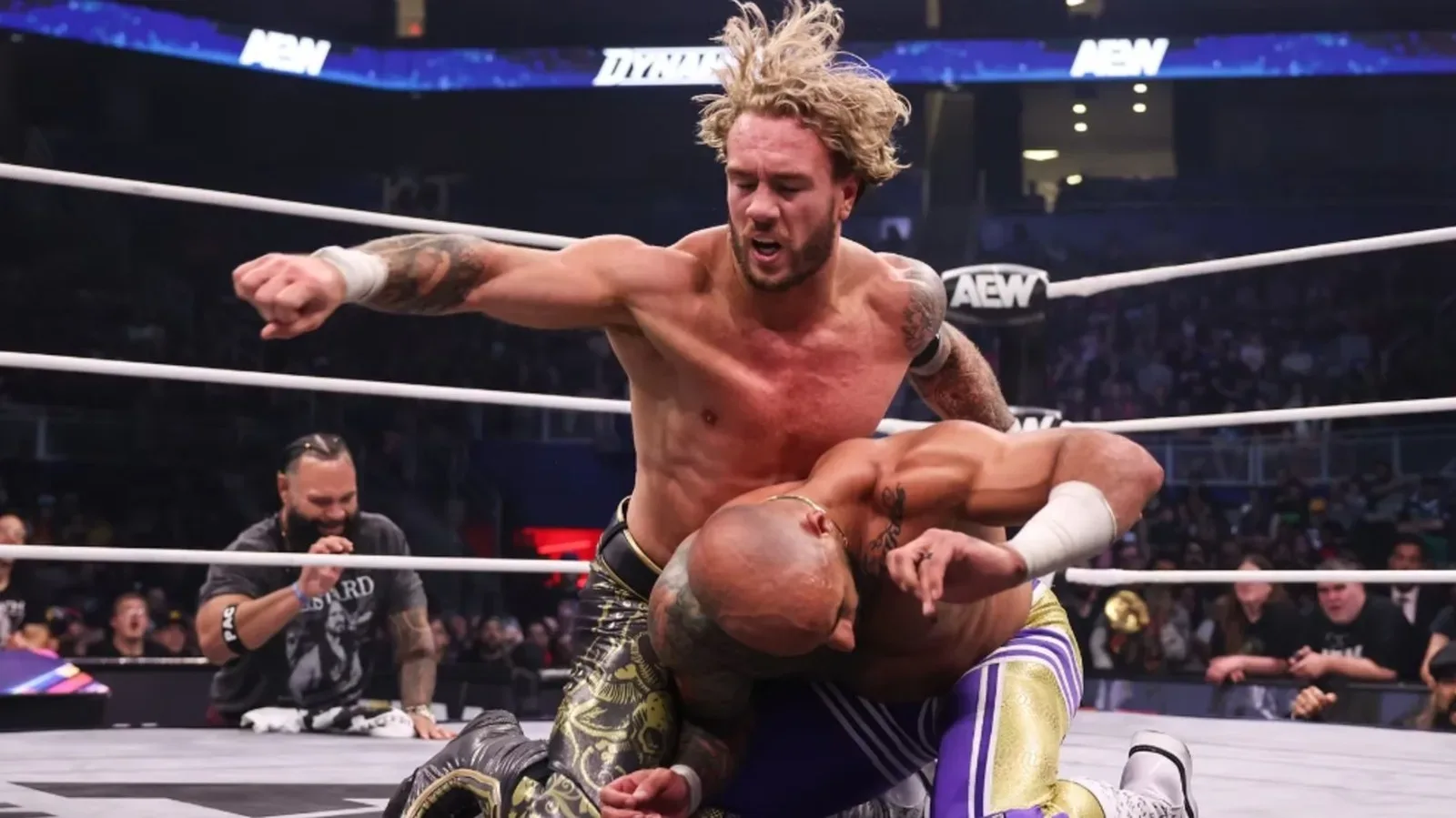
Will Ospreay has opened up about the emotional decision to perform the Black Arrow in tribute to PAC, explaining that the high-risk maneuver was something he had not completed in roughly eight years before using it during his AEW Dynamite match with Ricochet.
PAC’s death sent shockwaves through All Elite Wrestling and the wider professional wrestling community, particularly among the performers who had worked closely with him. For Ospreay, honoring a fellow English star and AEW colleague meant revisiting one of PAC’s most recognizable signature moves: the Black Arrow.
Ospreay used the move during the tribute match against Ricochet, creating a moment that carried significance well beyond the immediate competition in the ring. The AEW World Champion said the decision was not made lightly. He had once performed the maneuver himself years earlier, but had removed it from his own repertoire after a frightening experience made him unwilling to attempt it again.
“After we lost him, we had the tribute match with myself and Ricochet,” Ospreay said. “The amount of people that are hoping that one of us could pull off the Black Arrow, and I used to do it like years and years ago, but I haven't done it for years because it was just — I nearly didn't make the move, it had spooked me, and I never wanted to go near it again.”
For more background on this topic, read Toni Storm’s AEW Return Remains Unclear as Mystery Attacker Storyline Lingers.
A Tribute Rooted In Respect For PAC
The Black Arrow was closely associated with PAC throughout his career. A spectacular twisting, corkscrew shooting-star style attack from the top rope, it demanded extraordinary timing, body control, and awareness from the wrestler delivering it as well as the opponent positioned to receive it. It was a move that stood out even in an era full of elite aerial athletes.
That connection made it a natural gesture of remembrance, but it also raised the stakes for Ospreay. He was not simply bringing back an old move for a one-night surprise. He was attempting a maneuver that had previously scared him enough to shelve it for years, while carrying the emotional pressure of a tribute to a friend whose loss had affected the locker room.
Ospreay said he initially could not bring himself to execute the move from the top rope while preparing for the match. Despite his long history as one of the most accomplished high-flyers in wrestling, the hesitation was real. The Black Arrow had become tied to a past fear, and practice alone did not immediately remove that obstacle.
“I couldn't get it off the top rope [when practising],” Ospreay said. “I was too scared. So, when I did it [in the match], that was the first time I had ever done it for, like, eight years.”
That made the moment against Ricochet even more meaningful. Ospreay and Ricochet are both performers known for pushing the athletic limits of modern wrestling, and each has shared the ring with PAC during major stages of their respective careers. The sight of Ospreay successfully executing the Black Arrow in that setting was therefore not merely a callback to a dangerous move from his own past. It was a gesture made in recognition of PAC’s identity, influence, and impact on those around him.
Finding A Shared Emotional Release
Ospreay described the tribute as a way of giving people an outlet during an incredibly difficult period. In wrestling, performers regularly rely on the ring as a place to express emotions that may be difficult to put into words. A match can be athletic competition, storytelling, memorial, and personal catharsis all at once. For Ospreay, the Black Arrow provided a rare opportunity to communicate loss and respect through an action the audience instantly understood.
He felt the spot could offer a measure of release for the AEW roster, for the fans processing PAC’s passing, and for himself. The moment also reinforced why Ospreay takes pride in being AEW World Champion. Carrying a championship comes with visibility and responsibility, especially when the company and its fans are facing a collective loss.
“So, it was for me to be able to give not only the wrestlers backstage a little bit of a release, but fans a release,” Ospreay said. “And I think that was something that made me so proud to be champion and so proud to be part of the roster.”
Ospreay’s comments underline that the decision was never about trying to claim ownership over PAC’s move or replicate what made PAC special. Instead, it was an acknowledgment that the Black Arrow was inseparable from PAC’s legacy. Ospreay took on the risk because the gesture mattered to the people watching and to the colleagues mourning alongside him.
In a profession where signature moves often become lasting extensions of a wrestler’s personality, the Black Arrow represented far more than a highlight-reel aerial attack. It evoked PAC’s intensity, his fearlessness, and the distinctive style that made him stand apart in every major promotion where he performed. Bringing it back under those circumstances required care and conviction.
Ospreay Changed Plans After Learning Of PAC’s Death
Ospreay also revealed how abruptly the news affected him on a personal level. He had been on his way to attend a Michael Jackson show in Las Vegas when he learned that PAC had died. Rather than continue with those plans, Ospreay returned to his room, where he mourned the loss of his friend and cried.
The detail illustrates the sudden, disorienting nature of grief. Even for someone accustomed to appearing before large crowds and handling the pressure that comes with championship-level matches, there is no preparation for news of that kind. Ospreay’s account was candid in showing that the initial response was not about wrestling plans or television responsibilities. It was about the immediate heartbreak of losing someone important.
When AEW held the Ricochet match, that private grief became part of a public tribute. Ospreay’s Black Arrow was not presented as a routine escalation in the action. It carried the weight of everything that had happened between learning the news and entering the ring, including the fear he had needed to confront in order to perform the move.
The Risk Behind A Memorable Moment
Ospreay has built his career on innovation and an ability to make difficult aerial wrestling look fluid. Still, his recollection offers an important reminder that even the most gifted performers have limits and memories that influence what they are willing to do. A move being visually spectacular does not erase the physical danger involved.
His admission that he had “nearly didn't make the move” years earlier helps explain why it disappeared from his matches. Wrestlers regularly alter their arsenals as their careers evolve, whether because of injuries, changing styles, long-term preservation, or simple caution. In Ospreay’s case, the Black Arrow was a move he had consciously decided not to approach again.
That history is what gave the tribute its emotional gravity. He did not casually dust off an old favorite. He overcame a fear that had kept the move out of his repertoire for years, and he did it in a setting shaped by mourning for PAC.
There was no replacing PAC, and Ospreay’s comments did not suggest otherwise. The moment was instead an expression of respect from one wrestler to another, delivered in the language they knew best. For a roster and fan base dealing with devastating news, the Black Arrow became a brief but powerful symbol of remembrance.
Ospreay remains proud of what the gesture meant. As AEW World Champion, he found a way to honor PAC while also acknowledging the shared pain felt throughout the company. The move may have lasted only seconds, but the reason behind it—and the courage it took for Ospreay to attempt it again—gave it a significance that will endure far longer.
In pictures

Darryl Polo
Darryl Polo is a passionate wrestling fan covering WWE, AEW, TNA and beyond. He loves great rivalries, breakout stars and the moments that keep fans talking long after the bell. How we work.