
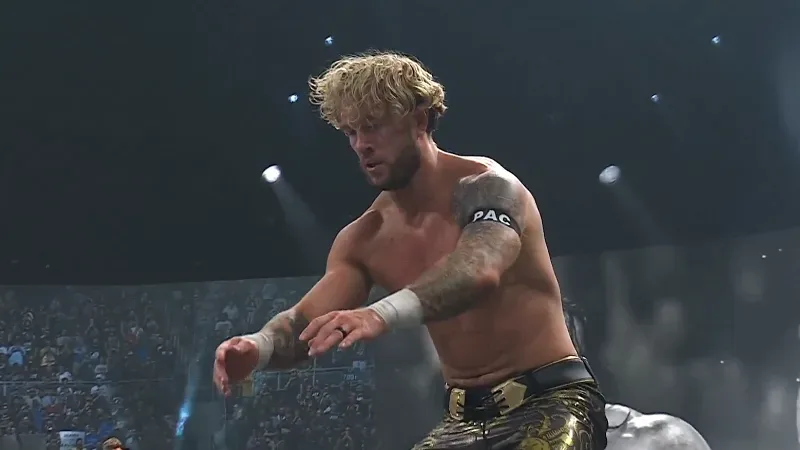
Will Ospreay has opened up about the immense physical and emotional challenge behind his tribute match with Ricochet on AEW Dynamite, describing it as one of the most difficult bouts of his life.
The match took place on the Dynamite following AEW All Out, after the wrestling world learned of the tragic death of PAC over that weekend. Ospreay and Ricochet, both longtime friends and rivals of PAC, met in singles competition in a bout built around honoring the former AEW star’s legacy. The most striking tribute came at the finish, when Ospreay delivered the Black Arrow, PAC’s signature high-risk move, to secure the victory.
For Ospreay, using the move was not simply a matter of recreating a familiar spot. He had not performed the Black Arrow in eight years, and the expectation from fans that he was the person capable of delivering it added another layer of pressure to an already emotional night.
Speaking on Speedball Mike Bailey’s vlog, Ospreay said the match demanded a great deal from both himself and Ricochet.
For more background on this topic, read Mick Foley Calls Chris Hero a ‘Wrestling Genius’ While Ruling Out AEW Producer Role.
“Yeah, that was a tough one. I ain’t done that in eight years. The last time I did it, I was like 10 kilos lighter. I don’t know what that is in pounds, but that was one of the most difficult matches I’ve ever done in my life when it comes to myself and Trevor (Ricochet).”
An Eight-Year Gap Before the Black Arrow
The Black Arrow is among the most visually spectacular moves associated with PAC. Performed from the top rope, it requires a wrestler to rotate through a corkscrew splash before landing across an opponent. Its degree of difficulty has made it an instantly recognizable part of PAC’s body of work, but it also makes it a move that cannot be treated casually, particularly by someone who has not attempted it in nearly a decade.
Ospreay acknowledged that he is no longer in the same physical position he was when he last used it. His comment that he was approximately 10 kilograms lighter at the time underlined why the moment carried real difficulty beyond its symbolic value. The challenge was not merely to execute a tribute in front of a national audience; it was to do so safely and convincingly while carrying the weight of an emotional farewell.
“I wanted to do it right,” Ospreay said.
That mindset shaped the entire presentation of the match. Rather than attempting to turn the Black Arrow into a routine highlight, Ospreay and Ricochet used it as the defining conclusion to a contest that recognized what PAC meant to each of them. The move served as a final tribute from one elite aerial wrestler to another, while also providing the Dynamite audience with a moment that reflected PAC’s lasting influence on modern wrestling.
Ospreay said there had been significant discussion from fans in the buildup about who could potentially pull off the maneuver.
“The whole time building up to this, one thing people kept saying was, if anyone can hit the Black Arrow, it was me. Hadn’t done it in eight years. I found a way of doing it now.”
His ability to complete it gave the match a memorable closing image, but Ospreay’s comments make clear that the accomplishment did not come without concern. An eight-year absence is substantial for any move, especially one requiring precise timing, body control, balance, and confidence from the top turnbuckle.
Putting Rivalry Aside for PAC
Ospreay also addressed the complicated competitive relationship he has with Ricochet. Their histories have long been intertwined, and their respective ambitions remain a point of tension. Ospreay indicated that there are still hard feelings between them, with both men driven by the desire to be at the top of the industry and positioned around championship aspirations.
Even so, the circumstances surrounding the Dynamite match called for something bigger than their individual goals.
“Obviously, there is always hard feelings between us because egos are always getting away, and you always want to be sitting on top of the throne, and I know he wants this championship. But to be able to put our differences aside, and do a great, great tribute to a very good friend of the pair of us.”
That honesty gives the match an added dimension. Ospreay and Ricochet were not portrayed as suddenly becoming inseparable allies. Their competitive instincts, personal pride, and championship motivations remain intact. However, both recognized the importance of honoring PAC in a way that reflected the friendship they shared with him.
In professional wrestling, tribute matches can be especially difficult because the performers must balance genuine grief with the obligation to deliver in the ring. Ospreay’s remarks suggest that he and Ricochet approached their match with that responsibility in mind. They were tasked with performing at a high level while ensuring the focus remained on PAC’s memory rather than their own rivalry.
The result was a match in which the personal history between the two competitors became part of the story without overwhelming the tribute. Ospreay’s victory mattered within the immediate result, but the Black Arrow and the shared connection to PAC were clearly the central elements of the night.
PAC’s Influence Was Felt Throughout the Tribute
PAC’s career has been defined by extraordinary athleticism, intensity, and a willingness to perform with a style that few wrestlers can replicate. The Black Arrow stands as one of the clearest examples of that reputation. It is a move that combines risk with precision, and it became synonymous with a performer who consistently pushed himself physically.
By selecting that maneuver as the finish, Ospreay did more than reference a famous move. He took on the challenge of embodying a piece of PAC’s in-ring identity at a moment when emotions were already high. Ospreay’s statement that he had “found a way” to do it speaks to the preparation and determination involved, even if he did not detail the process behind bringing the move back.
Ricochet’s role was equally essential. Ospreay specifically called the match difficult for both himself and “Trevor,” Ricochet’s real first name, emphasizing that this was a shared effort. Tribute bouts rely on mutual trust under normal circumstances, and that trust becomes even more important when performers are navigating such a demanding match and an emotionally charged finish.
Both men have built their reputations on innovative athletic performances, making them fitting choices to pay tribute to PAC in the ring. Yet Ospreay’s comments reveal that technical ability alone did not make the situation easy. The history with Ricochet, the loss of their friend, the significance of PAC’s signature move, and the personal expectation to execute it properly all contributed to the pressure.
A Meaningful Moment on AEW Dynamite
Ospreay’s reflections place the Dynamite match among the most personally demanding contests of his career. He has taken part in many high-profile matches and is no stranger to physically punishing performances, but this occasion carried a distinctly different burden.
The phrase “one of the most difficult matches” is particularly telling considering the reason he gave for it. Ospreay was not solely referring to the athletic strain of the contest. He was also describing the challenge of trying to honor PAC faithfully while wrestling a rival with whom he still has unresolved competitive tension.
For Ospreay, performing the Black Arrow was the way to make that tribute complete. It was a risk he had not taken in eight years, under conditions that made every aspect of the decision more meaningful. The successful execution allowed him and Ricochet to offer a farewell built around an unmistakable symbol of their friend’s career.
As Ospreay continues in AEW, the championship ambitions and rivalry issues he referenced with Ricochet may again become central to their paths. For one night, however, those concerns were placed to one side. The focus was PAC, the impact he left on those who knew him, and the effort required to give him the tribute Ospreay felt he deserved.

Darryl Polo
Darryl Polo is a passionate wrestling fan covering WWE, AEW, TNA and beyond. He loves great rivalries, breakout stars and the moments that keep fans talking long after the bell. How we work.