
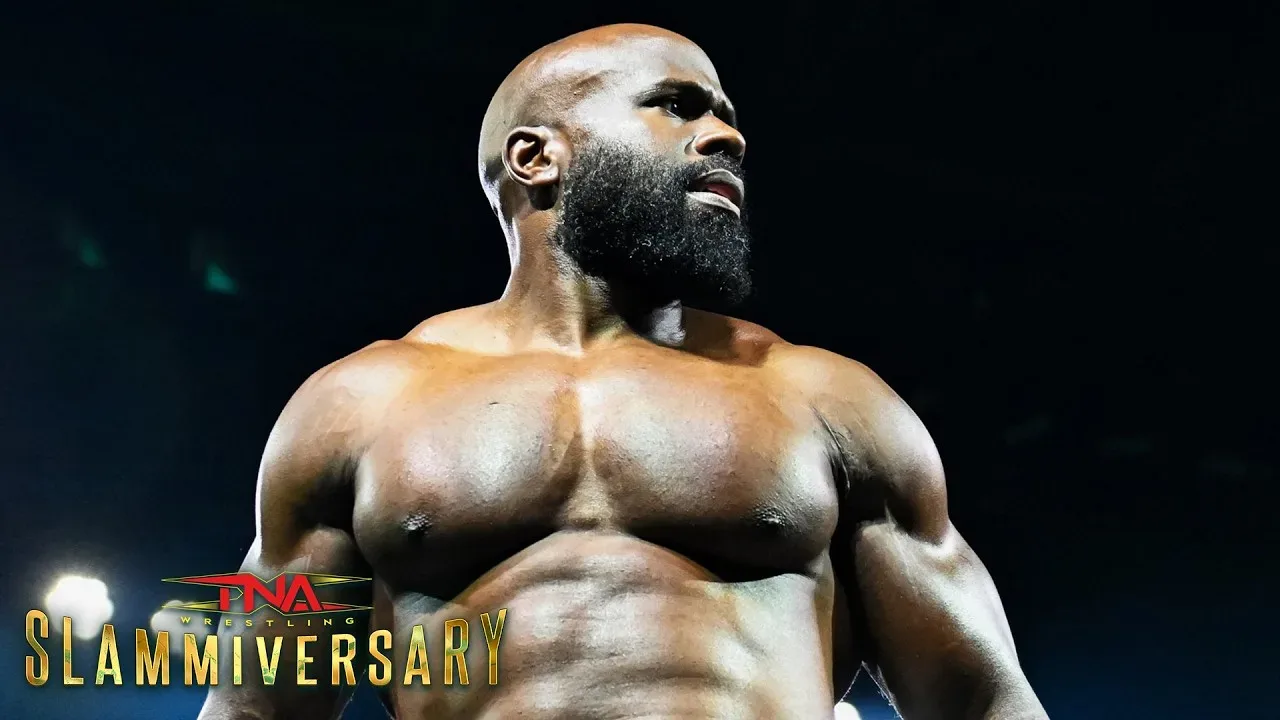
Uhaa Nation’s first major match after leaving WWE was not simply a surprise return to a familiar independent wrestling identity. For the performer known to WWE audiences as Apollo Crews, the TNA Slammiversary triple threat with Mustafa Ali and Rich Swann was also a chance to reset the direction of his career after a difficult stretch.
That is why one early question about the match mattered so much: would he be expected to lose?
Speaking on Insight with Chris Van Vliet, Uhaa reflected on the circumstances that brought him to TNA so soon after his WWE release in April. He explained that he was still within the 90-day non-compete period generally associated with a WWE departure, making the prospect of an immediate appearance elsewhere seem unlikely from his perspective. The WWE-TNA relationship, however, created an opening that allowed discussions to move forward.
Uhaa’s appearance at Slammiversary put him in a three-way match with Ali and Swann. Ali won the contest, while Swann took the deciding fall, giving Uhaa the opportunity to make an impactful return without being pinned or submitted in his first match outside WWE.
For more background on this topic, read John Morrison Explains How Triple H’s WWE Authority Differs From Vince McMahon’s.
A call that initially seemed impossible
Uhaa said TNA reached out to WWE while his non-compete was still active. The first contact he recalled came from Moose, who told him TNA was interested in bringing him in for Slammiversary. At the time, Uhaa and his family were on a staycation at a resort, and he did not view the proposal as something likely to materialize.
“My first thought was, ‘I’m in my 90 days. No way that’s going to happen,’” Uhaa said.
Not long afterward, Mustafa Ali contacted him with a similar idea. Ali believed TNA was trying to put the two of them together at Slammiversary, but there was an important issue to resolve before the match could take shape. Ali asked whether Uhaa would be willing to lose.
For Uhaa, it was not a routine creative conversation. He said the timing was especially delicate because less than a month had passed since his WWE release. He was still working through his feelings about professional wrestling and had not decided whether returning to the ring was even something he wanted to make a priority right away.
Still, he knew one thing: he did not want his first post-WWE appearance to feel like a continuation of the experiences that had left him frustrated.
“I spent my whole career losing at WWE,” Uhaa said. “The first thing outside of WWE that I don’t want to do is lose.”
Ali, Uhaa said, understood the response. Rather than creating a conflict, the former WWE colleagues had an honest conversation about the concern. Uhaa recalled Ali telling him that he respected the answer and likely would have felt the same way in that position.
Why the result carried real weight
The issue was not merely about avoiding a defeat on a single TNA pay-per-view. Uhaa viewed it through the larger context of his final WWE run, which he described as overwhelmingly defined by losses. He later received another call from Moose after word had apparently circulated that he did not want to work the match at all.
Uhaa clarified that this was not what he meant. He was not rejecting the opportunity or refusing to face Ali. He wanted to avoid arriving in a new environment only to be defeated immediately after what he felt had been a long stretch without momentum in WWE.
“I didn’t say that I didn’t want to do the match,” Uhaa said. “I just said that I don’t think that I want to come in there and lose after losing literally every single match since before I tore my pec.”
He pointed to a victory over Johnny Gargano before his pectoral injury as the last WWE win he had in mind during that discussion, placing it in February 2025. His comments also referenced a last singles victory on AAA television in November 2025, making the exact timeline of his final WWE-era wins somewhat unclear. The larger point, though, was unmistakable: Uhaa felt he had spent too long on the wrong end of results and did not want his next chapter to begin with the same presentation.
That perspective is understandable for a wrestler making his first notable appearance after a release. Results do not tell the entire story of a performer’s standing, but they can heavily influence how audiences perceive an act. A surprise debut or return is often a rare chance to make a first impression, particularly when the wrestler arrives after months of limited visibility or repeated defeats.
For Uhaa, Slammiversary was an opportunity to reintroduce himself as a major athlete rather than as someone continuing a downturn from his previous environment.
The triple threat solution
TNA ultimately found a structure that worked for everyone. Rather than presenting a standard singles match that required one participant to take a direct loss, the promotion booked a triple threat involving Uhaa, Ali and Swann. The format enabled Uhaa to wrestle, showcase himself, and be part of a featured match without taking the pin.
Ali won the match, with Swann absorbing the fall. Uhaa was therefore protected in his first match following WWE while Ali still came away with the official victory.
Uhaa said the final arrangement gave him what he needed from the appearance. After discussing it with his wife, he concluded that taking the match was a positive step. It was less about immediately launching into a packed wrestling schedule and more about giving himself an important opportunity to perform under a spotlight again.
“I thought I needed that opportunity where the spotlight would be on me again,” Uhaa said. “I always enjoy performing. I love being the focus for that moment.”
That distinction is significant. Uhaa did not frame Slammiversary as the beginning of an all-consuming push to wrestle everywhere possible after leaving WWE. Instead, he described a measured return that allowed him to reconnect with the part of the profession he still loves: performing in front of an audience and being given a meaningful platform to do it.
Working with Ali and Swann
Uhaa came away from the match appreciative of both men who shared the ring with him. Ali and Swann are established high-level performers with deep experience across major promotions, and the three-way format gave each wrestler room to contribute to a match built around athleticism and pace.
Reflecting on the experience, Uhaa called Ali and Swann “two studs” and “two amazing human beings.” He said he was happy to have worked with them and pleased with what the group accomplished at Slammiversary.
He also acknowledged the response to his appearance. Surprise returns and debuts can generate immediate online discussion, but that reaction clearly carried added meaning after a period in which Uhaa had not been positioned as a central figure on WWE programming. He said it was nice to receive an “internet pop” and to find himself being talked about again.
For performers who have experienced uncertainty after a release, that kind of reaction can be a reminder that the audience still sees value in what they bring to the ring. Uhaa’s Slammiversary appearance was not just an isolated match result; it offered evidence that fans remained interested in seeing what he could do outside the WWE system.
No immediate full-time TNA run
Despite the successful surprise appearance, Uhaa has not returned to TNA since Slammiversary. He explained that he took a vacation following the event and has accepted some bookings here and there, but wrestling has not been the central focus of his life at this stage.
That measured approach fits with the uncertainty he described from the weeks immediately after his WWE release. Rather than rushing to define his post-WWE identity through a nonstop series of appearances, Uhaa appears to be taking opportunities selectively while determining what he wants the next phase of his career to look like.
His TNA match nonetheless accomplished something important. It allowed Uhaa Nation to step back into a prominent wrestling setting, work with Ali and Swann, avoid being pinned, and remind viewers of the athletic presence that made him a notable name long before he adopted the Apollo Crews identity in WWE.
Whether another TNA appearance follows remains unanswered. What is clear is that Uhaa did not want his first night back to be shaped by the same pattern he believed defined too much of his final WWE stretch. The Slammiversary triple threat gave him a different kind of first step: visible, competitive, and protected from the loss he felt would have undermined the fresh start.

Darryl Polo
Darryl Polo is a passionate wrestling fan covering WWE, AEW, TNA and beyond. He loves great rivalries, breakout stars and the moments that keep fans talking long after the bell. How we work.