
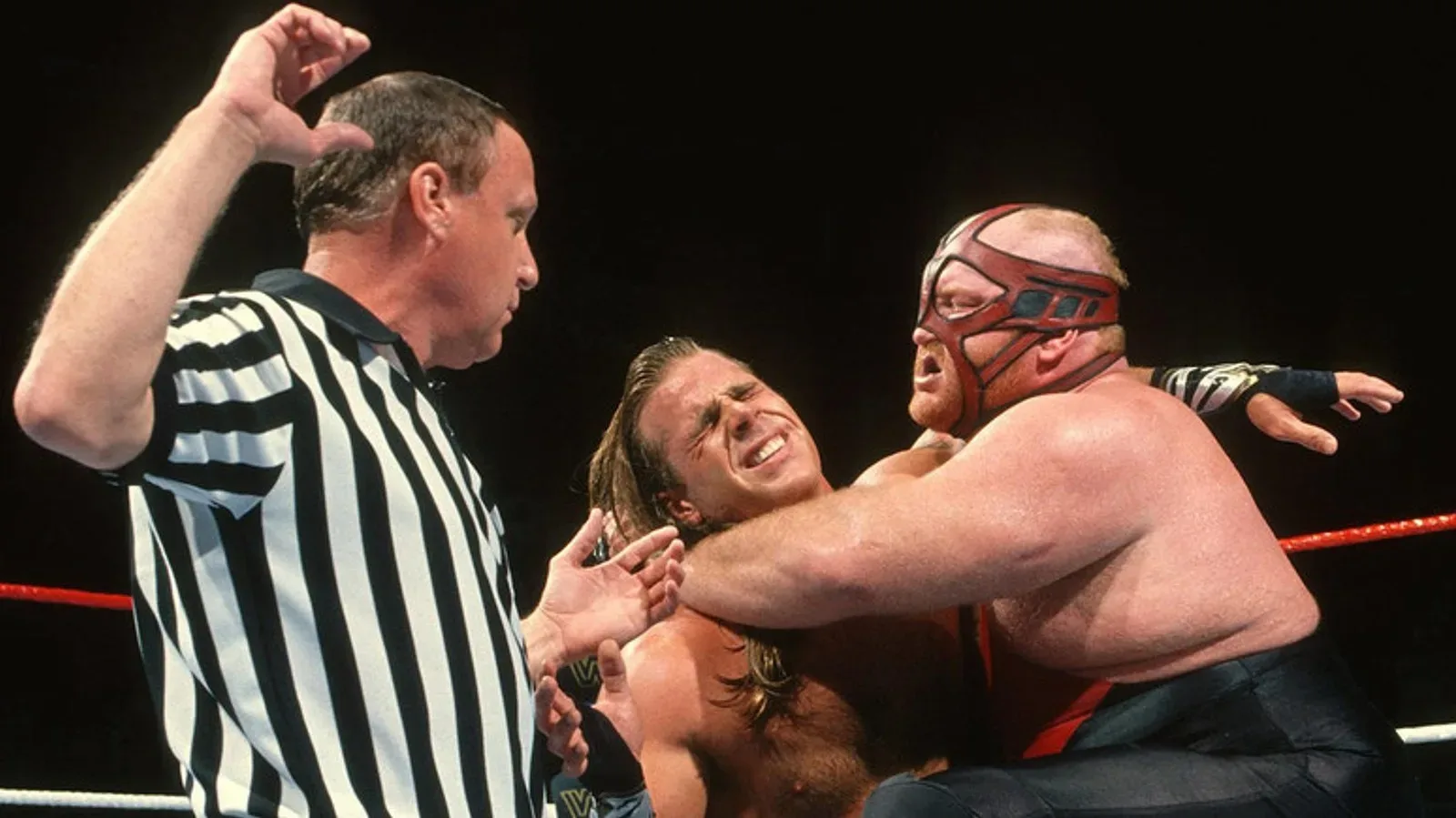
For decades, the WWE Championship main event between Shawn Michaels and Vader at SummerSlam 1996 has carried a complicated reputation. It was a major match on one of WWE’s biggest cards of the year, with Michaels defending the title against a performer who had built a formidable reputation before arriving in the company. Yet the discussion around the bout has often centered less on the result and more on a visible in-ring moment, the perception of tension between the two wrestlers, and the belief that Michaels’ dissatisfaction played a significant role in Vader’s reduced standing afterward.
John “Bradshaw” Layfield has offered a substantially different reading of that history. Speaking on Something To Wrestle, JBL rejected the idea that Michaels did not want to work with Vader because Vader was too stiff in the ring. In JBL’s view, that long-standing claim is simply inaccurate.
“The part about Shawn not liking to work with Vader because he was stiff? That’s a hundred percent not true,” JBL said on Something To Wrestle.
The comments directly challenge one of the most repeated conclusions attached to the SummerSlam match and its aftermath. Vader, real name Leon White, entered WWE with an established image as one of wrestling’s most intimidating heavyweights. His earlier work in Japan and WCW had made him a singular presence: a powerful, physically dominant wrestler whose style and presentation made him feel like a major threat to any champion.
For more background on this topic, read Bryce Remsburg: AEW Discussing Potential Plans for WrestleMania 43 Weekend.
That reputation was a central part of the appeal when he moved into WWE. Vader was not introduced as an unproven prospect or a developing attraction. He came in as a known force, and his program with Michaels positioned him at the highest possible level. A WWE Championship main event at SummerSlam was a clear statement of the role he was expected to fill.
Instead, the match has endured in part because of an instance in which Michaels broke from the expected performance dynamic after Vader was not in position for a spot. The moment has been discussed extensively by fans over the years, and it helped fuel the broader assumption that Michaels was frustrated by working with Vader. From there, the story often grew into a more sweeping claim: that Michaels complained backstage and that Vader’s time near the top of the card suffered because of it.
JBL did not deny that Michaels was demanding about the quality of his matches during that stage of his career. He described the champion as a perfectionist in the ring. But he drew a firm distinction between a wrestler caring deeply about execution and a wrestler being unwilling to work with physical contact. JBL’s point was that Michaels was not bothered by Vader’s hard-hitting approach because Michaels himself was tough and did not object to that aspect of the job.
“Shawn didn’t mind contact, so that wasn’t an issue,” JBL said on Something To Wrestle.
That distinction matters because it changes the framework around the alleged conflict. A wrestler being frustrated by a missed position or an in-ring mistake is not necessarily the same as objecting to an opponent’s style. The SummerSlam moment may remain memorable, but JBL’s comments argue against treating it as proof that Michaels was unwilling to share the ring with Vader due to stiffness.
JBL instead pointed to a different explanation for why Vader’s WWE run did not consistently reflect the dominant version of the character many viewers remembered from elsewhere. His assessment centered on timing, physical condition, and confidence. By the time Vader arrived in WWE in 1996, JBL believed that the wear on Vader’s body had become a meaningful factor.
“[Vader] gets down there [WWE], and has to be off the gas [steroids], and when that comes, you know he’s not as big, he’s not as strong, he’s not the physically imposing guy, and physically he can’t quite do what he did,” JBL said on Something To Wrestle.
JBL’s argument is not that Vader lacked ability or that his earlier acclaim was overstated. Rather, he contends that the WWE version of Vader was different from the performer fans had seen in Japan and WCW. That difference, in his telling, was substantial enough to affect expectations surrounding the main event program with Michaels.
It is an important nuance in looking back at Vader’s place in WWE history. Fans who had seen Vader at his peak elsewhere had reason to expect an overwhelming, physically imposing challenger. The image was already established. Vader was associated with power, menace, and a style that made opponents appear to be in danger whenever the match turned into a brawl. When an established star enters a new promotion carrying that level of expectation, any visible difference can become part of the conversation immediately.
JBL said Michaels was frustrated not because Vader hit hard, but because Michaels expected to be working with the version of Vader that had made such a strong impression before WWE.
That perspective also places the SummerSlam bout in the wider circumstances of WWE’s New Generation Era. JBL noted that the company’s top stars were operating under considerable pressure in that period. Michaels was the reigning WWE Champion, and Bret Hart was another defining figure at the top of the roster. Their performances and championship programs were being asked to carry significant weight.
“Shawn had all the pressure in the world,” JBL said on Something To Wrestle, adding that “there was so much pressure on him, on Bret [Hart], and the champions of those days.”
Viewed through JBL’s explanation, Michaels’ intensity in the ring becomes less evidence of a personal issue with Vader and more a reflection of the environment surrounding a WWE Championship main event. A champion under pressure, especially one known for demanding precision in his matches, could be expected to react strongly when a planned sequence did not unfold correctly. That does not automatically establish a deeper feud or validate the claim that Vader’s physical style was the source of Michaels’ displeasure.
None of this erases why the story has lasted so long. SummerSlam 1996 gave observers a rare visible moment that could be revisited repeatedly. When a match contains an apparent breakdown in communication, audiences tend to search for an explanation. In wrestling, those explanations can become fixed narratives, particularly when they involve two names as recognizable as Michaels and Vader.
Michaels was one of WWE’s defining stars and champion at the time. Vader was a decorated heavyweight whose reputation preceded him. Their clash was high profile, and the perceived disconnect between what fans expected from the matchup and what they saw created lasting debate. The later belief that Vader had been diminished because he fell out of favor with Michaels offered a simple answer to a much more complicated question.
JBL’s remarks do not present that simple answer as the right one. He characterizes the stiffness explanation as false and shifts attention toward Vader’s condition when he entered WWE. In his account, the key issue was not an aversion by Michaels to being hit hard. It was that Vader was no longer physically identical to the version of himself that had established such a fearsome standard, and that reality affected both Vader’s confidence and what others expected from him.
The comments are also a reminder that retrospective wrestling narratives often merge several separate ideas into one. A difficult moment in a match, a performer’s changing physical condition, a promotion’s evolving plans, and the pressure placed on a champion can all be folded into a single story about personal conflict. JBL’s recollection urges a more careful separation of those elements.
For fans revisiting the Michaels-Vader match, the exchange will likely remain a notable part of SummerSlam 1996 history. But JBL’s account offers a different lens for interpreting it. Michaels may have been exacting and under enormous pressure as WWE Champion, but JBL maintains that physicality was not the problem. The more consequential issue, he believes, was that WWE received a Vader who was no longer able to fully replicate the physical dominance that had defined his most celebrated work before 1996.
That may not end a debate that has persisted for years, but it does challenge one of its most familiar assumptions. In JBL’s telling, the story is not about Shawn Michaels refusing to work with a stiff Vader. It is about expectations, timing, a demanding championship environment, and a legendary heavyweight attempting to live up to the image he had built before arriving in WWE.
In pictures

Darryl Polo
Darryl Polo is a passionate wrestling fan covering WWE, AEW, TNA and beyond. He loves great rivalries, breakout stars and the moments that keep fans talking long after the bell. How we work.