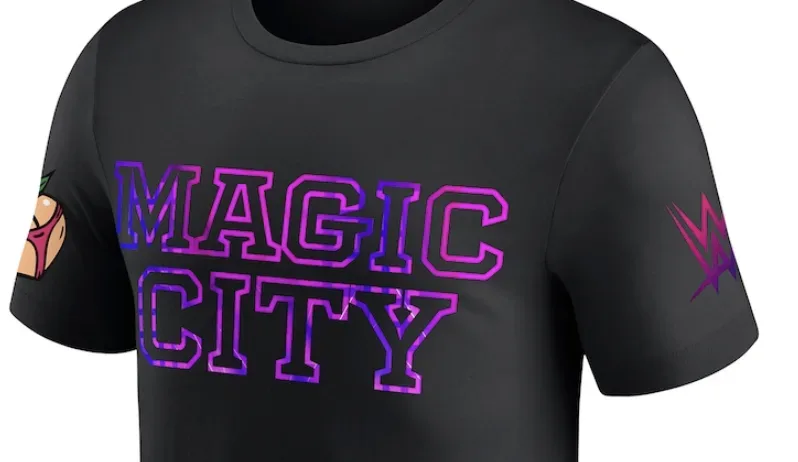
Trick Williams sees a clear connection between WWE’s recent Magic City merchandise collaboration and the persona he brought into WWE Sunday Night’s Main Event.
WWE released a collaborative merchandise line with Magic City in late August, creating considerable discussion among fans because of Magic City’s adult-oriented identity. Speaking in a new interview with The Tap Out Tea, Williams was asked about the crossover and argued that the timing fit naturally with his “Mr. Lemon Pepper Stepper” nickname.
“So the truth is, for all of those who have been to Magic City, I ain’t saying I have, I ain’t saying I haven’t. No, the rumor is they have the best chicken wings, and they probably have those lemon pepper wings at Magic City. So doesn’t it make sense for Mr. Lemon Pepper Stepper in the home of the lemon pepper wings to be promoted on the same show? I’m just saying.”
Williams’ response was delivered in the confident, playful style that has become central to his presentation. Rather than treating the partnership as an unexpected fit, he framed it as an extension of a nickname and identity that already give audiences an immediate association with lemon pepper wings. For Williams, the connection did not require a complicated explanation: Magic City, the city’s reputation for lemon pepper wings, and Mr. Lemon Pepper Stepper all belonged in the same conversation.
For more background on this topic, read Nic Nemeth Says Cody Rhodes May Have Gained More Than He Lost Against Randy Orton.
A Merchandise Collaboration That Drew Attention
The WWE and Magic City line arrived ahead of WWE Sunday Night’s Main Event, putting the collaboration in front of viewers during a significant point on the WWE calendar. The pairing stood out because WWE merchandise collaborations can range from wrestler-focused apparel to sports, entertainment, and lifestyle partnerships, while Magic City carries a distinctly adult reputation that generated an immediate reaction online.
Williams did not attempt to distance himself from the discussion surrounding the name. Instead, he leaned into the better-known food-related reputation attached to Magic City. His answer carefully played with the premise, joking that he would neither confirm nor deny whether he had visited, before steering the point back toward the lemon pepper wings and his own nickname.
That approach is important to the way Williams communicates on camera and in interviews. “Mr. Lemon Pepper Stepper” is not simply a one-off phrase; it is a recognizable part of the Trick Williams brand. The nickname gives him a local flavor while also fitting the swagger, rhythm, and self-assurance he projects as a WWE performer. By tying it to Magic City’s widely discussed wings, Williams turned the collaboration into something that could be understood as a natural promotional overlap rather than a random piece of merchandise.
His central point was straightforward. If a performer identified as Mr. Lemon Pepper Stepper is appearing on a show in the home associated with lemon pepper wings, a Magic City tie-in has an obvious thematic connection. Williams’ final line — “I’m just saying” — left the explanation with the same casual confidence that defined the rest of his remarks.
Williams Keeps the Focus on His Persona
WWE stars often rely on signature phrases, visuals, entrances, and apparel to make their identities easy for fans to recognize. Williams has consistently benefited from having a persona built around charisma and an unmistakable vocabulary. “Whoop That Trick” and the Mr. Lemon Pepper Stepper label are examples of branding that can travel from an arena reaction to a merchandise item or a media appearance.
In this case, Williams’ comments show how a location-specific reference can also function on a broader WWE stage. Fans do not need to know every detail behind the Magic City collaboration to understand the basic association Williams made. Lemon pepper wings are the bridge in the joke, and the nickname supplies the wrestling connection.
The remarks also demonstrate that Williams was comfortable making the collaboration part of his wider public image without claiming personal involvement beyond what was established. His wording was deliberately humorous: he referenced the rumors around Magic City’s wings and left his own experience there undefined. That allowed him to acknowledge the topic while keeping the focus on promotion, character, and the logic he saw behind the timing.
There is a difference between a wrestler merely appearing beside a promotional campaign and a wrestler finding a way to make that campaign reinforce an existing identity. Williams’ answer emphasized the latter. He did not present the Magic City merchandise as something detached from his WWE presence. He positioned it as something that matched his name, his confidence, and the atmosphere surrounding WWE Sunday Night’s Main Event.
The Timing Ahead of Sunday Night’s Main Event
The late-August release was particularly notable because it came ahead of WWE Sunday Night’s Main Event, where Williams was set to compete. His comments explicitly connected the merchandise launch to that appearance. In his view, promotion surrounding a major WWE show was the right place for a Magic City collaboration when Mr. Lemon Pepper Stepper was also on the card.
That does not mean Williams offered a detailed explanation of how the partnership was arranged or who initiated it. He did not provide business terms, backstage planning details, or any additional information about the scope of the merchandise release. His comments were about the public-facing fit of the collaboration, not the mechanics behind it.
Still, that fit was enough to make the release a talking point. Professional wrestling is built on presentation as much as performance, and merchandise can become part of the storytelling atmosphere around a major event. In this situation, the collaboration supplied a conversation starter while Williams had an obvious reason to connect himself to the campaign.
For WWE, the attention surrounding the line underscored how promotional partnerships can reach beyond standard wrestling imagery. For Williams, it created an opportunity to reinforce one of the most memorable pieces of his own presentation. His explanation was not a formal corporate defense of the collection. It was a character-driven answer from someone who believes the association was self-evident.
Confidence Remains Central to Trick Williams’ Appeal
Williams’ delivery is often as important as the words themselves. His answer on the Magic City merchandise was built around a simple chain of logic, but it was presented with humor and certainty. He created anticipation by opening with the line about not saying whether he had been to Magic City, then shifted to the chicken wings before landing on the Mr. Lemon Pepper Stepper connection.
That structure let him handle a headline-grabbing subject without overexplaining it. Williams did not need to make a lengthy argument. He treated the connection as obvious and invited listeners to arrive at the same conclusion. It is a style that suits a wrestler whose public persona depends heavily on being able to command attention with a short phrase, a look, or a well-timed reaction.
His comments also kept the emphasis on WWE programming rather than allowing the conversation to become solely about the adult nature of the Magic City brand. While the collaboration received attention for that reason, Williams redirected the discussion toward the local lemon pepper association and his upcoming WWE appearance. It was an effective way to acknowledge why people were discussing the merchandise while maintaining control of the wrestling angle.
Another Example of Character and Promotion Intersecting
The Magic City collaboration offered a distinctive promotional moment, and Williams’ response made clear that he viewed it through the lens of character. The relevant pieces, as he laid them out, were simple: Magic City is associated with lemon pepper wings, he is Mr. Lemon Pepper Stepper, and he was preparing to compete at WWE Sunday Night’s Main Event.
Whether fans viewed the merchandise as surprising, provocative, or simply an unusual WWE crossover, Williams found a way to make it work for his own image. His remarks did not reveal more about the partnership itself, but they did explain why he felt its placement around the event made sense.
Elsewhere in the same interview, Williams also discussed why he did not continue the United States Title open challenge after winning the championship. On the Magic City topic, however, his message was focused entirely on the connection between the nickname, the wings, and the setting. For Mr. Lemon Pepper Stepper, the collaboration was not difficult to understand at all.
Darryl Polo
Darryl Polo is a passionate wrestling fan covering WWE, AEW, TNA and beyond. He loves great rivalries, breakout stars and the moments that keep fans talking long after the bell. How we work.