
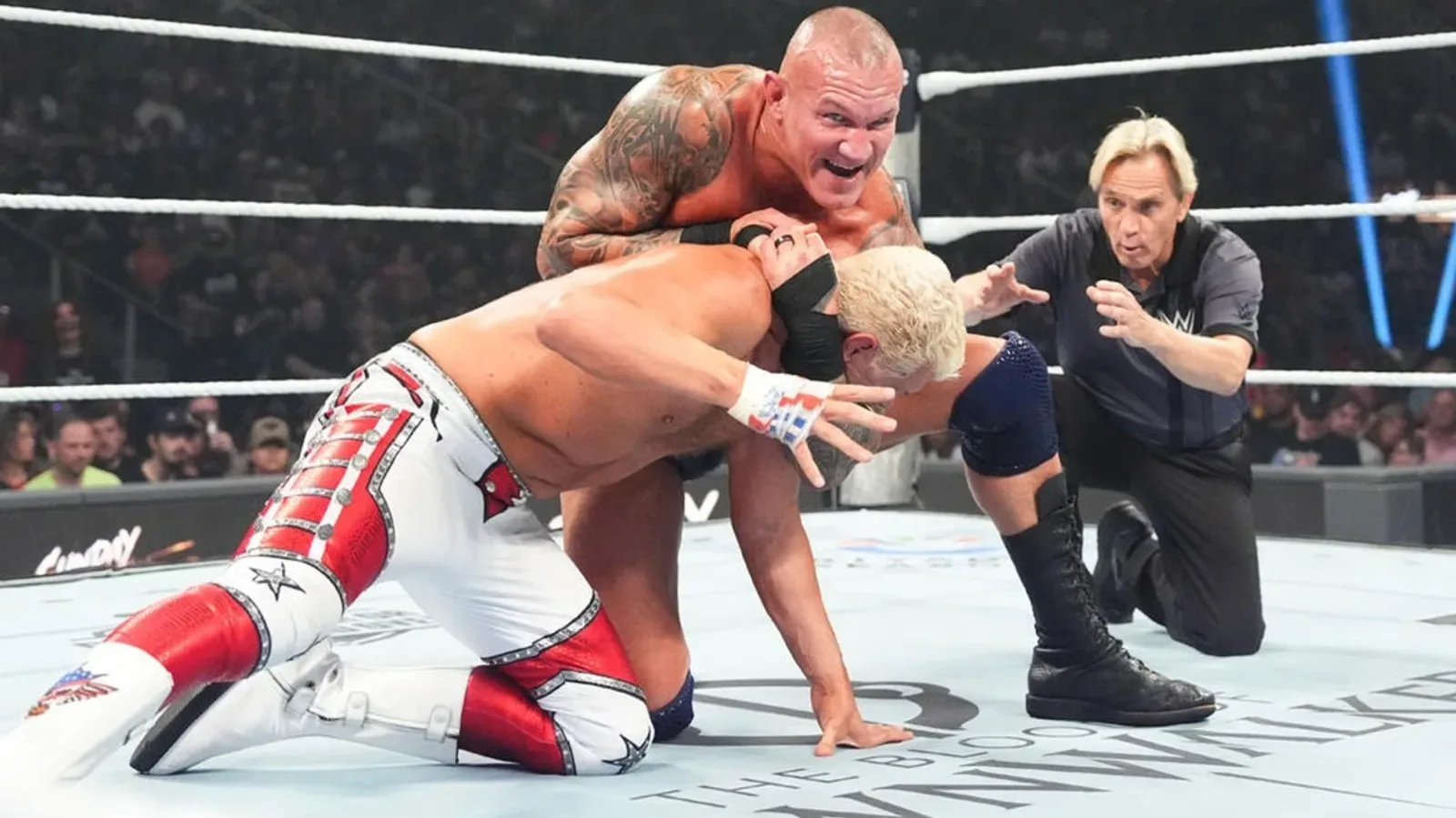
Cody Rhodes suffered a loss to Randy Orton at WWE Sunday Night’s Main Event, but Nic Nemeth believes the outcome may ultimately strengthen “The American Nightmare” rather than diminish him.
Orton defeated Rhodes through deception and a low blow after a dramatic closing stretch that placed both men’s emotions at the center of the story. With Rhodes appearing ready to use Orton’s own punt against “The Viper,” Orton dropped to his knees and pleaded with his opponent to stop. The image was striking because Orton has long been presented as WWE’s calculating, ruthless Apex Predator. Yet the apparent surrender did not last. Orton used Rhodes’ hesitation against him, caught him off guard, and secured the win with an underhanded attack.
For Nemeth, the important part of the segment was not simply that Orton escaped with the victory. It was that Rhodes was put in a position where even a performer with Orton’s reputation appeared afraid of what he might do.
“With Randy being this Apex Predator, he shouldn’t be afraid of anybody,” Nemeth said on Busted Open. “He’s bigger, stronger, and better. And actually he’s putting over Cody’s mindset as a wrestler. Because now Randy, who can take anybody, whether he was faking it or not, was begging for his life.”
For more background on this topic, read Trick Williams Explains Why He Ended the United States Title Open Challenge Tradition.
That distinction is central to Nemeth’s view of the match. A conventional reading of the result is simple: Rhodes lost, while Orton won. WWE storytelling, however, often asks viewers to look beyond the record book. A defeat can still advance a character if it changes how the audience sees that wrestler, exposes a new layer of conflict, or establishes a deeper personal issue that demands a future resolution.
In this case, Rhodes had Orton vulnerable. The visual of Orton on his knees created a moment in which the familiar power dynamic between the two stars appeared to shift. Rhodes, rather than being overwhelmed by one of WWE’s most dangerous veterans, became the man standing over Orton with the opportunity to deliver a punishing and symbolic blow.
Orton’s decision to beg added another dimension to the confrontation. Nemeth noted that whether the plea was sincere or merely a tactic is not necessarily the point. The uncertainty is part of what made the closing sequence work. Orton has made a career out of anticipating opponents, exploiting openings, and turning moments of hesitation into victories. Rhodes’ reluctance to go through with the punt allowed Orton to capitalize, but it also showed that Rhodes had pushed him to an unusual emotional extreme.
Why Orton’s Vulnerability Matters
Randy Orton has spent much of his WWE career defined by control. His character’s reputation is built around patience, calculated violence, and an ability to strike at precisely the right moment. He is rarely portrayed as panicked. Even when he is in trouble, Orton typically remains composed enough to find an escape route, whether it is an RKO, a shortcut, or a carefully timed act of manipulation.
That is why the moment at Sunday Night’s Main Event resonated with Nemeth. Seeing Orton plead with Rhodes was not simply a plot device to set up the low blow. It presented the idea that Rhodes had gotten inside Orton’s head, forcing the veteran to respond in a way that viewers do not often see from him.
“And then that ties into Cody’s struggle mentally that he’s having over the course of the last several months, possibly years, and this slow burn and build to it,” Nemeth said. “So Randy is putting over Cody by not doing wrestling moves. He’s getting everyone sucked into the story and the emotion. And Randy, it’s so hard to see him vulnerable, but it was a beautiful thing to be like, this is pathetic, and it was so great.”
Nemeth’s observation speaks to the value of non-physical storytelling in wrestling. The closing moments did not rely only on moves or near-falls to create stakes. Instead, the tension came from body language, hesitation, facial expressions, and the question of whether Rhodes was prepared to become more ruthless in order to defeat Orton.
Rhodes was handed an opportunity to use one of Orton’s signature weapons against the man who made it famous. That possibility carried obvious symbolism. The punt is associated with Orton’s coldest and most violent side, so Rhodes using it would have suggested that his rivalry with Orton had pulled him toward a darker place. Orton’s plea intensified that dilemma. Rhodes could have delivered the move, but doing so would have required him to make a choice that may conflict with his own sense of identity.
Instead, Orton took advantage of that pause. The low blow gave him the win, but it did not erase the fact that he had been put in a desperate position beforehand.
A Loss That Can Fuel Cody Rhodes’ Story
Nemeth compared the broader situation to a film structure in which a hero appears to have overcome a major obstacle, only to discover that the true challenge is still waiting. In that kind of story, the setback does not end the protagonist’s journey. It gives that journey more urgency.
For Rhodes, the loss to Orton can serve a similar purpose. He now has an unmistakable grievance: he was beaten by a low blow after choosing not to take advantage of a seemingly helpless opponent. The result gives Rhodes a reason to pursue Orton, but the emotional conflict reaches beyond the desire to even the score. Rhodes must also confront whether restraint cost him the match and whether he needs to change in order to deal with Orton moving forward.
That is the area Nemeth believes can benefit Rhodes most. The storyline is not limited to who is technically better inside the ring. It is about Rhodes’ mindset, his willingness to embrace aggression, and the consequences of fighting someone as manipulative as Orton.
There is also an important contrast between the two men. Orton was willing to appear vulnerable if it created an opening. Rhodes, by comparison, was unwilling or unable to deliver the punt while Orton begged him not to. Orton’s eventual low blow makes that contrast even sharper. One competitor weaponized emotion. The other was slowed down by it.
That does not necessarily make Rhodes look weak. Nemeth’s argument is that it can make him more compelling. Rhodes’ hesitation creates a human flaw and establishes a question that can follow him into future confrontations: can he remain true to himself and still defeat an opponent who has no problem crossing every line?
Believability in the Closing Sequence
Nemeth also praised the execution of the ending itself, calling the moment believable. The success of the scene depended on Orton making the begging feel plausible enough for Rhodes and the audience to question it, while also preserving the possibility that “The Viper” had been planning the deception all along.
That ambiguity is especially fitting for Orton. If his pleading was a calculated ruse, it reinforces his status as a master manipulator who knew exactly how to create hesitation. If there was any sincerity to it, then Rhodes had truly taken Orton to a place of fear before Orton reverted to the tactics that have helped define him. Either interpretation gives the rivalry material to explore.
The crowd response to such a moment is driven by the emotional clarity of the characters. Viewers understand Orton’s instinct to survive by any means necessary. They also understand why Rhodes may hesitate before delivering a move associated with serious damage and one of his rival’s most infamous acts. Neither man needed a lengthy explanation in the ring for the stakes to be clear.
Orton’s win at WWE Sunday Night’s Main Event therefore gives him momentum on paper, but Rhodes was not presented as a competitor who had been decisively outclassed. He was presented as someone who had Orton beaten emotionally before a familiar shortcut changed everything.
What Comes Next for Rhodes and Orton
The immediate result leaves Rhodes with unfinished business and leaves Orton with a victory that may prove more complicated than it first appears. Orton escaped with the win, yet he also revealed that Rhodes can force him into discomfort. Rhodes lost, yet he was shown as a threat capable of making the Apex Predator plead for mercy.
That is why Nemeth sees upside for Rhodes despite the defeat. The match supplied a reason for Rhodes to become more determined, more conflicted, and potentially more dangerous as the story continues. It also preserved Orton’s ability to be the calculating antagonist who can steal a victory at the exact moment his opponent believes the fight is won.
Whether Orton’s pleading was genuine or a carefully laid trap remains open to interpretation. What is certain is that the sequence gave their rivalry a stronger emotional foundation. Rhodes now has more than a loss to avenge. He has to reckon with the moment when he chose not to pull the trigger, while Orton proved once again that he will exploit any hesitation.
For Nemeth, that emotional exchange may matter more than the final decision. Orton got the victory, but Rhodes was made to feel like a man capable of pushing one of WWE’s most feared competitors to the brink.
In pictures
Darryl Polo
Darryl Polo is a passionate wrestling fan covering WWE, AEW, TNA and beyond. He loves great rivalries, breakout stars and the moments that keep fans talking long after the bell. How we work.