
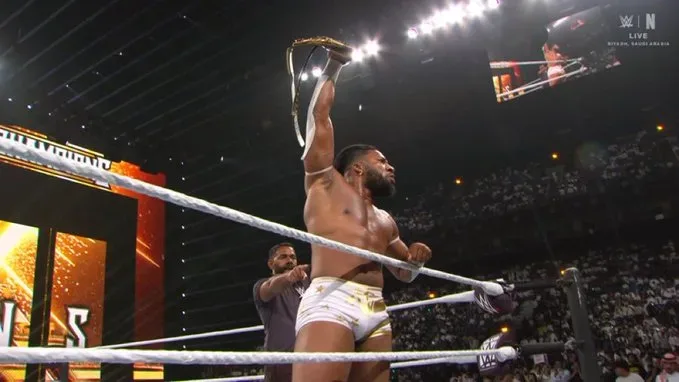
Trick Williams has made it clear that his approach to the WWE United States Championship will not mirror that of the men who held the title before him.
Before Williams captured the championship for the first time earlier this year, Carmelo Hayes and Sami Zayn helped establish a recurring open-challenge tradition around the United States Title. Those matches created opportunities for a range of WWE competitors to step forward, test themselves against the champion and potentially reshape the division in a single night.
Williams did not continue that format once he became champion. Speaking in a new interview, he explained that decision by framing championship contention as something that should be earned through value, performance and the ability to create a major match for SmackDown.
“Because that’s how life works. You don’t get no handouts in life. Nobody’s just knocking at your door and say, ‘hey, I have a championship opportunity for you. Do you want it? Here, come.’ No, man, you gotta prove yourself.”
For more background on this topic, read Tate Wilder Says WWE Tryout Made His Wrestling Decision Clear After Jets Exit.
That philosophy goes beyond a simple refusal to revive an open challenge. Williams sees the United States Championship as a prize that should demand a higher threshold from prospective challengers. In his view, a wrestler should be able to demonstrate not only why they deserve a match, but also what they can bring to the brand and whether the audience has reason to invest in the confrontation.
“What do you have to offer me? What do you have to offer Trick Williams and the brand? Are you the best thing for SmackDown? Are people gonna wanna see you versus me?”
Williams recently regained the United States Championship when he defeated Baron Corbin at WWE Sunday Night’s Main Event. That victory returned the title to Williams and reinforced the perspective he has brought to the championship: the belt is not meant to be a routine reward for anyone willing to issue a challenge. It is intended to represent a central attraction.
Williams Wants the Title to Feel Bigger
The United States Championship has historically occupied several different roles in WWE. At times, it has been presented as a workhorse championship, with champions defending regularly against a broad group of opponents. At other times, it has served as a major television prize attached to an established top star and protected through more selective title matches.
The open-challenge model leans heavily toward the first version. It can make a championship feel active and give viewers the sense that any episode could produce a fresh matchup or an unexpected breakthrough. It also places a great deal of emphasis on a champion’s willingness to fight whoever comes forward.
Williams is pursuing something different. His comments suggest he does not see accessibility as the defining feature of a prestigious title reign. Rather, he wants challengers to establish their worth before they receive a chance to compete for the belt. In practical terms, that can mean rivalries built around a competitor’s momentum, a personal issue, a standout performance or the simple question of whether the challenger belongs in a marquee SmackDown match.
For Williams, the key is raising the perceived standard around the championship. He said that giving every wrestler an automatic opportunity would undermine the message he wants the title to send.
“So you have to know your worth and be able to raise the standard of everything because, hey, if everybody gets a chance, then what are you saying?”
It is a character-driven answer, but it also outlines a clear championship strategy. Williams wants the audience to see a United States Title opportunity as a destination, not an entry point. That naturally places more attention on the process of identifying and elevating contenders.
A Different Standard From Hayes and Zayn
Williams specifically watched Carmelo Hayes and Sami Zayn defend the United States Championship through open challenges before his own first reign. Their examples showed a contrasting style of leadership around the title: a champion publicly inviting competition and allowing a challenger to step into the spotlight without a long campaign for a match.
There is no indication that Williams is dismissing what those champions did. Instead, he is drawing a distinction between their respective reigns and his own identity as titleholder. The same championship can be defined differently depending on who holds it, and Williams appears determined to make selectivity part of his presentation.
That is especially notable considering the history between Williams and Hayes. Their careers have long been connected, and Hayes was among the champions whose open challenges Williams observed. Williams is now taking the opposite route, using the United States Championship to establish that a direct path to him will not be available simply because someone asks for it.
The difference also gives Williams a strong basis for future rivalries. Any wrestler pursuing him can challenge the legitimacy of his stance, arguing that a fighting champion should defend against all comers. Williams, meanwhile, has already laid out his response: an opponent must prove they are worth his time, worth the title match and worth the SmackDown spotlight.
“Whatever Title Trick Williams Wants or Has”
Williams’ broader ambition was perhaps the most significant part of his explanation. He does not want the United States Championship to be treated as a secondary prize simply because of its name or its traditional placement within WWE’s title hierarchy. He wants the championship he possesses to command the biggest possible level of attention.
“I don’t want it to be that title, whatever title Trick Williams wants or has, I want that to be the main title.”
That statement captures the confidence that has become central to Williams’ WWE persona. He is not presenting himself as someone content to merely carry a championship. He wants to make the title synonymous with his own significance, treating it as the premier prize whenever it is in his possession.
It also provides a direct explanation for why open challenges do not fit his vision. If every competitor can receive a title shot immediately, Williams believes the championship risks becoming too easy to access. His goal is for the pursuit of the belt to feel consequential, with every challenger needing to show why a Williams title defense should be one of the important events on the show.
Whether fans agree with that reasoning is a separate question. Open challenges often generate enthusiasm precisely because of their unpredictability and their potential to introduce a new opponent. They can make a champion look fearless. On the other hand, Williams’ model can make the championship feel guarded and exclusive, while allowing larger programs to develop around contenders who force their way into consideration.
Williams is plainly choosing exclusivity. He is casting himself as the person who decides when a prospective challenger has met the standard, rather than as a champion who leaves that decision open to the locker room.
What It Means for the United States Title Scene
Following his win over Baron Corbin at WWE Sunday Night’s Main Event, Williams is once again the man standing at the center of the United States Title picture. The question now is not whether an open challenge will produce his next opponent. Williams has already explained why that is unlikely. The more relevant question is who can make a compelling enough case to demand his attention.
That puts added importance on every would-be challenger’s performances and presence on SmackDown. A wrestler hoping to face Williams will need to show that they bring something meaningful to the matchup, whether that is a winning streak, a personal conflict, crowd support or the ability to create a match viewers want to see.
Williams has set an intentionally demanding bar. He wants a challenger to answer the same questions he raised in the interview: What do they offer him? What do they offer the brand? Are they truly the best possible opponent for SmackDown?
Those questions may be self-serving, but they are also a declaration of how Williams intends to operate as champion. The United States Title will not be offered as a handout in his reign. It will be treated as a prize that challengers have to pursue, justify and earn.
With the championship back around his waist after defeating Corbin, Williams has the opportunity to further define that standard. His refusal to continue the open-challenge tradition is not being positioned as an absence of ambition. Williams sees it as the opposite: a deliberate attempt to make his title reign, and any match involving his championship, feel like the main event.
Darryl Polo
Darryl Polo is a passionate wrestling fan covering WWE, AEW, TNA and beyond. He loves great rivalries, breakout stars and the moments that keep fans talking long after the bell. How we work.