
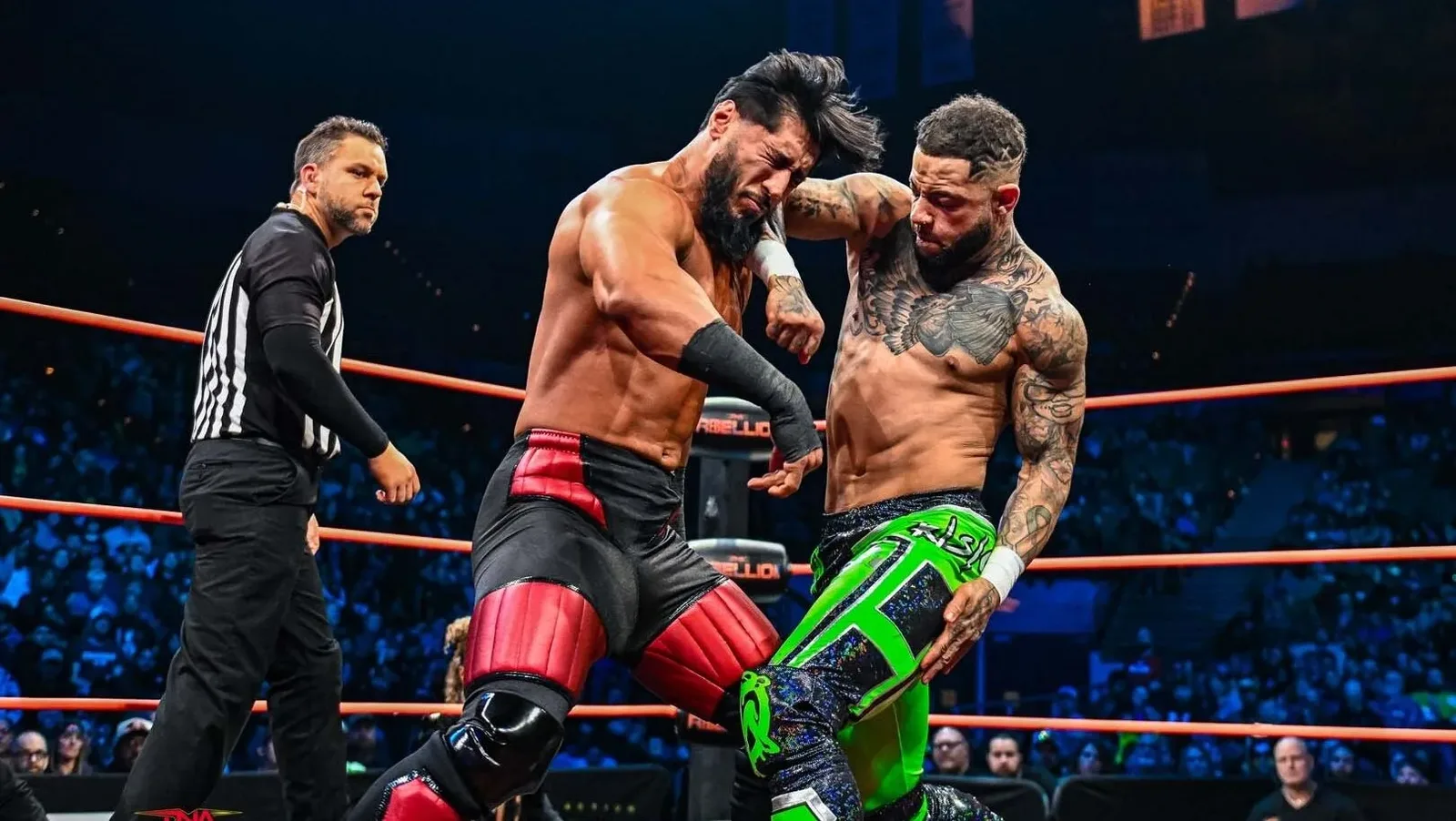
Trey Miguel has offered emphatic praise for Mustafa Ali’s ability to construct a professional wrestling match, describing Ali as a performer capable of bringing the best out of virtually anyone who steps into the ring with him.
Speaking on the November 5 edition of Busted Open, Miguel discussed the extensive work that went into his match with Ali at TNA Rebellion 2026. The former X-Division Champion did not merely point to Ali’s athleticism or in-ring execution. Instead, he focused on the detailed planning, emotional direction, camera awareness, and character work that Ali brings to every stage of preparing a match.
“You can’t have a bad match with Mustafa Ali and if you do, you should quit,” Miguel said. “He can pull the best out of anyone.”
It was a striking endorsement from Miguel, who has built his own reputation as one of the more dynamic and creative wrestlers associated with TNA. His comments also provide a close look at the differences between the rapid preparation often required on independent wrestling events and the far more deliberate process he experienced while working with Ali in TNA.
For more background on this topic, read Judas Icarus Announces 2026 Wrestling Hiatus After Radial Bone Fracture.
Four Hours of Details Before Bell Time
Miguel explained that he is accustomed to the fast-moving pace of independent shows, where wrestlers may not have the luxury of spending most of a day mapping out a bout. On those events, performers can arrive shortly before the building opens, put together the core of a match in a limited period of time, and then run through the key points before heading out in front of the crowd.
That approach can produce memorable wrestling, particularly when two experienced performers understand each other’s instincts. But Miguel said an Ali match operates on an entirely different level of preparation.
“When you’re putting together a match with Ali, it’s hours of process,” Miguel said. “You’ll see guys ringside, sitting there up until they start letting fans in from the moment we can get around the ring. It’s not an easy thing to do, and it takes a lot of time.”
He contrasted that process with his independent wrestling routine, saying that he might arrive an hour before doors—or in some situations just 30 minutes beforehand—and assemble a match in 30 minutes or even 15. Miguel noted that wrestlers can then go over the material several times and be ready to perform it. With Ali, however, he said the preparation continues far beyond the point at which many talents would consider a match fully laid out.
Miguel estimated that, before a match with Ali reaches its halfway-planned stage, the two can already have spent four hours working through the details. The purpose, he stressed, is not simply to fill time or overcomplicate the action. It is to ensure that every movement has a reason and that the audience is being guided through a specific story.
Mustafa Ali’s Vision Extends Beyond Moves
In Miguel’s description, Ali’s process encompasses far more than deciding which sequences will be used and when a finish will occur. Ali considers facial expressions, selling, positioning and production elements, including where a camera should be placed to best capture a moment.
“It’s because of all of the little details that he cares about,” Miguel said. “He cares about what facial you make and he plans where the camera needs to be specifically, how your sell needs to be and why your sell needs to be that.”
That attention to detail is especially meaningful in a televised wrestling environment. A wrestler’s expression may tell a different story to the audience in the building than it does to the viewers watching at home. A well-timed close-up can emphasize pain, doubt, anger or desperation. A sell can establish the consequences of an earlier move and give the next part of the match a stronger dramatic foundation.
For Miguel, Ali’s greatest skill in that process is his ability to explain the intended feeling behind each portion of the match. He said Ali breaks down what the audience should experience with every beat, approaching wrestling not merely as a sequence of athletic exchanges but as a connected emotional narrative.
“He breaks down exactly what you want people to feel with every beat of the match and he has such a mind for wrestling and the way he breaks it down,” Miguel said.
Miguel added that a wrestler who understands that vision and can put it into practice is in an excellent position to have one of the standout bouts on the card. The comment reflects an aspect of wrestling that can be easy to overlook: preparation alone does not guarantee success. The performers still have to translate the plan into natural reactions, physical timing, and believable conflict once the bell rings.
Ali’s approach, as Miguel described it, demands commitment from both wrestlers. The planning may be exhaustive, but the outcome is intended to feel immediate rather than rehearsed. When it works, the audience sees a match with a clear escalation, meaningful reactions and a payoff rooted in what has happened throughout the contest.
Rebellion Match Became a Personal Favorite
The TNA Rebellion 2026 match between Miguel and Ali stands out in Miguel’s mind as one of his all-time favorites, even though it included a serious and unexpected physical setback. Miguel revealed that he broke his kneecap during the bout.
Rather than ending the match immediately, Miguel continued for approximately six more minutes. He believes the unplanned injury added to the story the match was telling, creating a layer of urgency and struggle that could not have been designed in advance.
“I think the match that I had with him at Rebellion was one of my favorite matches of all time, even after breaking my kneecap,” Miguel said. “I think doing that and continuing for the next six minutes only helped that story.”
Injuries are an unfortunate reality of professional wrestling, and an unexpected injury can force wrestlers to make split-second decisions. Miguel was clear that the injury was not something he and Ali had planned to incorporate. Still, he said that wrestlers are sometimes faced with a choice to adapt to an organic development or allow it to stop the match’s momentum.
What mattered most to Miguel was Ali’s conduct while the situation unfolded. He praised Ali for repeatedly checking on him between moments in the match and ensuring that Miguel was capable of continuing. That professionalism allowed them to adjust while still working toward an ending that Miguel felt did justice to a match that was already connecting with the audience.
“We didn’t plan for that but sometimes these things just happen organically, and you either roll with it or you don’t,” Miguel said. “Luckily, he was such a professional. He checked on me in between everything that we did, and he made sure that I was able to keep going and I think we had an amazing ending to a match that was already doing well because of the added spice that knee injury gave us.”
The story underlines why communication remains essential in the ring, even in a match that has been planned with intense precision. A detailed outline can give wrestlers the framework for a compelling contest, but adaptability and trust are just as vital when circumstances change without warning.
Miguel’s Attention Turns to Leon Slater
While Miguel’s comments looked back on his work with Ali, his immediate focus is on a major championship opportunity. Miguel is set to challenge Leon Slater for the TNA World Championship at Destination X on November 15.
The title match places Miguel opposite a champion representing a new generation of TNA’s high-flying and ambitious talent. Slater’s reign has put a spotlight on his speed, fearlessness and ability to perform under pressure, while Miguel brings years of experience, a deep familiarity with TNA’s competitive environment, and the kind of creative in-ring mindset evident in his discussion of Ali.
Miguel’s reflections on match structure may also offer a window into the mentality he will carry into Destination X. He has openly acknowledged that preparation matters, whether a match is assembled quickly on an independent card or developed over hours at ringside. Against Slater, the margin for error will be narrow, particularly with the TNA World Championship at stake.
For now, Miguel has made one thing unmistakably clear: he views Mustafa Ali as one of wrestling’s exceptional match architects. Their Rebellion encounter remains a defining experience for Miguel—not despite its painful turn, but because both wrestlers were able to navigate that challenge and preserve the story at the center of the match. With a world title contest against Leon Slater approaching, Miguel will be looking to create another defining chapter of his TNA career at Destination X.

Darryl Polo
Darryl Polo is a passionate wrestling fan covering WWE, AEW, TNA and beyond. He loves great rivalries, breakout stars and the moments that keep fans talking long after the bell. How we work.