
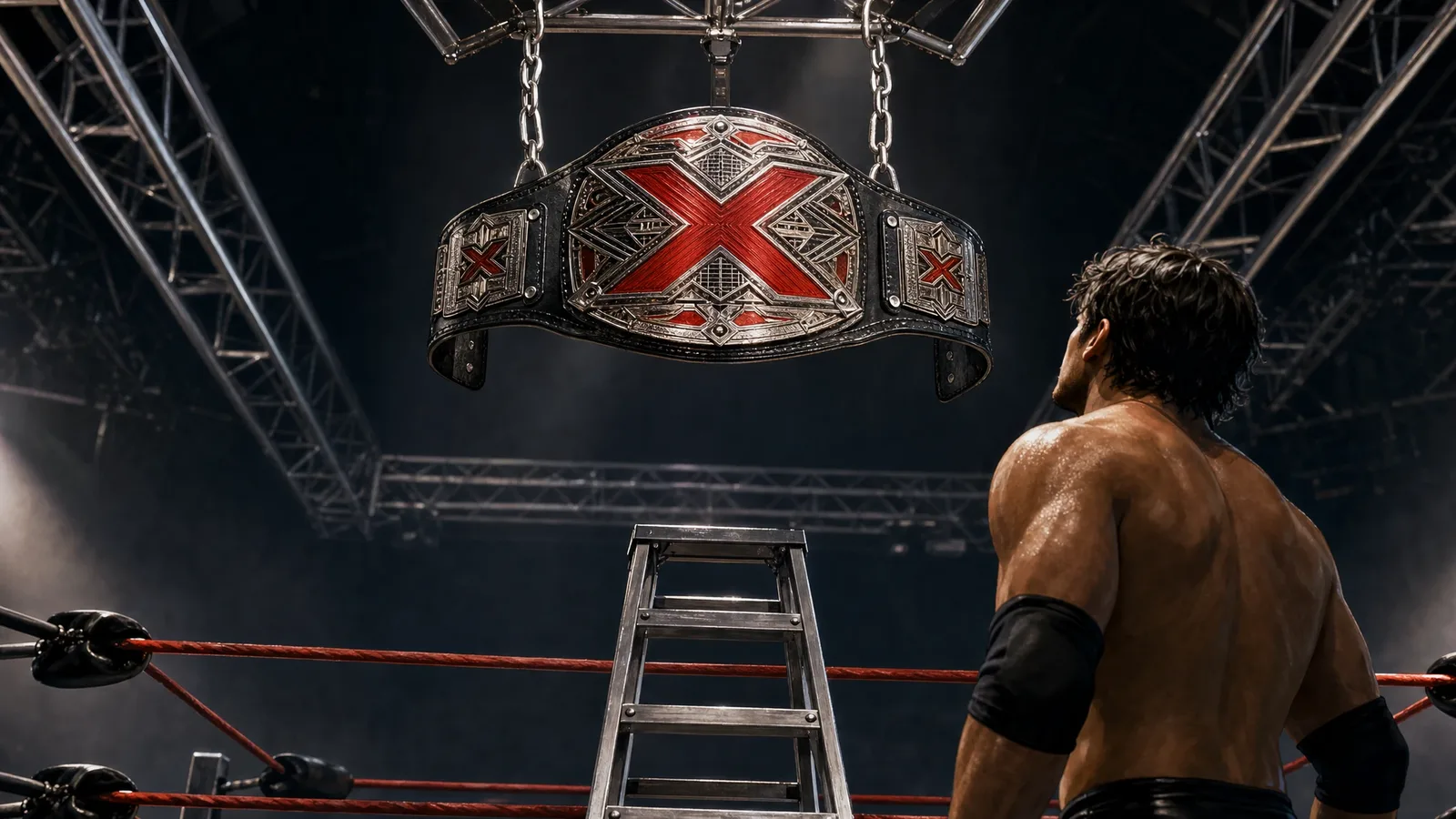
Start with the championship, not a presumed athlete type
The most secure way to approach the X Division is as a championship-centered identity. That framing keeps the focus on what TNA’s presentations actually put before viewers: the title, its holders, the special formats used around it, and the stakes attached to it. It is more precise than assuming the division can be fully defined by a fixed kind of wrestler. A useful first viewing question is simple: what does this segment or match say the championship represents right now? In the available accounts, the answer changes through lineage, match construction, and opportunities connected to the title.
AJ Styles provides a documented historical entry point because he was the first X Division Champion. He is also described as a six-time champion. Those facts make him relevant to the title’s early association and recurring championship history, but they do not make one performer a complete definition of the division. For a viewer, the distinction matters. Styles can function as a reference point for a lineage story without turning that lineage into a rule that later champions must reproduce the same persona, physique, repertoire, or match approach.
Lineage can be presented as symbolism
TNA’s Slammiversary 2025 presentation placed that lineage in the foreground when Leon Slater defeated Moose for the X Division Championship and Styles appeared afterward to endorse Slater’s achievement. The sequence connected a new champion to a past titleholder with deep documented ties to the championship. It is fair to read the moment as an on-screen act of recognition: the title’s past was used to frame its present. It is not evidence of a formal qualification test, a succession system, or a requirement that every champion receive validation from an earlier one.
Carlos Silva told SI that the original purpose of Styles’ appearance was to celebrate Styles’ X Division history. That account helps separate intended presentation from enforceable structure. A celebration can tell viewers which history TNA wishes to emphasize; it does not, by itself, establish the conditions under which someone may enter the division or challenge for its championship. When a familiar former champion appears around the title, ask whether the segment is changing a rule or simply placing a current result in a longer championship narrative.
This is why heritage messaging should be read as one layer of X Division identity rather than the whole thing. The 2025 scene presents an older standard-bearer recognizing a newer champion, which gives the title a visible sense of continuity. Yet continuity is different from uniformity. It allows a promotion to invoke a past champion while centering someone new. The practical viewing payoff is avoiding a false choice between “the division has never changed” and “its past does not matter.” The documented presentation instead shows history being actively used in a contemporary championship moment.
Ultimate X changes how a championship can be won
Ultimate X is a separate layer: a distinctive match format associated with the X Division. It should not be mistaken for the division’s only possible match type. In the June 2013 title match, the belt was suspended above the ring on cables, so the championship was not decided through the conventional pinfall described in the event report. The match’s premise directed attention upward and made access to the suspended belt central. That provides viewers with a concrete way to identify the format before trying to make broader claims about the entire division.
Chris Sabin’s winning action in that 2013 Ultimate X match makes the altered objective especially clear. He reached the cables and pulled down the belt, and that retrieval decided the championship. The report also describes competitors climbing ropes and cables while trying to prevent rivals from reaching the title. Thus, the route to victory and the match’s visual language were both different from a bout settled by the conventional finish noted in the account. A useful question is not merely who is competing, but what physical objective has been set for them in this format.
The same 2013 championship contest was a three-person match involving Kenny King, Chris Sabin, and Suicide. That is another reminder that an X Division title match need not be reduced to a standard singles structure. The result was a multi-person contest with a suspended championship objective. Its three-way field and retrieval condition are specific documented choices, not proof that every future title match must use either one. Viewers can describe the event accurately by naming both elements: multiple contenders and an Ultimate X route to the belt.
A signature format has history, but it is not a blanket style rule
Commentary at the 2013 event identified the bout as the 30th Ultimate X match and the first Ultimate X held at Slammiversary. The same commentary noted that Sabin had wrestled in the first Ultimate X match in 2003. Together, those details show that the format had an established documented history by the time it appeared on that Slammiversary card. They do not establish that Ultimate X was constantly used, that it governed all X Division title defenses, or that a particular event placement carried a broader business meaning.
The event report recorded rapid exchanges, rope-based positioning, and cable climbing in the 2013 match. Those are useful observations for explaining what viewers saw in that specific contest, especially alongside the suspended-belt objective. But an individual match report has limits. It cannot establish that every X Division match uses the same pace, positioning, or aerial route. The soundest conclusion is narrow: Ultimate X can produce a recognizable set of visual and tactical problems because the championship hangs above the ring and competitors must navigate ropes and cables to reach it.
Sabin won that 2013 Ultimate X match in 13 minutes and 30 seconds to become X Division Champion, according to the contemporaneous report. The precise result anchors discussion of the format in a championship outcome rather than a vague reputation. Still, duration alone does not prove a universal pace or establish what all division matches are supposed to look like. When evaluating a claim that the X Division has one inherent style, viewers should distinguish a recorded feature of one match from a promotion-wide rule that the available reporting does not supply.
The title can also point upward
Immediately after Sabin’s 2013 title victory, Hulk Hogan announced that the X Division Champion would receive a TNA World Title opportunity later that summer, as Austin Aries had at Destination X the prior year. This presentation matters because it placed the division championship in relation to the promotion’s top singles title. The X Division belt was not framed only as a self-contained prize in that moment; it was also connected to a possible next-level opportunity. That connection is a documented storyline and championship-stakes relationship, not a claim about the standing of every champion in every period.
The later name for the mechanism is Option C. F4W described it as a process through which an X Division Champion surrenders the belt in exchange for a World Championship opportunity. The word “surrenders” is the key to understanding the arrangement. Option C is not simply a bonus match added to a champion’s schedule while the champion remains in possession of the X Division title. It is a trade-off between retaining the division championship and pursuing a World Championship challenge, with a vacancy created by the choice.
That vacancy consequence makes Option C a useful lens for reading X Division stories. It turns the title into both something to hold and something that can be relinquished for a different opportunity. The resulting question is concrete: what happens to the X Division Championship when its holder makes the exchange? F4W’s description answers that it becomes vacant. This distinguishes Option C from a conventional champion-versus-champion scenario or an additional title shot granted without cost. The mechanism links two championships while ensuring that the X Division title must be awarded again.
Vacancies can produce new match structures
In August 2026, TNA announced a qualification series after Leon Slater exercised Option C, leading to a six-way match to crown a new X Division Champion. The announced format demonstrates a further possibility in the title’s presentation: a vacancy can be resolved through qualifying matches and a multi-person final. That is different from the 2013 Ultimate X example, where an existing title was contested in a three-person cable-retrieval match. The two accounts show distinct ways that the championship’s competitive setting can be built without proving either is the permanent default.
The 2026 announcement explicitly tied Slater’s use of Option C to a planned World Championship challenge. That made the exchange legible within the storyline: pursuing the World title meant no longer holding the X Division Championship, and a process would determine a successor. The viewer question here is about consequence rather than slogan: has the champion simply gained an opportunity, or has the choice changed the status of the title itself? In this case, the reported answer is both—a World title pursuit and an X Division vacancy resolved through qualification and a six-way match.
F4W also reported that Slater had won the X Division Championship from Cedric Alexander at Lockdown before announcing he would use Option C. That report included a separate Lockdown stipulation: if Slater lost, his prior X Division reign would be erased from the record. It is important to keep that condition narrow. The stipulation was specific to that match and is not presented as a general rule for all X Division champions. It does show that TNA can make the official status of a championship reign part of a particular match’s stated stakes.
A careful way to describe the division
Taken together, the documented material supports three complementary reading tools. Heritage messaging appears when a champion such as Styles is used to recognize a newer titleholder. Ultimate X supplies special match architecture, with a suspended belt, cables, and retrieval determining the result. Option C creates an escalation path in which the X Division Champion can surrender the title for a World Championship opportunity. What these sources do not provide is a complete promotion-wide eligibility code or proof that every participant shares one body type, move set, or primary match format. That limit is essential to an accurate fan description of the X Division.
Explore more

Darryl Polo
Darryl Polo is a passionate wrestling fan covering WWE, AEW, TNA and beyond. He loves great rivalries, breakout stars and the moments that keep fans talking long after the bell. How we work.