
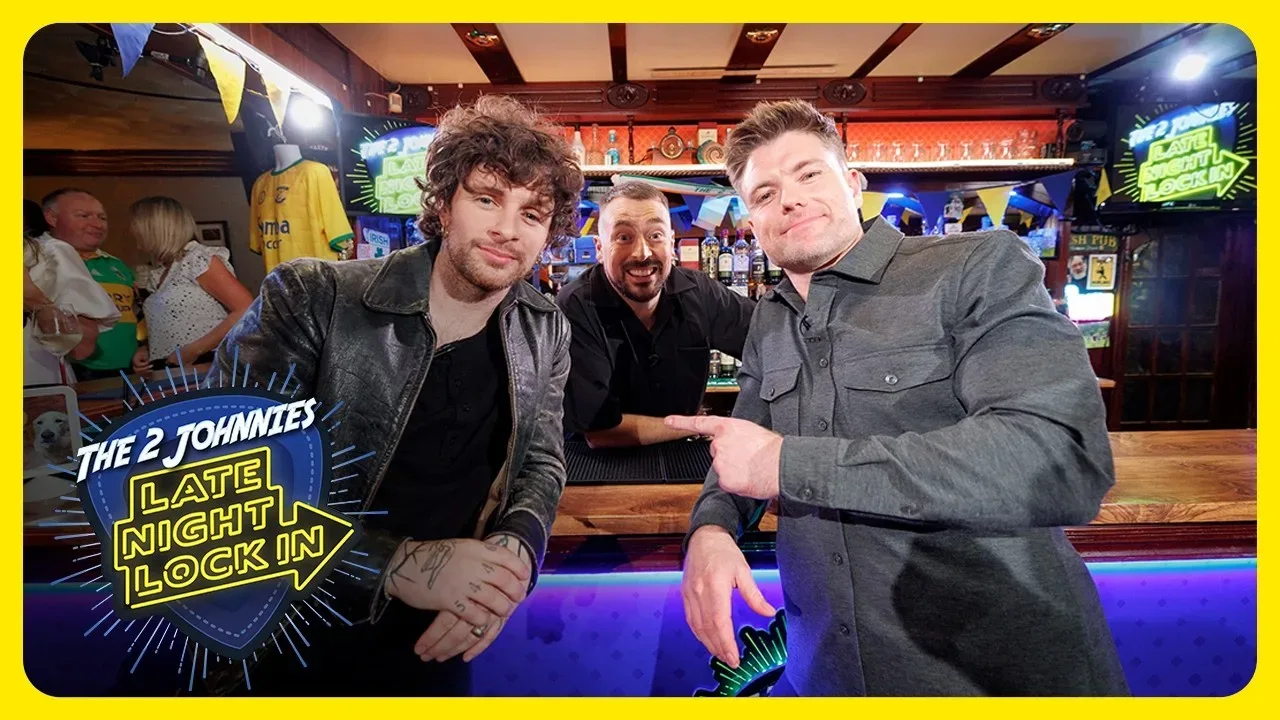
For generations of professional wrestling fans, the urge to imitate a favorite wrestler’s biggest move has been part of growing up. Trampolines, mattresses, backyards and improvised rings have often become the setting for youthful recreations of what viewers see on television. Tom Grennan has now shared a painful reminder of just how dangerous that can be.
The UK singer-songwriter recalled a teenage backyard wrestling incident in which he attempted to perform a Swanton Bomb, the high-risk move closely associated with Jeff Hardy. What began as wrestling with his brother on the family trampoline ended with Grennan landing on a tree stump, suffering a broken back and facing a potentially life-changing outcome.
Grennan discussed the story during an appearance on The 2 Johnnies Late Night Lock In, explaining that WWE was a major part of his childhood. He said his admiration for Hardy, one of wrestling’s most distinctive daredevil performers, directly inspired the attempted move.
“Yeah, man. WWE was my childhood. Yeah, but there’s a story. We had a trampoline at home and I’d just beat my brother up, and I loved a wrestler called Jeff Hardy.”
For more background on this topic, read Chelsea Green Sees Crown Jewel Match as a Test of Her Place at WWE’s Summit.
The singer then described the setup that went wrong. Grennan said he bounced off the trampoline while trying the move and came down on a stump left behind after his father had cut down a tree. The impact immediately caused serious pain, though the full extent of the injury was not known at the time.
“He had a move called Swanton Bomb, and I tried this Swanton Bomb and I bounced out of the trampoline onto a tree stump that my dad had cut, and I got my back and I crawled into the house and I said, dad, dad, my back, my dad. My dad said, ‘cop on, get up.’”
A childhood wrestling tribute with serious consequences
Grennan estimated that he was around 15 years old, or possibly a little younger, when the accident occurred. His father initially did not realize how seriously he had been hurt, with Grennan joking that his previous behavior had made his dad think he was crying wolf. But the pain did not disappear, and the issue continued for several weeks.
Eventually, Grennan insisted that he needed medical attention. When he was taken to hospital, doctors were alarmed that he had waited so long after the accident to be examined. Grennan said the medical assessment revealed he had broken his back, a diagnosis that put the earlier dismissal of his complaints in an entirely different light.
“I was probably like 15 maybe, a bit younger. My dad didn’t believe me for crying wolf kind of thing. A few weeks later, I’m still complaining about this back. I’m like, ‘Dad, you’re going to have to take me to hospital man’, and he said, ‘for fuck’s sake, let’s go.’ So he took me to hospital and the doctor was like, ‘why didn’t you come in six weeks before?’ I said, ‘he didn’t let me.’ Mate, I had a broken back.”
Grennan said he had been just one vertebra away from paralysis. His father, understandably shocked by the diagnosis and the delayed trip to hospital, was spoken to by the doctors before returning to apologize to his son.
“One vertebrae from being paralysed, and my dad doesn’t hate me for this, but he was like, obviously, he’s gobsmacked. The doctors pulled him out, had a full-on word of him. My dad came in like this, ‘I’m so sorry.’”
It is an extraordinary story, delivered with the mix of humor and disbelief that often accompanies childhood memories in hindsight. Yet the central point is undeniably serious: a moment intended to replicate a wrestling move had consequences far beyond a routine backyard mishap.
Why the Swanton Bomb remains one of wrestling’s most recognizable risks
The Swanton Bomb is one of the signature moves most immediately connected to Jeff Hardy. Its visual appeal is obvious. The performer launches from the ropes or another elevated position, rotates backward in the air and crashes down across an opponent. When executed in a professional ring, it remains a dramatic finishing sequence because of its timing, height and the commitment required from everyone involved.
But a professional wrestling ring is not simply a soft landing surface. It is a specialized structure designed for wrestling performance, with trained athletes who understand positioning, timing and how to receive impact as safely as possible in a controlled environment. Even then, the move carries genuine physical risk. A trampoline in a family garden, particularly one placed near a solid obstacle, offers none of those protections.
Grennan’s story also underlines a distinction that wrestling fans understand more clearly with age: the spectacular moments seen in the ring are the work of trained professionals. The presentation can make athletic moves look effortless, especially when a performer such as Hardy has built a career around making extreme risks appear exciting and fluid. That does not make them safe to recreate outside the ring.
Wrestling’s biggest aerial moves have long inspired fans because they stand apart from ordinary sports action. Hardy’s willingness to launch himself from ladders, turnbuckles and other precarious positions helped make him one of the defining stars for an era of viewers. For many young fans, that fearlessness was exactly what made him compelling. Grennan’s experience demonstrates the other side of that inspiration: children may see the highlight without fully grasping the technical preparation and physical danger behind it.
Jeff Hardy’s influence reached far beyond the ring
Grennan’s recollection is another example of the cultural reach Hardy had among fans who grew up watching WWE. Hardy’s distinctive appearance, high-energy entrance and willingness to take to the air made him an easy wrestler for young viewers to connect with. His style was not subtle. It was built around personality, emotion and breathtaking risks, all of which made a move like the Swanton Bomb feel like something fans could instantly recognize.
That influence extended well beyond wrestling audiences. Hardy’s image, from his colorful presentation to his alternative-rock sensibility, made him an identifiable figure to viewers who may not have followed every weekly storyline. Grennan’s comments were not framed as a detailed wrestling analysis, but they clearly came from the perspective of someone who remembers WWE as a formative childhood passion.
The singer’s admission that he and his brother would wrestle on their trampoline will also feel familiar to many fans. Informal backyard matches and attempts to recreate favorite moves have been a longstanding part of wrestling fandom. In most cases, they amount to harmless childhood play. In Grennan’s case, the combination of a trampoline bounce, a mistimed landing and a nearby stump turned an imitation of a famous move into a medical emergency.
A cautionary tale for wrestling fans
Grennan was able to tell the story years later, but the diagnosis he received makes clear how narrowly he avoided a far more devastating result. Being told that the injury was one vertebra away from paralysis is a sobering detail, particularly given that he had continued dealing with the pain for weeks before receiving treatment.
There is also a human element to the story in his father’s reaction. Grennan did not present it as a lasting grievance. Instead, he described a father who had initially misunderstood the situation, then was stunned and remorseful once doctors confirmed the severity of the injury. The account has the awkward comedy of a family story that has been retold over time, but it also carries the lesson that persistent pain after a serious impact should not be ignored.
For wrestling fans, the takeaway is straightforward. The moves that create unforgettable moments on television and at live events are not playground stunts. They are performed by athletes with extensive training, experience and an understanding of how their bodies and their opponents’ bodies move under pressure. A trampoline is not a ring, and a backyard is not a controlled wrestling environment.
Grennan’s Swanton Bomb attempt may have been inspired by a childhood hero, but it became a frightening example of the real-world danger involved in copying high-flying wrestling maneuvers. His recollection serves as both a testament to Jeff Hardy’s enduring impact on a generation of fans and a clear warning about the risks hidden behind one of professional wrestling’s most thrilling sights.

Darryl Polo
Darryl Polo is a passionate wrestling fan covering WWE, AEW, TNA and beyond. He loves great rivalries, breakout stars and the moments that keep fans talking long after the bell. How we work.