
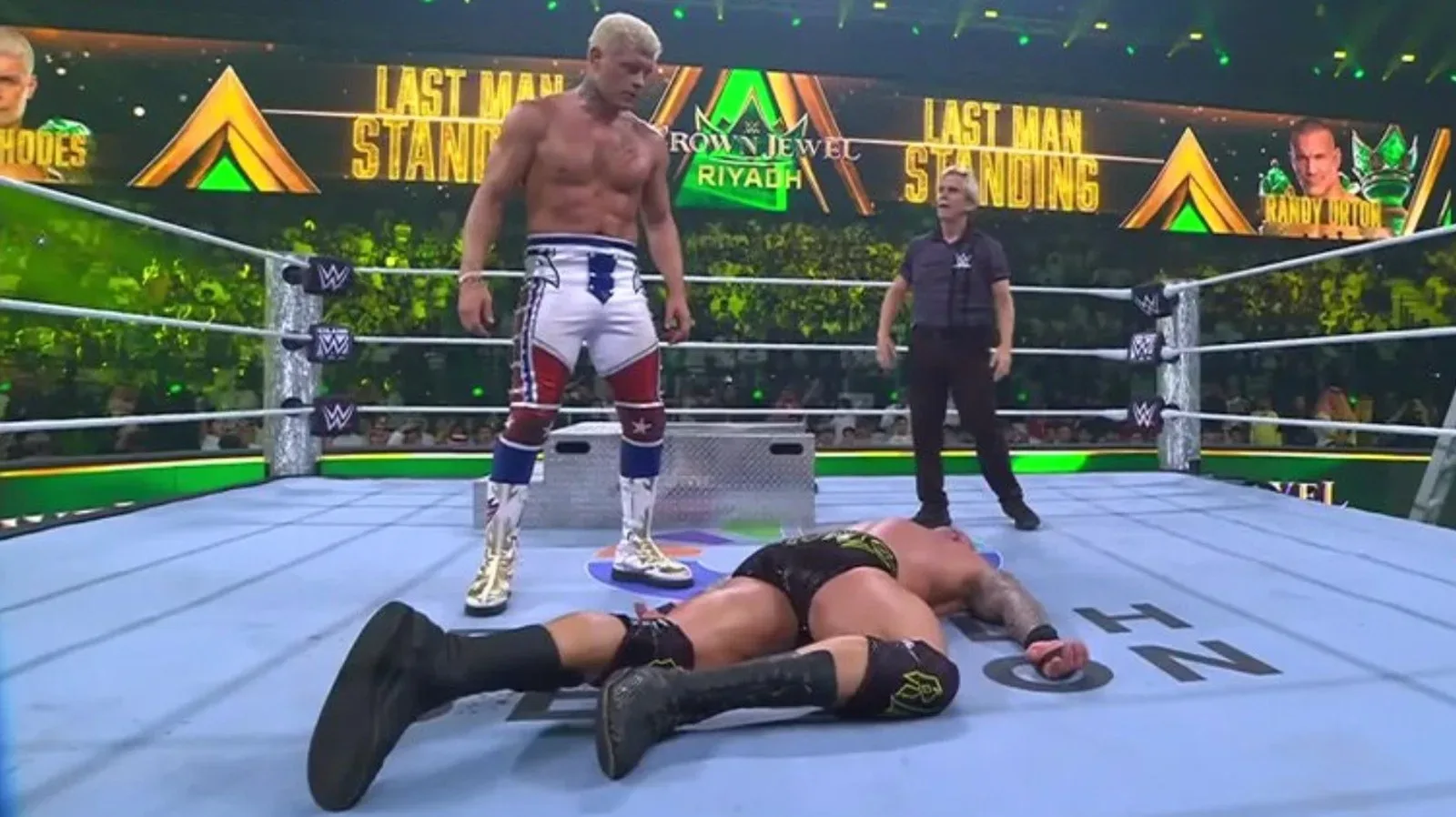
Cody Rhodes defeated Randy Orton in a punishing Last Man Standing match at WWE Crown Jewel 2026, bringing an end to a rivalry that had defined much of both men’s year. The battle was built around the former allies knowing each other’s instincts, signature offense, and vulnerabilities better than almost anyone, and that familiarity made the encounter especially volatile.
There were no pinfalls or submissions to provide an escape. The only objective was to keep an opponent down for a referee’s count of 10. Rhodes and Orton used that stipulation to turn their grudge match into a prolonged fight involving announce tables, kendo sticks, trash cans, a ladder, steel steps, a chair, and a table. Both men absorbed signature moves and survived major crashes, only for the contest to end when Rhodes delivered a Punt to Orton after a brutal sequence involving three Cross Rhodes.
The finish was particularly striking because the Punt has long been one of Orton’s most feared weapons. In this case, Rhodes used it to defeat the man most associated with it, punctuating his victory over a rival who had repeatedly pushed him to the brink throughout 2026.
A Fast Start Turns Into a Fight for Survival
Rhodes opened with urgency, seemingly determined to prevent Orton from dictating the pace. He connected with a tope suicida to the outside, taking the action beyond the ring almost immediately. The early momentum did not last, however. Orton quickly reasserted himself and began targeting Rhodes with the measured, punishing approach that has made him dangerous in every kind of major-match setting.
For more background on this topic, read Becky Lynch Reflects on Fear and Overthinking During Her First WWE Years.
Near the announce position, Orton repeatedly drove Rhodes into the announce table with side slams. Three impacts wore Rhodes down before Orton landed a fourth, putting Rhodes through the covering of the table. The sequence established the tone of the match: Orton was less interested in simply landing a highlight-reel strike than in systematically leaving Rhodes unable to answer the referee’s count.
Rhodes eventually rallied as the fight moved out among the crowd, but Orton continued to find ways to halt his comeback. A trash can and its lid became tools for Orton to maintain control while the official’s count remained a constant presence. The weapons were not decorative additions to the stipulation. Each one was used with the clear intent of inflicting enough damage to keep the other man down.
Orton later introduced a kendo stick, only for Rhodes to turn the weapon back against him. That shift carried the fight up the entrance ramp and toward the stage. Rhodes used another trash can to create separation, then brought a table into the equation in an effort to escalate the damage. Orton, though, countered at a crucial moment with an eye poke before powerbombing Rhodes through the table.
Rhodes answered the referee’s count at eight. It was one of several moments that showed how difficult it would be for either man to put the other away. Orton had delivered the kind of move that often ends a standard match outright, but Rhodes refused to stay down.
Orton’s Signature Offense Cannot Finish Rhodes
When the action returned to the ring, Rhodes looked for an opening by kicking the ropes to slow Orton down. The two climbed to the top rope, where Orton gained control and delivered a superplex. Rhodes was staggered, but again beat the count. Orton followed with a draping DDT, another familiar weapon in his arsenal, and once more Rhodes rose before the 10-count could be completed.
The contest increasingly became a test of resilience. Orton had found success by using methodical offense, weapons, and his extensive experience, yet Rhodes repeatedly forced the match to continue. Rhodes had openings of his own, though Orton’s ability to strike suddenly remained a threat at every turn.
Orton went for the RKO, but Rhodes countered with an eye poke of his own. Rhodes then landed a Cody Cutter, building momentum and putting Orton in danger. Orton managed to stand, preserving the match and denying Rhodes a decisive breakthrough.
Rhodes then attempted to honor his father with a series of punches. The tribute created an emotional moment, but it also gave Orton time to recover. Rhodes lingered too long, and Orton capitalized with an RKO out of nowhere. It was a reminder of why the RKO has remained one of WWE’s most effective equalizers: Orton can produce it in an instant, even when an opponent appears to have control.
Yet Rhodes got up again. In a Last Man Standing match, landing a major maneuver is only part of the task. A wrestler must still ensure their opponent cannot regain their feet, and neither Rhodes nor Orton could immediately accomplish that against the other.
The Ladder Crash Changes the Match
Orton brought the fight back outside and looked to use the steel steps to finally end it. Rhodes avoided the attack, then used the steps against Orton. With Orton vulnerable, Rhodes cleared the announce table and placed him on top of it. He then found a ladder and climbed to the top, seeking a splash that could have ended the match in dramatic fashion.
Orton rolled away at the last possible second.
Rhodes crashed through the announce table and to the floor below. The impact left him in a dangerous position, and Orton sensed a chance to close the rivalry for good. As Rhodes struggled to rise, Orton returned to the ring and set up for the Punt. Given the damage Rhodes had just sustained, the move appeared poised to provide the final answer.
Rhodes avoided it.
That miss changed everything. Rhodes fired back with another Cody Cutter, then landed Cross Rhodes. Orton got to his feet at nine, narrowly surviving and keeping the match alive. Rhodes responded by introducing a chair and the steel steps, seemingly ready to deliver a final, conclusive blow.
Orton stopped him with a low blow. With no disqualification in a Last Man Standing match, the tactic was legal and bought Orton more time. It also reflected the desperation that had taken over the match. Both competitors had gone far beyond conventional wrestling offense and were searching for any advantage that could keep the other down.
Rhodes Turns Orton’s Most Dangerous Weapon Against Him
Rhodes ultimately found the answer by returning to Cross Rhodes. He hit Orton with the move three times. The third proved especially damaging, as Orton’s head struck the steel steps and he was busted open. Rhodes then made the defining choice of the match: he delivered a Punt to Orton.
The Punt gave Rhodes the opening he needed to finally secure the referee’s 10-count and the Last Man Standing victory.
For Rhodes, the win was more than another major result. Orton had been a central obstacle in his 2026 campaign, and the history between the two added extra weight to the confrontation. Their shared past made every counter and every signature maneuver feel personal. Rhodes knew what Orton could do, but Orton also knew Rhodes’ heart, determination, and refusal to remain down.
Rhodes’ use of the Punt was a fitting final image for a rivalry driven by escalation. Orton had appeared ready to use the move to finish Rhodes after the ladder splash went wrong. Instead, Rhodes survived the danger, fought back, and used that same decisive strike to leave Orton down for the count.
The match also reinforced Rhodes’ ability to endure when the stakes are highest. He survived repeated side slams into the announce table, a powerbomb through a table, a superplex, a draping DDT, an RKO, and a devastating missed splash through the announce table. Orton, meanwhile, survived a Cody Cutter, Cross Rhodes, and several weapon-assisted attacks before Rhodes finally put together the sequence that ended the fight.
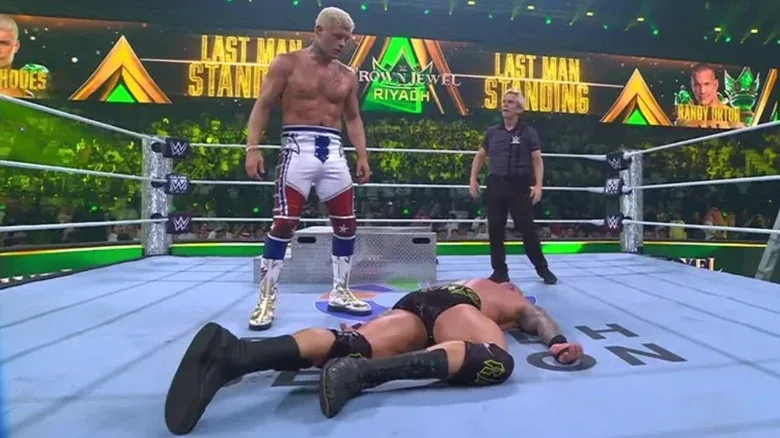
At WWE Crown Jewel 2026, neither man gave the other an easy victory. But when the referee reached 10, Cody Rhodes was the one still standing, while Randy Orton was left on the canvas after a Punt that brought their hard-fought feud to its violent conclusion.
In pictures

Darryl Polo
Darryl Polo is a passionate wrestling fan covering WWE, AEW, TNA and beyond. He loves great rivalries, breakout stars and the moments that keep fans talking long after the bell. How we work.