
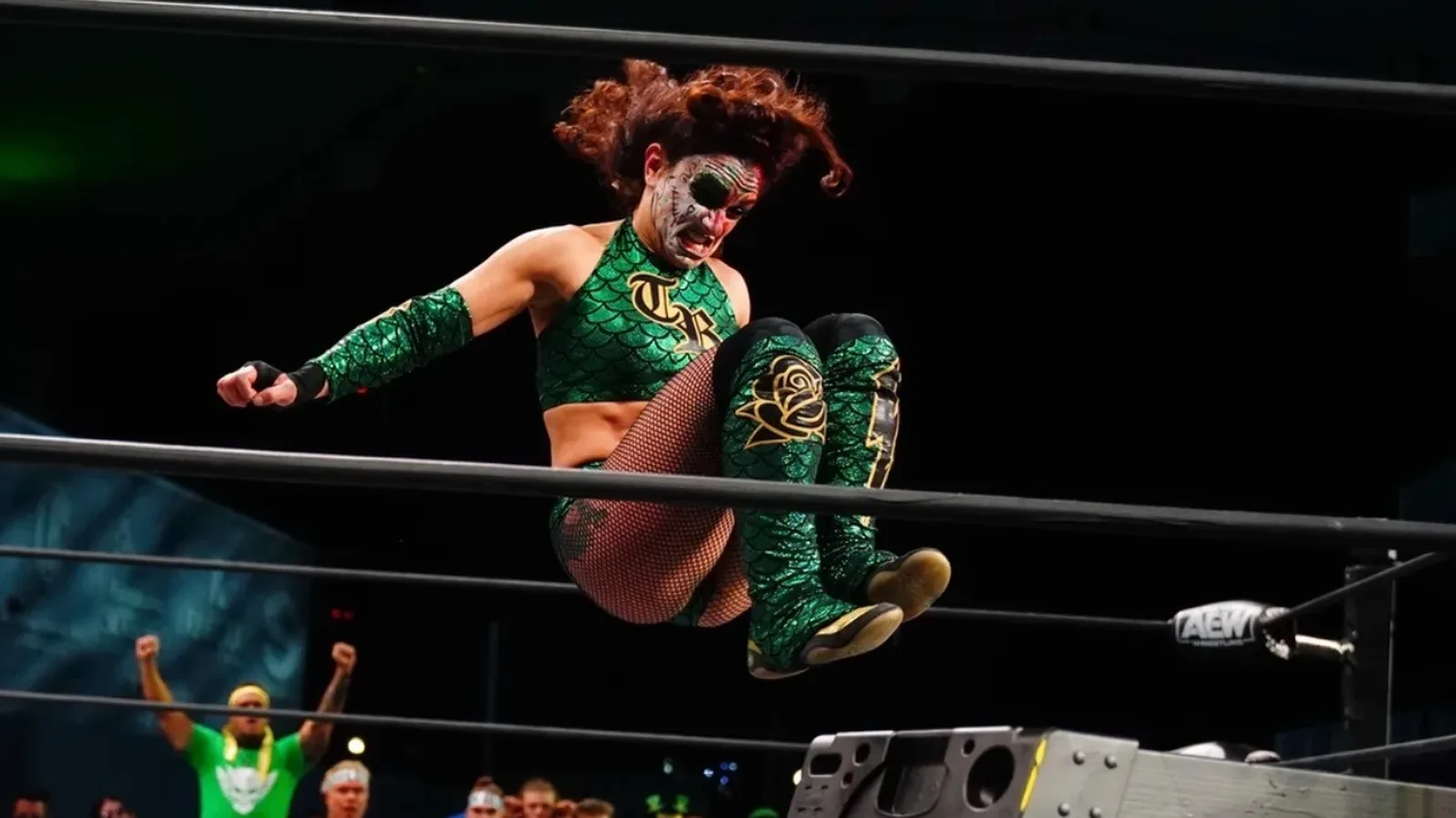
Thunder Rosa does not view her celebrated Lights Out match against Britt Baker as a performance she needs to spend the rest of her career trying to surpass.
Reflecting on the March 11, 2021 Unsanctioned Lights Out match during an appearance on the Battleground Podcast, Rosa spoke about the lasting response to the contest and the unusual place it occupies in AEW history. The bout has frequently been cited by fans as one of the strongest women’s matches the company has presented, and Rosa said the continued discussion around it is something she receives as a blessing rather than a burden.
“I’m blessed that people still talk about it and still talk very highly of this match,” Rosa said. “Because that means that we made history.”
That sense of history matters to Rosa because of what the match represented beyond a major chapter in her rivalry with Baker. The Lights Out setting gave both wrestlers room for a violent, urgent, emotionally charged fight, and its reception placed it among AEW’s most talked-about matches. Rosa noted that it remains the only women’s match to win AEW’s Match of the Year recognition, even as she acknowledged that many strong women’s matches have followed.
For more background on this topic, read Thunder Rosa Details the Time and Technique Behind Her Face Paint.
“They haven’t had another female match that has won Match of the Year in AEW with any of the females and they’ve been fantastic matches,” Rosa said. “But we were able to do that and that’s a huge deal in professional wrestling.”
A landmark night in the Baker-Rosa rivalry
The March 11, 2021 encounter was not presented as a conventional sanctioned contest. The Unsanctioned Lights Out stipulation helped establish the mood before the match even began: this was a personal fight where the wrestlers were prepared to go beyond the usual boundaries. Rosa and Baker responded with a performance built around intensity, weapons, punishment, and the feeling that their rivalry had reached a breaking point.
For Rosa, the enduring reputation of that match is evidence that the work connected. Her remarks did not frame the bout solely as an individual achievement, either. By saying that “we made history,” she emphasized the shared nature of what she and Baker accomplished. A major match can become important because of its stipulation or its placement on a card, but it still requires two performers who can create an atmosphere and make every escalation feel meaningful. Rosa’s comments recognize that the legacy belongs to both women.
The match also arrived at a consequential point for women’s wrestling in AEW. Its acclaim gave the division a high-profile benchmark and demonstrated the audience appetite for a women’s rivalry presented with major stakes and full commitment. That does not mean every future match needs the same weapons-heavy framework or the same level of brutality. Rosa’s point is that its achievement should be appreciated for what it was, rather than used as an obligation that dictates what she must do next.
Why Rosa is not trying to outdo herself
Asked whether she feels she is competing with that performance, Rosa was clear that chasing a repeat of the Lights Out match is not her goal. She said the purpose is not to outdo herself. Instead, she wants to keep finding situations that force her to grow and attempt things she once believed were outside of her range.
“For me, right now, is how can I challenge myself to do things that I thought that I will never do,” Rosa said.
One challenge she identified involves wrestling fully in the lucha libre style in Mexico. Rosa explained that her training came through American wrestling, making that shift a matter of changing her mindset and remaining flexible enough to work in different ways. It is a revealing contrast with the match for which she is most often celebrated. The Lights Out match was defined by an edge that made room for physical creativity, while Rosa’s current ambition includes proving herself through adaptability and a deeper engagement with another wrestling tradition.
That approach offers a broader definition of progress than simply increasing the danger level of a match. A wrestler can evolve through pacing, technical adjustment, different cultural styles, character work, or a new match structure. Rosa is looking at those types of tests rather than treating violence as the only path to creating a memorable performance.
There is also a practical wisdom in that position. A defining match can become a difficult shadow for any wrestler. Fans remember iconic moments, compare later work to them, and sometimes expect every major program to recreate the same sensation. Rosa is not rejecting the importance of the Baker match. She is protecting its place while also allowing herself the freedom to make different kinds of art in the ring.
Rosa remains confident in an anything-goes environment
While she is not seeking to replicate the Lights Out match, Rosa made it clear that she has not lost her appetite for an edgier contest when the circumstances call for it. She described herself as an artist and said that, when weapons are part of the assignment, she intends to use them.
“If you have me do a match, like a edgy match, believe me, I’m going to find a way to do some crazy stuff,” Rosa said. “Because that’s just how I am. I’m an artist and when you give me weapons, guess what? I’m going to use them damn weapons.”
Rosa’s confidence comes from experience, not merely from one famous AEW bout. She recalled a stretch of her independent wrestling career in which she was working one of those types of matches every week. In her words, she was “on fire” and “crazy” during that period. That background helps explain why the Lights Out environment suited her so naturally. The match was a major stage for a style of performance in which Rosa had already developed significant comfort and instincts.
Her comments also show that the physicality of the Baker match was not accidental or disconnected from the rest of her career. Rosa has experience making weapons and high-risk environments part of a match’s creative language. When used effectively, those elements are not just spectacle; they can communicate animosity, desperation, and escalation. The March 2021 match remains memorable because its violence was attached to the intensity of the rivalry.
Still, Rosa drew a distinction between being able to work that way and needing to work that way constantly. She said she is now more mature and more conscious of pacing herself. That does not diminish the work she did in the past. Rather, it reflects a veteran performer’s understanding that different stages of a career can demand different priorities.
A new season of professional growth
Rosa described her present outlook in terms of seasons. Earlier in her career, she embraced frequent wild matches and the relentless momentum that came with them. Now, she is approaching her work with a greater sense of timing and self-awareness. She remains driven, but the goal is to choose challenges that reaffirm her abilities without being trapped by a single image of what Thunder Rosa is supposed to be.
“There is seasons in your life where you want to do certain things,” Rosa said. “I think, right now, this season in my life is to challenge myself to a point in where I’m like, ‘Oh shit. I know, I’m still super good and I still can do this.’”
That is an important distinction for a wrestler whose résumé includes one of AEW’s defining women’s matches. Rosa is not looking backward in an attempt to recreate a moment that cannot be recreated. She is looking ahead, with the confidence that she can still deliver in a violent match if necessary and the curiosity to take on entirely different demands.
The Britt Baker Lights Out match will continue to be part of how fans discuss Thunder Rosa’s career, and understandably so. It was a major match between two competitors whose rivalry helped produce an enduring moment for AEW’s women’s division. But Rosa’s own assessment is measured: its legacy is proof of history made, not a ceiling she must break through every time she wrestles.
For Rosa, the next meaningful milestone may not look like March 11, 2021 at all. It may come through a different style, a different setting, or a challenge that requires her to rethink her instincts. That willingness to evolve is precisely why a past classic does not have to become a limitation.

Darryl Polo
Darryl Polo is a passionate wrestling fan covering WWE, AEW, TNA and beyond. He loves great rivalries, breakout stars and the moments that keep fans talking long after the bell. How we work.